• About
    • Who We Are
    • Partners & Providers
    • News & Events
    • The ESRD Blog
    • Careers
    • Contact Us
  • Applications
    • What We Solve
    • Detailed Stress
    • Composites
    • Fracture Mechanics
    • Residual Stress
    • Sim Apps
  • Products
    • What We Develop
    • StressCheck Professional
      • StressCheck Core
      • Solvers
      • Advanced Modules
      • Utilities
      • Academic Licensing
    • StressCheck Apps
      • CAE Handbook
      • StressCheck Tool Box
    • Product Updates
  • Support
    • How We Can Help
    • Training
    • Webinars
    • Quick Start Guide
    • Help Documentation
    • Software FAQ’s
  • Simulation
    • How We Simulate
    • Benchmarks
    • Simulation Governance
    • History of FEA
    • Dictionary & Terms
  • Resources
    • Browse Our Resource Library
    • White Papers
    • Case Studies
    • Product Demos
    • StressCheck Tutorials
Serving the Numerical Simulation community since 1989
  • Contact Us
  • Register
Login
Forgot Password?
Join Us
ESRDESRD
ESRDESRD
  • About
    • Who We Are
    • Partners & Providers
    • News & Events
    • The ESRD Blog
    • Careers
    • Contact Us
  • Applications
    • What We Solve
    • Detailed Stress
    • Composites
    • Fracture Mechanics
    • Residual Stress
    • Sim Apps
  • Products
    • What We Develop
    • StressCheck Professional
      • StressCheck Core
      • Solvers
      • Advanced Modules
      • Utilities
      • Academic Licensing
    • StressCheck Apps
      • CAE Handbook
      • StressCheck Tool Box
    • Product Updates
  • Support
    • How We Can Help
    • Training
    • Webinars
    • Quick Start Guide
    • Help Documentation
    • Software FAQ’s
  • Simulation
    • How We Simulate
    • Benchmarks
    • Simulation Governance
    • History of FEA
    • Dictionary & Terms
  • Resources
    • Browse Our Resource Library
    • White Papers
    • Case Studies
    • Product Demos
    • StressCheck Tutorials

StressCheck Demo: Thermo-Mechanical Analysis with Temperature-Dependent Material Properties

Home ShopHeat Transfer SolverStressCheck Demo: Thermo-Mechanical Analysis with Temperature-Dependent Material Properties
StressCheck Demo: Thermo-Mechanical Analysis with Temperature-Dependent Material Properties

StressCheck Demo: Thermo-Mechanical Analysis with Temperature-Dependent Material Properties

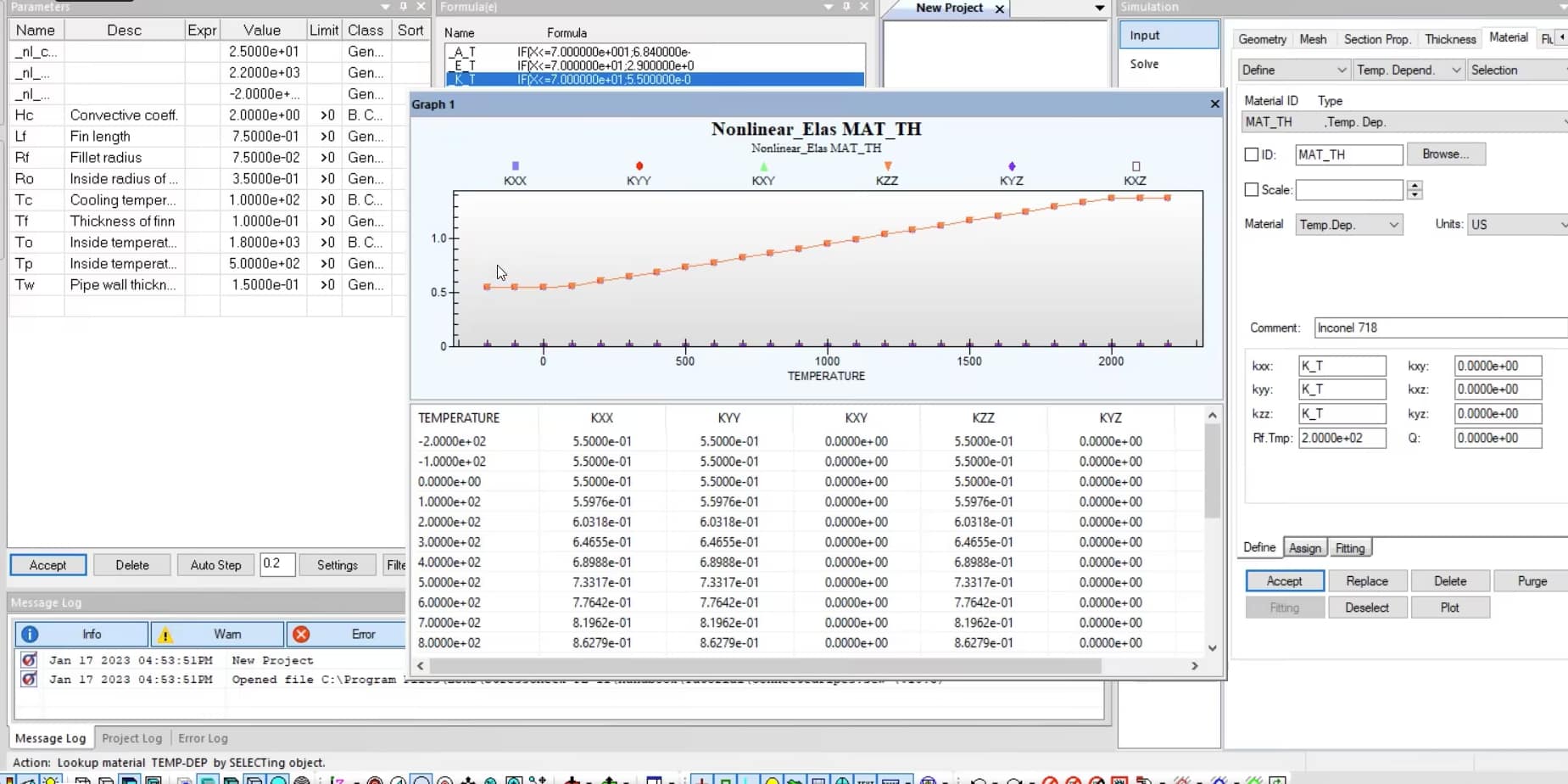
Abstract: A thermo-mechanical (Heat Transfer -> Elasticity) analysis is performed for a Handbook model of two Inconel 718 connected pipes connected by a thin fin (\Handbook\Tutorial\ConnectedPipes.scw). The parametric Handbook model contains formula-based, temperature-dependent coefficients of thermal conductivity (when the theory is Heat Transfer) as well as formula-based, temperature-dependent linear isotropic material properties (when the theory is Elasticity).

The goals of the thermo-mechanical analysis are to:

  • Compute the linear (coefficient of thermal conductivity for a reference temperature T=200 °F) and material nonlinear (coefficient of thermal conductivity is allowed to be temperature-dependent) temperature distributions via steady-state conduction heat transfer
  • Apply the temperature distribution computed from the material nonlinear solution as a thermal load for all elements using a reference temperature of 0 °F
  • Solve a linear elastic solution using the thermal load, symmetry/rigid body constraints, and temperature-dependent linear isotropic properties
  • Extract the local stresses at the intersection of the fin and the pipes.


For the steady-state conduction heat transfer analysis, the following boundary conditions are assigned:

  • Cooling of the external pipe surfaces is by convection via parameters “Hc” (convective film coefficient) and  “Tc”(convective temperature).
  • The left pipe inside temperature is given by parameter “To”, and the right pipe inside temperature is given by parameter “Tp”.


For the linear elastic analysis, the following boundary conditions are assigned:

  • Thermal loading of the connecting pipes + fin is defined by importing the temperatures from the material nonlinear steady state conduction heat transfer solution.
  • Double-symmetry conditions are used to model 1/4 of the connecting pipes + fin.
  • A nodal constraint in the global X direction restricts rigid body translation.


  • Scroll to View This Resource (Login May Be Required)

Hit the play button to view this video. You may maximize the video to fit your screen.

Related Content:

  • StressCheck Demo: 3D Material Nonlinear Analysis
  • StressCheck Demo: Aircraft Keel Beam Stress Analysis
  • StressCheck Demo: 2D Margin Check Analysis
  • StressCheck Tutorial: Importing Material Properties
  • StressCheck Demo: 2D Fastened Joint Analysis


Related products

Fracture Mechanics with Residual Stress Product Brief Read more View Details

Fracture Mechanics with Residual Stress Product Brief

Fracture Mechanics Module, Linear Elasticity Solver, MeshSim Advanced Module, Non-Linear Solver, Residual Stress Modules, Simulation Technology, StressCheck Core, StressCheck Professional
The Effects of Residual Tensile Stresses Induced by Cold-Working a Fastener Hole Read more View Details

The Effects of Residual Tensile Stresses Induced by Cold-Working a Fastener Hole

Linear Elasticity Solver, Non-Linear Solver, Simulation Technology, StressCheck Core, StressCheck Professional
Eigenvalue convergence in the p-version of the FEM Read more View Details

Eigenvalue convergence in the p-version of the FEM

Modal & Buckling Solver, Simulation Technology, StressCheck Core, StressCheck Professional
StressCheck Professional Software Read more View Details

StressCheck Professional Software

StressCheck Professional
Categories: Heat Transfer Solver, Linear Elasticity Solver, Non-Linear Solver, StressCheck Core, StressCheck Professional. Tags: Boundary Conditions, Convergence Extraction, Detailed Stress, Formula Definition, Heat Transfer, Linear Analysis, Material Properties, Nonlinear Analysis, Parametric Modeling, Points Extraction, Results, StressCheck GUI, Theory.

Search Resources

Products/Modules info Products/Modules Filter by one or more ESRD software products and/or modules.

Applications/Features info Applications/Features Filter by one or more Engineering Applications and/or Features.

Resource Categories info Resource Categories Filter by one or more Resource Categories.

Customer Resources info Customer Resources Filter by one or more Resource Permissions.

Testimonials

“Accurate and reliable stresses and Stress Intensity Factors are required for determination of static and residual strength and for crack growth analyses in analysis tools such as AFGROW. For some geometries, industry solutions are either insufficient or nonexistent. The geometry, applied forces, and crack shapes and dimensions must be modeled reasonably well to obtain useful engineering data. The p-version finite element software StressCheck (ESRD, Inc., St. Louis, Missouri, USA) is used to demonstrate how accurate finite element solutions can lead to good quality engineering analysis.”

, Analytical Processes/Engineering Solutions, Inc. (AP/ES)

Member Portal

  • Member Registration
  • Member Login

Contact Us

© 2026 · Engineering Software Research & Development, Inc. | Terms & Conditions | Privacy & Cookie Policy | Software License Agreement | Software Maintenance and Technical Support Policy

We use cookies on our website to give you the most relevant experience by remembering your preferences and repeat visits, as outlined in our Cookie Policy. You may adjust your cookie preferences within .

ESRD
Powered by  GDPR Cookie Compliance
Privacy Overview

This website uses cookies to improve your experience while you navigate through the website. Out of these, the cookies that are categorized as necessary are stored on your browser as they are essential for the working of basic functionalities of the website. We also use third-party cookies that help us analyze and understand how you use this website. These cookies will be stored in your browser only with your consent. You also have the option to opt-out of these cookies. But opting out of some of these cookies may affect your browsing experience.

Strictly Necessary Cookies

Strictly Necessary Cookies should be enabled at all times so that we can save your preferences for cookie settings.