• About
    • Who We Are
    • Partners & Providers
    • News & Events
    • The ESRD Blog
    • Careers
    • Contact Us
  • Applications
    • What We Solve
    • Detailed Stress
    • Composites
    • Fracture Mechanics
    • Residual Stress
    • Sim Apps
  • Products
    • What We Develop
    • StressCheck Professional
      • StressCheck Core
      • Solvers
      • Advanced Modules
      • Utilities
      • Academic Licensing
    • StressCheck Apps
      • CAE Handbook
      • StressCheck Tool Box
    • Product Updates
  • Support
    • How We Can Help
    • Training
    • Webinars
    • Quick Start Guide
    • Help Documentation
    • Software FAQ’s
  • Simulation
    • How We Simulate
    • Benchmarks
    • Simulation Governance
    • History of FEA
    • Dictionary & Terms
  • Resources
    • Browse Our Resource Library
    • White Papers
    • Case Studies
    • Product Demos
    • StressCheck Tutorials
Serving the Numerical Simulation community since 1989
  • Contact Us
  • Register
Login
Forgot Password?
Join Us
ESRDESRD
ESRDESRD
  • About
    • Who We Are
    • Partners & Providers
    • News & Events
    • The ESRD Blog
    • Careers
    • Contact Us
  • Applications
    • What We Solve
    • Detailed Stress
    • Composites
    • Fracture Mechanics
    • Residual Stress
    • Sim Apps
  • Products
    • What We Develop
    • StressCheck Professional
      • StressCheck Core
      • Solvers
      • Advanced Modules
      • Utilities
      • Academic Licensing
    • StressCheck Apps
      • CAE Handbook
      • StressCheck Tool Box
    • Product Updates
  • Support
    • How We Can Help
    • Training
    • Webinars
    • Quick Start Guide
    • Help Documentation
    • Software FAQ’s
  • Simulation
    • How We Simulate
    • Benchmarks
    • Simulation Governance
    • History of FEA
    • Dictionary & Terms
  • Resources
    • Browse Our Resource Library
    • White Papers
    • Case Studies
    • Product Demos
    • StressCheck Tutorials

ESRD Benchmarks

Home Our Simulation TechnologyESRD Benchmarks

ESRD Benchmarks

At ESRD, we take Simulation Governance, Verification and Validation seriously. That’s why we have developed a comprehensive Handbook library of verified and validated models, compared our solutions to NAFEMS Benchmarks, implemented only theories that have been refereed in engineering journals and challenged our users to find a more efficient solution.

Would you like to propose a Benchmark Challenge?

Do you have a challenging solid mechanics problem that you have been unable to sufficiently solve in other FEA tools? If so, complete our brief form and we will be happy to investigate.

Propose Benchmark
Proper benchmarking should always require gauging the numerical solution quality.

Public FEA Benchmarks

The following are publicly available benchmark solutions, either posed by NAFEMS, the FEA community or in the available literature.

  • NAFEMS Linear Benchmarks (2020)
  • NAFEMS Standard Benchmarks
  • NAFEMS Benchmark Challenges
  • The Girkmann Challenge

NAFEMS Linear Benchmarks (2020)

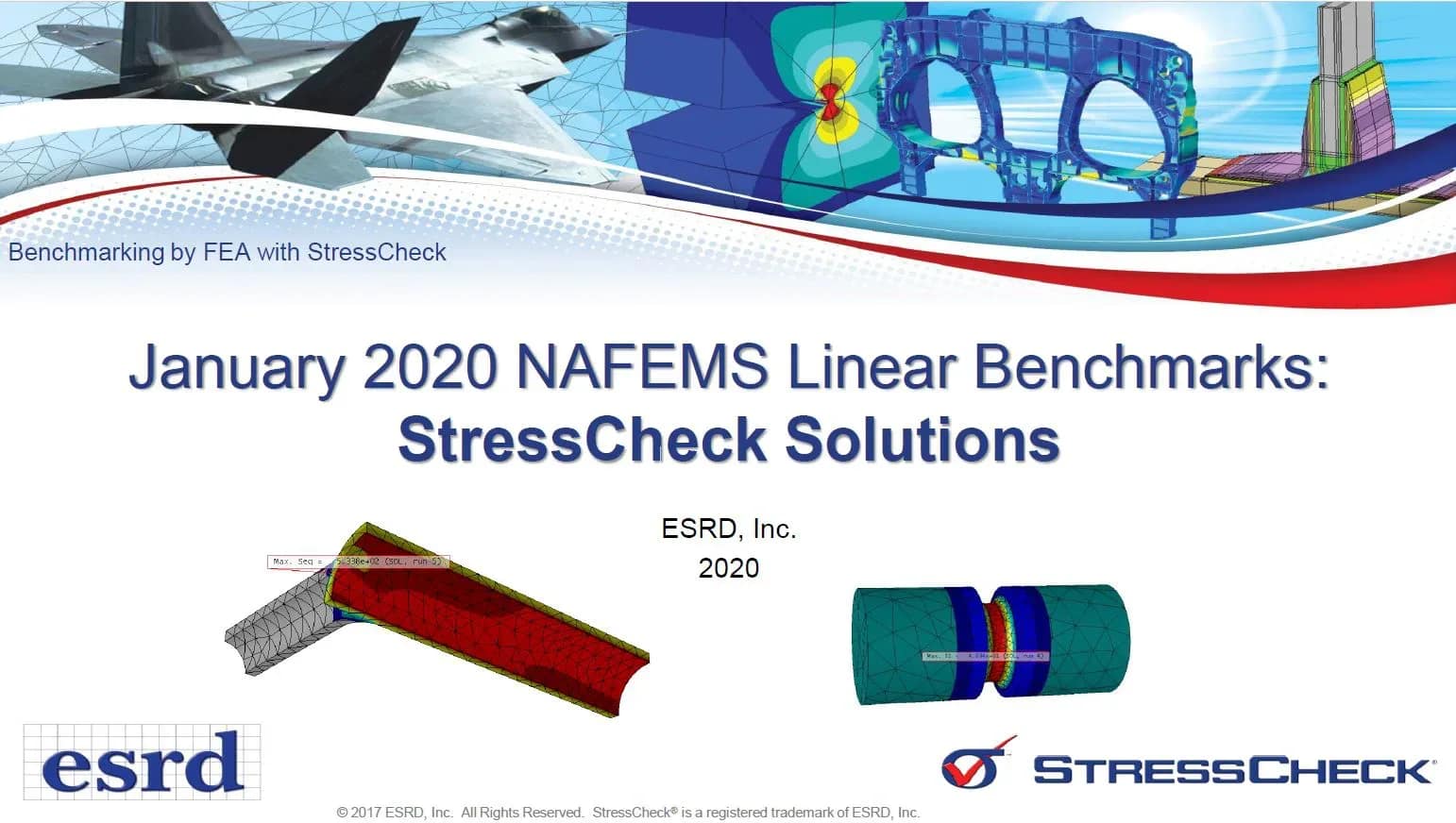
StressCheck Professional solutions to the linear benchmarks found in the article “Designer Oriented Software – Is It Accurate?” from the January 2020 edition of NAFEMS Benchmark magazine are provided below.

Goal: To determine the target values within 1% accuracy using the minimum mesh, p-level and DOF.

January 2020 NAFEMS Linear Benchmarks: StressCheck Solutions

Verified StressCheck Professional results for the benchmarks found in the January 2020 edition of NAFEMS Benchmark magazine are provided.
Download PDF

NAFEMS Standard Benchmarks

StressCheck Professional solutions to selected NAFEMS Standard Benchmarks are provided below.  Our solutions indicate that our Numerical Simulation Technology is the simplest and most effective way to solve these benchmark problems.

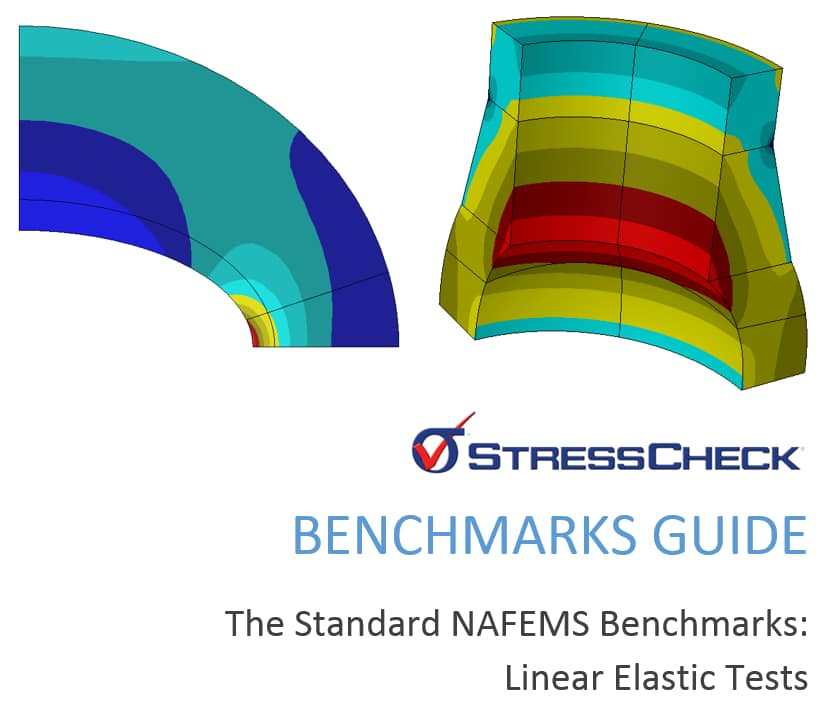
The Standard NAFEMS Benchmarks: Linear Elastic Tests

Verified StressCheck Professional results for “The Standard NAFEMS Benchmarks: Linear Elastic Tests” are provided.
Download PDF

NAFEMS Benchmark Challenges

In late 2014, ESRD began participating in the NAFEMS Benchmark Challenge series.  NAFEMS is the International Association for the Engineering Modelling, Analysis and Simulation Community (about NAFEMS).  The goal is to compare solutions from multiple FEA tools, and determine who is closest to the exact solution.

A sample of NAFEMS Benchmark Challenges solved in StressCheck Professional are presented below:

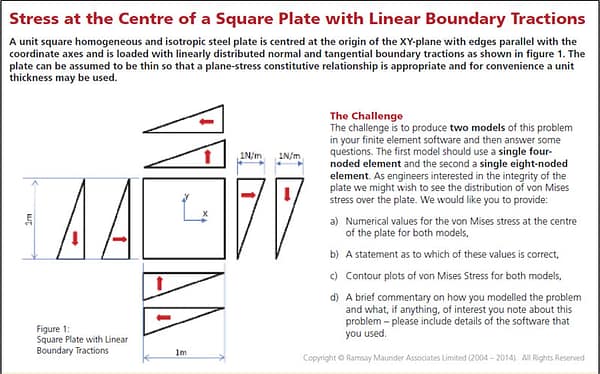
NAFEMS Benchmark Challenge -01: Stress At the Centre of a Square Plate with Linear Boundary Tractions
  • NAFEMS Solution/Outstanding Solutions

Download

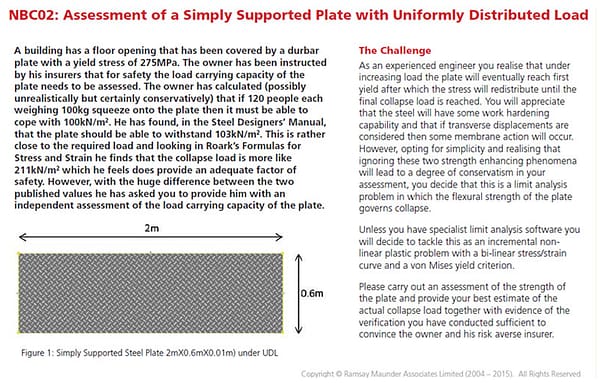
NAFEMS Benchmark Challenge -02: Stress At the Centre of a Square Plate with Linear Boundary Tractions
  • NAFEMS Solution/Outstanding Solutions

Download

Visit our Resource Library Benchmarks to see the full list of NAFEMS Benchmark Challenge solutions.

The Girkmann Challenge

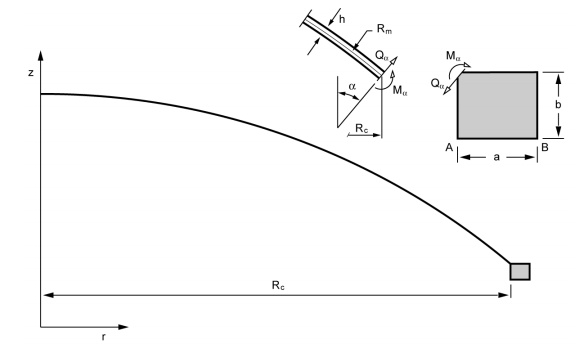
In many cases, benchmark challenges are defined as problems involving significant resources to solve accurately using numerical methods.  We invite those who are users of FEA tools to solve one such problem, the classical Girkmann Problem:

  • Stress resultants Qa (shearing force, kN/m) and Ma (bending moment, Nm/m)
  • The location and magnitude of the maximum bending moment in the shell.
  • Verify the results are accurate to within 5 percent.  Describe how accuracy was verified.
  • Software used, what mesh and type of elements were used.
Download

ESRD received responses to this exercise from 15 FEA experts using a range of different modeling techniques and FEA software tools.

Visit our Resource Library to view a summary of the study results, and download a PDF of the proper approach to the solution of the problem.

CAE Handbooks, Verification & Validation

ESRD provides with the StressCheck Professional and CAE Handbook software a Handbook Library of parametrically defined models for comparison to published solutions from Timenshenko, Peterson, Mura, Tada, Blevins, Roark, et al.  If there are differences, do they result from the mathematical model (in this case an approximation using the finite element method) or are they the result of errors in idealization (boundary conditions, material properties, etc.)?

ESRD's CAE Handbook contains a variety of trusted, verified digital engineering handbook solutions.

StressCheck Professional is the only FEA software tool on the market that provides feedback to the user regarding the quality of the computed information.  This ‘verification’ process assesses the sensitivity of the computed data to changes in the mesh density, order of the element shape functions, and element mapping.  Verification is an important first step in validating the model.

  • Verification – Am I solving the equations correctly?
  • Validation – Am I solving the correct equations?


It is clear that validation can only be achieved if verification of the data of interest has been completed.

Users want to know: How well does your finite element analysis software predict the response of a physical system to an applied load?  A comparison is made to test data if available, or benchmark solutions (e.g. classical methods, text books).

General guidelines pertaining to the use of mathematical models in solid mechanics were issued by the American Society of Mechanical Engineers (ASME) in 2006 and adopted by the American National Standards Institute. This document describes the importance of verification and validation.
ASME released their guide to V&V in computational solid mechanics in 2006.

For a technical brief summarizing the general verification & validation process for numerical simulation, refer to Verification and Validation Technical Brief.

Benchmark Request
Do you have a benchmark you would like to see from ESRD? Submit the details below and we will contact you soon.
If other please specify in the message.
If a benchmark already exists, please include the details in your message.
Loading

Looking for Resources?

Interested in a Demo, Evaluation or Purchase?

Have a Software Question, Issue or Feature Request?

Recent News & Events

  • Trustworthiness in Simulation: Credibility or Decision-grade Reliability?
  • Beyond the Black Box: Explainable AI Requires Explainable Simulation
  • Turtle Shells and Legacy Finite Element Codes: Evolutionary Constraints in the Age of Explainable AI

Quick Links

  • Quick Start Guide
  • Documentation
  • Software FAQs
  • Software Demos

Testimonials

  • “As the United States Air Force continues to extend the service life of their aircraft the Aircraft Structural Integrity Program (ASIP) has had to refine the methods it uses to analyze and predict fatigue crack growth. Through the use StressCheck, coupled with AFGROW, we in A-10 ASIP have been able to more accurately model, predict and analyze critical aircraft structure for the A-10 and other types of structure for non-A-10 system managers. This also allows us within the A-10 to more accurately assess risk for decision makers, streamline aircraft inductions into scheduled maintenance and reduce cost for total life cycle management.”

    A-10 ASIP Manager

Testimonials

“Through the use of StressCheck the A-10 Aircraft Structural Integrity Program’s (ASIP) Analysis Group is able to model more accurately the physics of fatigue crack propagation in critical aircraft structure.  Through this tool we are able to model, analyze and predict failure of aircraft structure and then develop crucial inspection and maintenance planes to ensure the safety and sustainability of our nations warplanes.  Without the analysis capability provided to us through StressCheck we would not be able to provide accurate assessments of the A-10 structure to top USAF leadership.”

SWRI Research Engineer, Southwest Research Institute

Member Portal

  • Member Registration
  • Member Login

Contact Us

© 2026 · Engineering Software Research & Development, Inc. | Terms & Conditions | Privacy & Cookie Policy | Software License Agreement | Software Maintenance and Technical Support Policy

We use cookies on our website to give you the most relevant experience by remembering your preferences and repeat visits, as outlined in our Cookie Policy. You may adjust your cookie preferences within .

ESRD
Powered by  GDPR Cookie Compliance
Privacy Overview

This website uses cookies to improve your experience while you navigate through the website. Out of these, the cookies that are categorized as necessary are stored on your browser as they are essential for the working of basic functionalities of the website. We also use third-party cookies that help us analyze and understand how you use this website. These cookies will be stored in your browser only with your consent. You also have the option to opt-out of these cookies. But opting out of some of these cookies may affect your browsing experience.

Strictly Necessary Cookies

Strictly Necessary Cookies should be enabled at all times so that we can save your preferences for cookie settings.