• About
    • Who We Are
    • Partners & Providers
    • News & Events
    • The ESRD Blog
    • Careers
    • Contact Us
  • Applications
    • What We Solve
    • Detailed Stress
    • Composites
    • Fracture Mechanics
    • Residual Stress
    • Sim Apps
  • Products
    • What We Develop
    • StressCheck Professional
      • StressCheck Core
      • Solvers
      • Advanced Modules
      • Utilities
      • Academic Licensing
    • StressCheck Apps
      • CAE Handbook
      • StressCheck Tool Box
    • Product Updates
  • Support
    • How We Can Help
    • Training
    • Webinars
    • Quick Start Guide
    • Help Documentation
    • Software FAQ’s
  • Simulation
    • How We Simulate
    • Benchmarks
    • Simulation Governance
    • History of FEA
    • Dictionary & Terms
  • Resources
    • Browse Our Resource Library
    • White Papers
    • Case Studies
    • Product Demos
    • StressCheck Tutorials
Serving the Numerical Simulation community since 1989
  • Contact Us
  • Register
Login
Forgot Password?
Join Us
ESRDESRD
ESRDESRD
  • About
    • Who We Are
    • Partners & Providers
    • News & Events
    • The ESRD Blog
    • Careers
    • Contact Us
  • Applications
    • What We Solve
    • Detailed Stress
    • Composites
    • Fracture Mechanics
    • Residual Stress
    • Sim Apps
  • Products
    • What We Develop
    • StressCheck Professional
      • StressCheck Core
      • Solvers
      • Advanced Modules
      • Utilities
      • Academic Licensing
    • StressCheck Apps
      • CAE Handbook
      • StressCheck Tool Box
    • Product Updates
  • Support
    • How We Can Help
    • Training
    • Webinars
    • Quick Start Guide
    • Help Documentation
    • Software FAQ’s
  • Simulation
    • How We Simulate
    • Benchmarks
    • Simulation Governance
    • History of FEA
    • Dictionary & Terms
  • Resources
    • Browse Our Resource Library
    • White Papers
    • Case Studies
    • Product Demos
    • StressCheck Tutorials

Intro to Fracture Mechanics for DaDT Solution Automation
Home SupportWebinarsIntro to Fracture Mechanics for DaDT Solution Automation

October 8, 2020 @ 1:00 pm EST

Introduction to Fracture Mechanics for DaDT Solution Automation

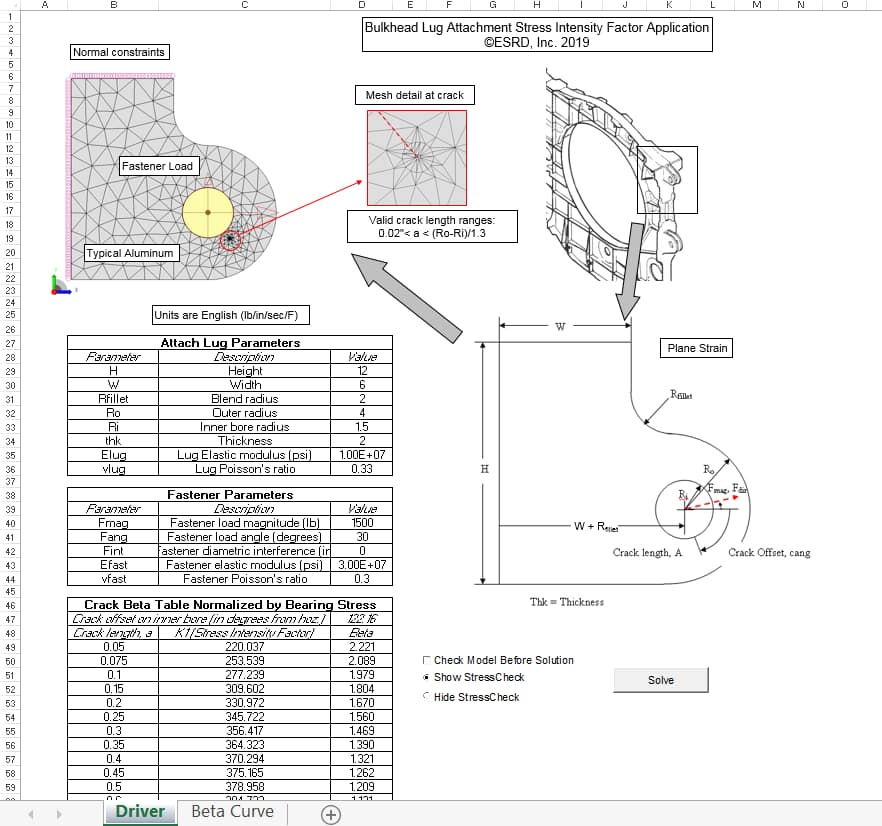
Strategies for the automation of durability and damage tolerance (DaDT) solutions, driven by Sim Apps designed for the computation of FEA-based total beta factors, will be explored.

This webinar is now available to watch on-demand.

WATCH NOW

WEBINAR SUMMARY

In this pre-recorded 2 hour webinar we will discuss the creation of Sim Apps for the automatic generation of complex, solution-verified 2D and 3D beta factors via the integration of StressCheck's parametric FEA engine, the Windows Component Object Model (COM) and Microsoft Excel VBA.

WEBINAR HIGHLIGHTS

In Part 1 of this webinar series, the following topics are presented:

  • 3D StressCheck Fracture Mechanics demo
  • Overview of linear elastic fracture mechanics (LEFM) parameters for fatigue crack growth: SIF’s, J-integrals and beta factors.
  • Computation of LEFM parameters in StressCheck.
  • Beta factor compounding pros and cons.
  • FEA-based total beta factors.
  • Why use StressCheck for LEFM?


In Part 2 of this webinar series, the following topics are presented:

  • What is a Sim App? And how can they help DaDT analysts?
  • StressCheck’s COM API
  • Sim App Case Studies for DaDT
  • Live Sim App Demo

WATCH THIS WEBINAR

Part 1: E2E Demo, Overview of LEFM, FEA-Based Beta Factors

Part 2: Sim Apps, StressCheck COM API, Sim App Demo

Want to Set Up an Instructor-Led Training?

Click the below button to get a quote for an on-site, off-site or web-based training course:

Request Training

Looking for Resources?

Interested in a Demo, Evaluation or Purchase?

Have a Software Question, Issue or Feature Request?

Recent News & Events

  • Trustworthiness in Simulation: Credibility or Decision-grade Reliability?
  • Beyond the Black Box: Explainable AI Requires Explainable Simulation
  • Turtle Shells and Legacy Finite Element Codes: Evolutionary Constraints in the Age of Explainable AI

Quick Links

  • Quick Start Guide
  • Documentation
  • Software FAQs
  • Software Demos

Testimonials

  • “The addition of incremental theory of plasticity in StressCheck has greatly improved our ability to accurately predict the fatigue life of joints with interference fit fasteners and cold worked holes. This ability is especially important, not only in support of maintaining aging aircraft but also in analyzing some of the new cold working techniques that have been introduced in recent years.
    Prior to this implementation, analysts often relied on closed-form approximations or simple factors that were often overly conservative and sometimes even unconservative when used in life prediction. Now, not only can we more accurately predict residual stresses in these complex structural joints, but we can also do so in a timely manner given the modeling and analysis efficiency that exists with a p-version FEA code such as StressCheck.”

    F-15 Structures Manager
    The Boeing Company

Testimonials

The capabilities available with BAMF, AFGROW and StressCheck are highly advanced and offer significant potential to achieve the high-level goal of TITANS –to reduce the need to conduct expensive and time consuming physical tests and to rely more on simulation.

Dr. Kevin Walker, Defence Science and Technology Group – Melbourne, Australia

Member Portal

  • Member Registration
  • Member Login

Contact Us

© 2026 · Engineering Software Research & Development, Inc. | Terms & Conditions | Privacy & Cookie Policy | Software License Agreement | Software Maintenance and Technical Support Policy

We use cookies on our website to give you the most relevant experience by remembering your preferences and repeat visits, as outlined in our Cookie Policy. You may adjust your cookie preferences within .

ESRD
Powered by  GDPR Cookie Compliance
Privacy Overview

This website uses cookies to improve your experience while you navigate through the website. Out of these, the cookies that are categorized as necessary are stored on your browser as they are essential for the working of basic functionalities of the website. We also use third-party cookies that help us analyze and understand how you use this website. These cookies will be stored in your browser only with your consent. You also have the option to opt-out of these cookies. But opting out of some of these cookies may affect your browsing experience.

Strictly Necessary Cookies

Strictly Necessary Cookies should be enabled at all times so that we can save your preferences for cookie settings.