• About
    • Who We Are
    • Partners & Providers
    • News & Events
    • The ESRD Blog
    • Careers
    • Contact Us
  • Applications
    • What We Solve
    • Detailed Stress
    • Composites
    • Fracture Mechanics
    • Residual Stress
    • Sim Apps
  • Products
    • What We Develop
    • StressCheck Professional
      • StressCheck Core
      • Solvers
      • Advanced Modules
      • Utilities
      • Academic Licensing
    • StressCheck Apps
      • CAE Handbook
      • StressCheck Tool Box
    • Product Updates
  • Support
    • How We Can Help
    • Training
    • Webinars
    • Quick Start Guide
    • Help Documentation
    • Software FAQ’s
  • Simulation
    • How We Simulate
    • Benchmarks
    • Simulation Governance
    • History of FEA
    • Dictionary & Terms
  • Resources
    • Browse Our Resource Library
    • White Papers
    • Case Studies
    • Product Demos
    • StressCheck Tutorials
Serving the Numerical Simulation community since 1989
  • Contact Us
  • Register
Login
Forgot Password?
Join Us
ESRDESRD
ESRDESRD
  • About
    • Who We Are
    • Partners & Providers
    • News & Events
    • The ESRD Blog
    • Careers
    • Contact Us
  • Applications
    • What We Solve
    • Detailed Stress
    • Composites
    • Fracture Mechanics
    • Residual Stress
    • Sim Apps
  • Products
    • What We Develop
    • StressCheck Professional
      • StressCheck Core
      • Solvers
      • Advanced Modules
      • Utilities
      • Academic Licensing
    • StressCheck Apps
      • CAE Handbook
      • StressCheck Tool Box
    • Product Updates
  • Support
    • How We Can Help
    • Training
    • Webinars
    • Quick Start Guide
    • Help Documentation
    • Software FAQ’s
  • Simulation
    • How We Simulate
    • Benchmarks
    • Simulation Governance
    • History of FEA
    • Dictionary & Terms
  • Resources
    • Browse Our Resource Library
    • White Papers
    • Case Studies
    • Product Demos
    • StressCheck Tutorials

Non-Linear Solver

Home ProductsStressCheck ProfessionalSolversNon-Linear Solver

Non-Linear Solver

Switching between linear and non-linear analyses in StressCheck’s Non-Linear Solver is seamless because of our simple element library.  We treat elements and model definitions separately allowing the analyst the freedom to move between linear and nonlinear analysis after model formulation.  No need to start over, no need to break the chain of analysis.

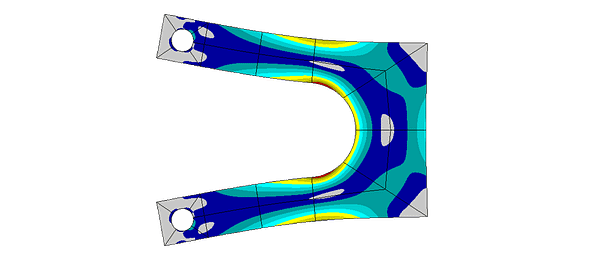
Incremental nonlinear analysis of a U-shaped member.

The Non-Linear Solver allows users to incorporate geometric and material nonlinear effects into elasticity analyses. Seamless integration with linear analysis is made possible by the hierarchic simulation structure upon which StressCheck is formulated.

Key Features and Advantages

Multiple Elastic-Plastic Material Laws

Four different material laws supported to represent elastic-plastic material needs:

  • Elastoplastic
  • Bilinear
  • 5-parameter
  • Ramberg-Osgood

Material Nonlinearities (Plasticity)

Material nonlinear analysis supports problems for which there are changes in material properties and plasticity must be assessed. The solver incorporates both the deformation theory of plasticity (for single overload events) and the incremental theory of plasticity for simulating multiple load-unload events such as during cold-working processes. It can perform a load step analysis to determine limit load at which there is unrestricted plastic flow.

Geometric Nonlinearities (Large Deformation)

Geometric nonlinear analysis support problems undergoes large displacements (and/or strain), ensuring equilibrium is satisfied in the deformed configuration. The user can switch from the default solver to the Newton-Raphson method for cases in which there is a strong coupling between membrane and bending forces.

General Nonlinearities (Material + Geometric Effects)

The General nonlinear option combines the strengths of geometric and material nonlinear analyses (via deformation theory of plasticity) for problems undergoing both large deformation (and/or strains) and localized plasticity.

Multi-Body Contact with Plasticity Effects

Material nonlinear with multi-body contact – StressCheck also supports the solution of an assembly for which one or more parts undergo localized plasticity (e.g. fastened joints, lugs, etc.). Dual iterative approach to update contact pressures as material plasticizes.

Core Advantages

  • StressCheck’s high-order elements are well suited for effectively and efficiently capturing non-uniform plastic boundaries as well as large structural rotations
  • Transition seamlessly from a linear to a non-linear solution process by simply switching solvers
  • Simple to check convergence of nonlinear analyses via StressCheck’s hierarchic framework

Looking for Resources?

Interested in a Demo, Evaluation or Purchase?

Have a Software Question, Issue or Feature Request?

Recent News & Events

  • Trustworthiness in Simulation: Credibility or Decision-grade Reliability?
  • Beyond the Black Box: Explainable AI Requires Explainable Simulation
  • Turtle Shells and Legacy Finite Element Codes: Evolutionary Constraints in the Age of Explainable AI

Quick Links

  • Quick Start Guide
  • Documentation
  • Software FAQs
  • Software Demos

Testimonials

  • “Aerospace materials scientists and structural engineers now have a new state-of-the-art software product called StressCheck, which provides efficient and reliable analysis tools for composite bonded aircraft structures. A composites research team from the aeronautics industry, known as the Composites Affordability Initiative (CAI), has just completed an extensive study of current capabilities in the area of failure analysis tools for composite bonded joints. This study led the CAI team to unanimously choose StressCheck as the software tool to replace as well as radically improve existing industry standard software currently used to size bonded joints.”

    Air Force Research Laboratory (AFRL)

Testimonials

“Hearty congratulations to management and staff at ESRD on their 25th anniversary. The quality and capability of their software products are excellent. I hope that ESRD successfully continues for many more years with the fundamental principles of mathematical precision, numerical accuracy, and integrity in computational simulation.”

Dr. William Oberkampf, Author of Verification and Validation in Scientific Computing

Member Portal

  • Member Registration
  • Member Login

Contact Us

© 2026 · Engineering Software Research & Development, Inc. | Terms & Conditions | Privacy & Cookie Policy | Software License Agreement | Software Maintenance and Technical Support Policy

We use cookies on our website to give you the most relevant experience by remembering your preferences and repeat visits, as outlined in our Cookie Policy. You may adjust your cookie preferences within .

ESRD
Powered by  GDPR Cookie Compliance
Privacy Overview

This website uses cookies to improve your experience while you navigate through the website. Out of these, the cookies that are categorized as necessary are stored on your browser as they are essential for the working of basic functionalities of the website. We also use third-party cookies that help us analyze and understand how you use this website. These cookies will be stored in your browser only with your consent. You also have the option to opt-out of these cookies. But opting out of some of these cookies may affect your browsing experience.

Strictly Necessary Cookies

Strictly Necessary Cookies should be enabled at all times so that we can save your preferences for cookie settings.