• About
    • Who We Are
    • Partners & Providers
    • News & Events
    • The ESRD Blog
    • Careers
    • Contact Us
  • Applications
    • What We Solve
    • Detailed Stress
    • Composites
    • Fracture Mechanics
    • Residual Stress
    • Sim Apps
  • Products
    • What We Develop
    • StressCheck Professional
      • StressCheck Core
      • Solvers
      • Advanced Modules
      • Utilities
      • Academic Licensing
    • StressCheck Apps
      • CAE Handbook
      • StressCheck Tool Box
    • Product Updates
  • Support
    • How We Can Help
    • Training
    • Webinars
    • Quick Start Guide
    • Help Documentation
    • Software FAQ’s
  • Simulation
    • How We Simulate
    • Benchmarks
    • Simulation Governance
    • History of FEA
    • Dictionary & Terms
  • Resources
    • Browse Our Resource Library
    • White Papers
    • Case Studies
    • Product Demos
    • StressCheck Tutorials
Serving the Numerical Simulation community since 1989
  • Contact Us
  • Register
Login
Forgot Password?
Join Us
ESRDESRD
ESRDESRD
  • About
    • Who We Are
    • Partners & Providers
    • News & Events
    • The ESRD Blog
    • Careers
    • Contact Us
  • Applications
    • What We Solve
    • Detailed Stress
    • Composites
    • Fracture Mechanics
    • Residual Stress
    • Sim Apps
  • Products
    • What We Develop
    • StressCheck Professional
      • StressCheck Core
      • Solvers
      • Advanced Modules
      • Utilities
      • Academic Licensing
    • StressCheck Apps
      • CAE Handbook
      • StressCheck Tool Box
    • Product Updates
  • Support
    • How We Can Help
    • Training
    • Webinars
    • Quick Start Guide
    • Help Documentation
    • Software FAQ’s
  • Simulation
    • How We Simulate
    • Benchmarks
    • Simulation Governance
    • History of FEA
    • Dictionary & Terms
  • Resources
    • Browse Our Resource Library
    • White Papers
    • Case Studies
    • Product Demos
    • StressCheck Tutorials

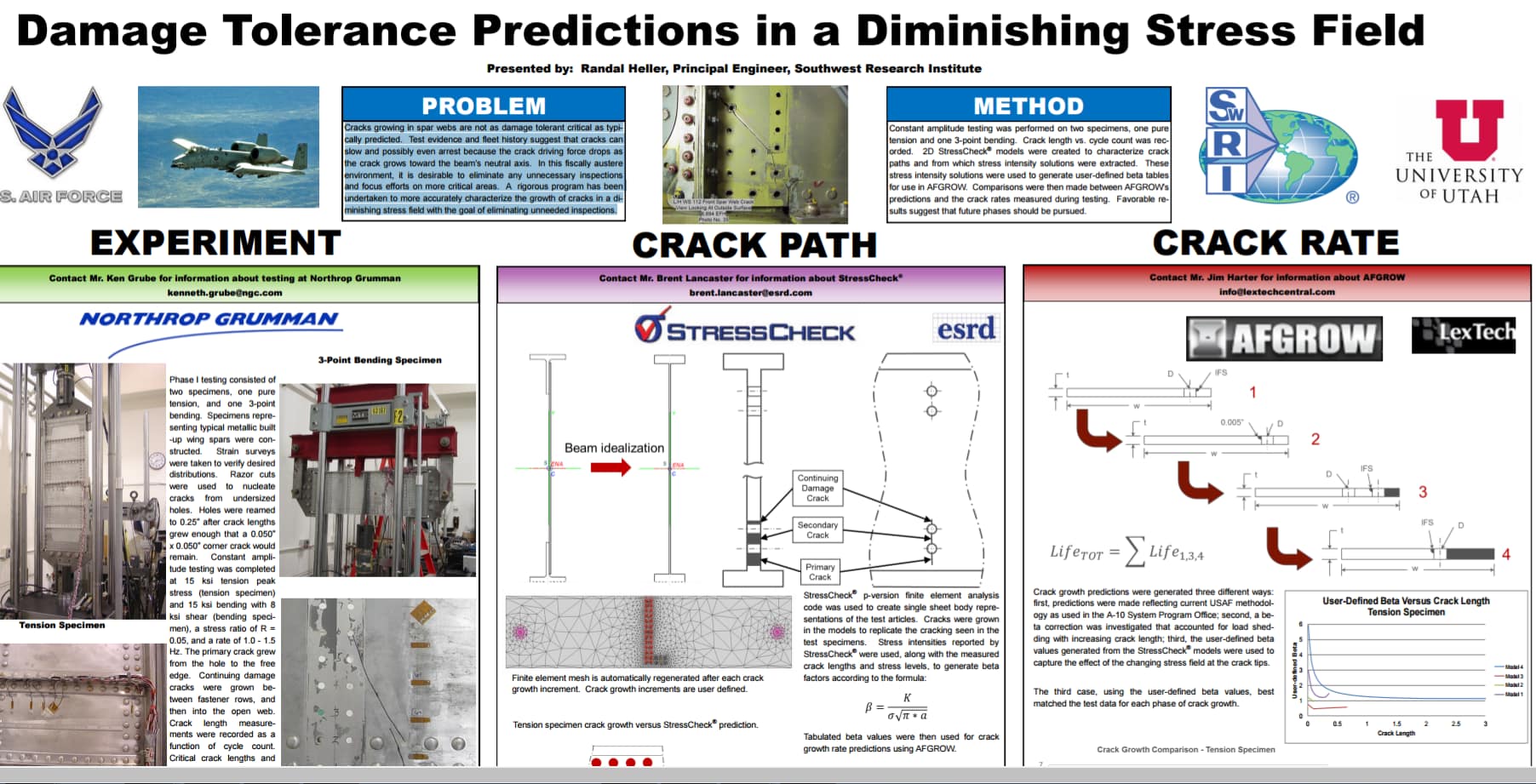
Damage Tolerance Predictions in a Diminishing Stress Field

Home ShopFracture Mechanics ModuleDamage Tolerance Predictions in a Diminishing Stress Field
Damage Tolerance Predictions in a Diminishing Stress Field

Damage Tolerance Predictions in a Diminishing Stress Field

Abstract: Cracks growing in spar webs are not as damage tolerant critical as typically predicted. Test evidence and fleet history suggest that cracks can slow and possibly even arrest because the crack driving force drops as the crack grows toward the beam’s neutral axis. In this fiscally austere environment, it is desirable to eliminate any unnecessary inspections and focus efforts on more critical areas. A rigorous program has been undertaken to more accurately characterize the growth of cracks in a diminishing stress field with the goal of eliminating unneeded inspections.

  • Scroll to View This Resource (Login May Be Required)
Loader Loading...
EAD Logo Taking too long?
Reload Reload document
| Open Open in new tab
Download Damage Tolerance Predictions...
ASIP-2011-Poster.pdf - 1.41 MB

Related Content:

  • Durability and Damage Tolerance (DaDT) Analysis Best Practices Webinar Slides
  • Improving Global-Local Simulation Workflows for High-Fidelity Stress and Damage Tolerance Analysis
  • Conference Presentation: ASIP T-38 Vertical Tail Teardown Analysis
  • Integrating Residual Stress Analysis of Critical Fastener Holes into USAF Depot Maintenance
  • ASIP 2019 Training – Automated 3D Crack Beta Curve Development via Smart Sim Apps


Related products

Crack Path Analysis Technical Brief Read more View Details

Crack Path Analysis Technical Brief

Fracture Mechanics Module, Linear Elasticity Solver, Simulation Technology, StressCheck Core, StressCheck Professional
StressCheck Overview Product Brief Read more View Details

StressCheck Overview Product Brief

StressCheck Professional
Laminated Composites Overview Presentation Read more View Details

Laminated Composites Overview Presentation

Composites Module, Linear Elasticity Solver, Simulation Technology, StressCheck Core, StressCheck Professional
NAFEMS Benchmark Problem 01 Solution Read more View Details

NAFEMS Benchmark Problem 01 Solution

Linear Elasticity Solver, Simulation Technology, StressCheck Core, StressCheck Professional
Categories: Fracture Mechanics Module, Linear Elasticity Solver, MeshSim Advanced Module, Simulation Technology, StressCheck Core, StressCheck Powered Apps, StressCheck Professional. Tags: Fastened Joints, Fracture Mechanics, Simulation Apps.

Search Resources

Products/Modules info Products/Modules Filter by one or more ESRD software products and/or modules.

Applications/Features info Applications/Features Filter by one or more Engineering Applications and/or Features.

Resource Categories info Resource Categories Filter by one or more Resource Categories.

Customer Resources info Customer Resources Filter by one or more Resource Permissions.

Testimonials

“As the United States Air Force continues to extend the service life of their aircraft the Aircraft Structural Integrity Program (ASIP) has had to refine the methods it uses to analyze and predict fatigue crack growth. Through the use StressCheck, coupled with AFGROW, we in A-10 ASIP have been able to more accurately model, predict and analyze critical aircraft structure for the A-10 and other types of structure for non-A-10 system managers. This also allows us within the A-10 to more accurately assess risk for decision makers, streamline aircraft inductions into scheduled maintenance and reduce cost for total life cycle management.”

A-10 ASIP Manager

Member Portal

  • Member Registration
  • Member Login

Contact Us

© 2026 · Engineering Software Research & Development, Inc. | Terms & Conditions | Privacy & Cookie Policy | Software License Agreement | Software Maintenance and Technical Support Policy

We use cookies on our website to give you the most relevant experience by remembering your preferences and repeat visits, as outlined in our Cookie Policy. You may adjust your cookie preferences within .

ESRD
Powered by  GDPR Cookie Compliance
Privacy Overview

This website uses cookies to improve your experience while you navigate through the website. Out of these, the cookies that are categorized as necessary are stored on your browser as they are essential for the working of basic functionalities of the website. We also use third-party cookies that help us analyze and understand how you use this website. These cookies will be stored in your browser only with your consent. You also have the option to opt-out of these cookies. But opting out of some of these cookies may affect your browsing experience.

Strictly Necessary Cookies

Strictly Necessary Cookies should be enabled at all times so that we can save your preferences for cookie settings.