Serving the Numerical Simulation community since 1989
With the Heat Transfer Solver, you can solve thermo-elastic problems with ease by switching between heat transfer and elasticity on the fly. In StressCheck, a linear heat conduction analysis can progress to a nonlinear analysis—seamlessly.
Heat Transfer Solver
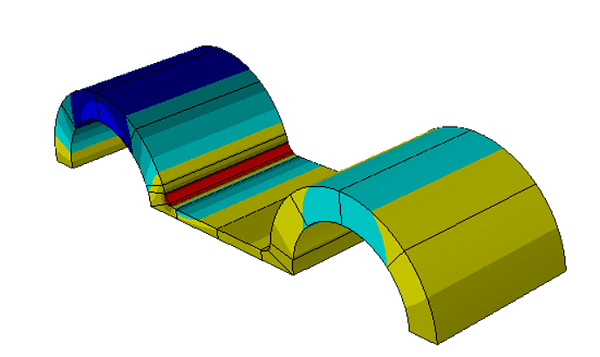
The Heat Transfer Solver supports linear, steady-state heat conduction with prescribed temperature, flux and convective boundary conditions. Also supports radiation and temperature dependent materials. Temperature-dependent material properties can be specified as a formula or as tabular data. The computed temperature distribution can be used in a very convenient way for computing the load vector for thermo-elastic problems. Simply solve the heat transfer problem, switch reference/theory selector from Heat Transfer to Elasticity, apply constraints to the model and solve.
Key Features and Advantages
- Applicable to planar, axisymmetric and three-dimensional problems
- Predict problems with linear, steady-state heat conduction with prescribed temperature, flux and convective boundary conditions.
- Radiation and temperature dependent material properties
- A thermo-elastic problem can be easily simulated by applying a Heat Transfer Analysis temperature distribution to the same mesh in elasticity as a thermal load.
- Simply select the Heat Transfer Analysis solution as a loading condition and StressCheck will automatically apply the thermal distribution to the mesh
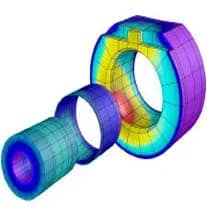
StressCheck’s unique hierarchic modeling framework makes it easy to pass from a linear heat transfer analysis (convection) to a nonlinear heat transfer analysis (radiation). Simply apply a radiation boundary condition and use the Non-Linear Solver.

Interested in a Demo, Evaluation or Purchase?



Have a Software Question, Issue or Feature Request?