 Serving the Numerical Simulation community since 1989

In September 2026, Computational Mechanics published “From Legacy Finite Element Modeling to Explainable Simulation: Technical Requirements for XAI in Computational Mechanics” authored by ESRD Co-founder and Chairman Dr. Barna Szabó. The paper explores the technical foundations required for Explainable Artificial Intelligence (XAI) in computational mechanics, with particular emphasis on controlling model-form and discretization errors in AI-assisted simulations. It also discusses the advantages and limitations of model-centric and element-centric implementation approaches. The work aims to advance the discussion on how trustworthy AI can be developed and deployed for engineering analysis and design.
The following is the technical paper abstract:
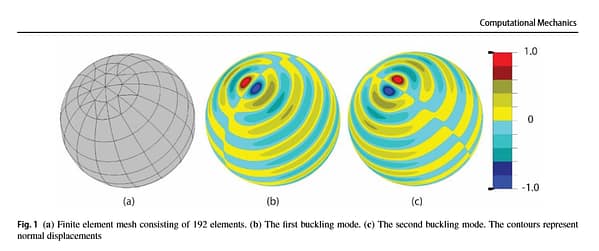
This paper establishes technical requirements for explainable artificial intelligence (XAI) in computational mechanics, with an emphasis on controlling both the model-form and discretization errors in finite element analysis. We argue that explanation accuracy and the identification of knowledge limits—central requirements of XAI—can be satisfied only when these error sources are systematically estimated and controlled. A model-centric framework is developed in which hierarchical discretization and model hierarchies enable traceability of modeling assumptions and quantitative assessment of their impact on quantities of interest. The approach is illustrated through numerical studies of the stability and post-buckling behavior of spherical and hemispherical shells. The results indicate that achieving XAI in engineering requires a transition from legacy element-centric implementations to formulations grounded in the science of finite element analysis, with important implications for software architecture and simulation workflows.
The paper is available as an open-access article via the following SharedIt link:
For a full list of publications regarding ESRD’s simulation technology and theoretical background, as well as additional publications by ESRD staff, visit our Simulation Technology References page.







Leave a Reply
We appreciate your feedback!
You must be logged in to post a comment.