• About
    • Who We Are
    • Partners & Providers
    • News & Events
    • The ESRD Blog
    • Careers
    • Contact Us
  • Applications
    • What We Solve
    • Detailed Stress
    • Composites
    • Fracture Mechanics
    • Residual Stress
    • Sim Apps
  • Products
    • What We Develop
    • StressCheck Professional
      • StressCheck Core
      • Solvers
      • Advanced Modules
      • Utilities
      • Academic Licensing
    • StressCheck Apps
      • CAE Handbook
      • StressCheck Tool Box
    • Product Updates
  • Support
    • How We Can Help
    • Training
    • Webinars
    • Quick Start Guide
    • Help Documentation
    • Software FAQ’s
  • Simulation
    • How We Simulate
    • Benchmarks
    • Simulation Governance
    • History of FEA
    • Dictionary & Terms
  • Resources
    • Browse Our Resource Library
    • White Papers
    • Case Studies
    • Product Demos
    • StressCheck Tutorials
Serving the Numerical Simulation community since 1989
  • Contact Us
  • Register
Login
Forgot Password?
Join Us
ESRDESRD
ESRDESRD
  • About
    • Who We Are
    • Partners & Providers
    • News & Events
    • The ESRD Blog
    • Careers
    • Contact Us
  • Applications
    • What We Solve
    • Detailed Stress
    • Composites
    • Fracture Mechanics
    • Residual Stress
    • Sim Apps
  • Products
    • What We Develop
    • StressCheck Professional
      • StressCheck Core
      • Solvers
      • Advanced Modules
      • Utilities
      • Academic Licensing
    • StressCheck Apps
      • CAE Handbook
      • StressCheck Tool Box
    • Product Updates
  • Support
    • How We Can Help
    • Training
    • Webinars
    • Quick Start Guide
    • Help Documentation
    • Software FAQ’s
  • Simulation
    • How We Simulate
    • Benchmarks
    • Simulation Governance
    • History of FEA
    • Dictionary & Terms
  • Resources
    • Browse Our Resource Library
    • White Papers
    • Case Studies
    • Product Demos
    • StressCheck Tutorials

Aerospace and Defense

Home Tag Aerospace and Defense (Page 4)
Webinar: Intro to Fracture Mechanics for DaDT Solution Automation

Webinar: Intro to Fracture Mechanics for DaDT Solution Automation

Oct 8, 2020

October 8, 2020 @ 1:00 pm EST

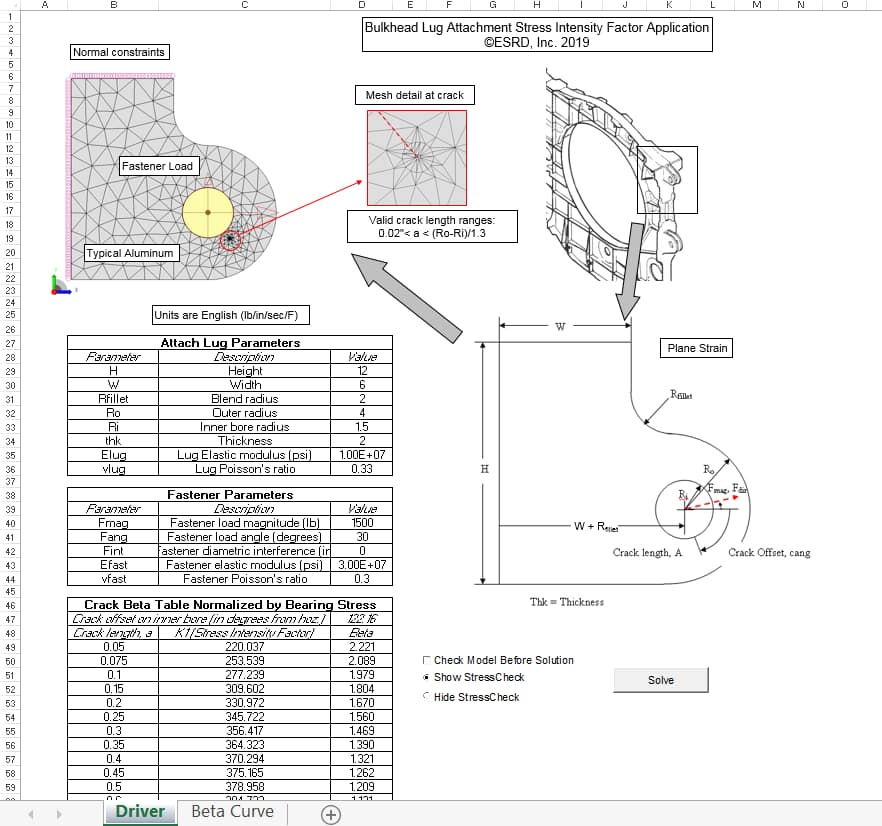
Strategies for the automation of durability and damage tolerance (DaDT) solutions, driven by Sim Apps designed for the computation of FEA-based total beta factors, will be explored.
This webinar is now available to watch on-demand.

WATCH NOW

WEBINAR SUMMARY

In this pre-recorded 2 hour webinar we will discuss the creation of Sim Apps for the automatic generation of complex, solution-verified 2D and 3D beta factors via the integration of StressCheck's parametric FEA engine, the Windows Component Object Model (COM) and Microsoft Excel VBA.

WEBINAR HIGHLIGHTS

In Part 1 of this webinar series, the following topics are presented:

  • 3D StressCheck Fracture Mechanics demo
  • Overview of linear elastic fracture mechanics (LEFM) parameters for fatigue crack growth: SIF’s, J-integrals and beta factors.
  • Computation of LEFM parameters in StressCheck.
  • Beta factor compounding pros and cons.
  • FEA-based total beta factors.
  • Why use StressCheck for LEFM?

In Part 2 of this webinar series, the following topics are presented:

  • What is a Sim App? And how can they help DaDT analysts?
  • StressCheck’s COM API
  • Sim App Case Studies for DaDT
  • Live Sim App Demo

Webinar: How Do You Verify the Accuracy of Engineering Simulations?

Webinar: How Do You Verify the Accuracy of Engineering Simulations?

Jan 16, 2019

January 16, 2019 @ 1:00 pm EST

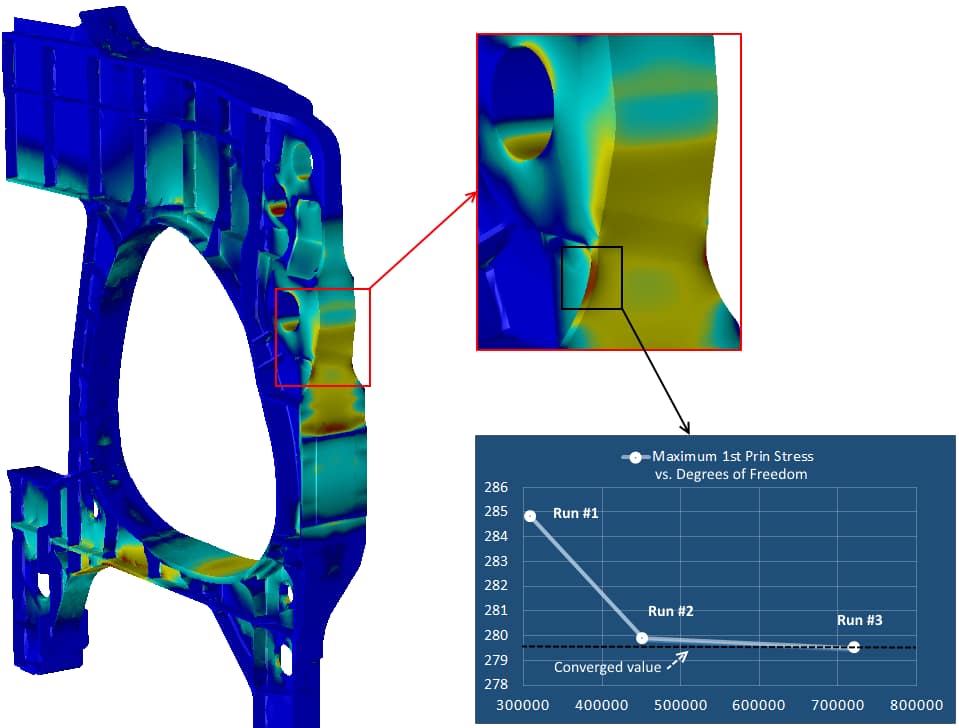
Strategies for verifying the accuracy of engineering data will be explored, including best practices and common pitfalls engineers may encounter when assessing the quality of the results.

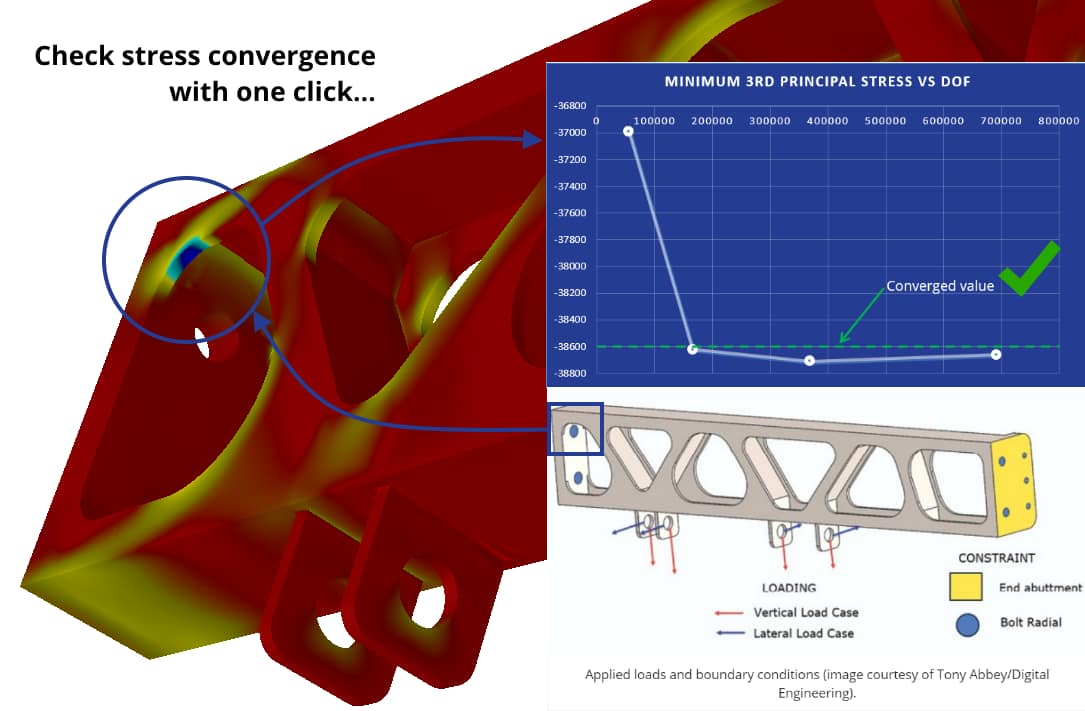
Convergence of minimum principal stress in an aircraft keel beam structure (courtesy Digital Engineering).

In this webinar we will discuss how ESRD’s S.A.F.E.R. Simulation techniques can be used to objectively verify the accuracy of engineering simulations computed by FEA.

WEBINAR HIGHLIGHTS

  • Why is the practice of solution verification for FEA results important? And what checks must always be performed before reporting your FEA results as “accurate”?
  • We will examine a variety of publicly-available and industry-applicable case studies, benchmarks and industry examples to determine the most efficient and reliable methodologies to perform solution verification.
  • LIVE DEMO: You will see a demonstration of ESRD’s StressCheck and its S.A.F.E.R. live dynamic results extractions for an industry example, and learn how StressCheck makes verifying the accuracy of results quick and pain-free.

Webinar: High-Fidelity Stress Analysis for S.A.F.E.R. Structural Simulation

Webinar: High-Fidelity Stress Analysis for S.A.F.E.R. Structural Simulation

Dec 14, 2017

December 14, 2017 @ 1:00 pm EST

Strategies in engineering simulation for reducing the frequency, cost, complexity, and uncertainty of aircraft maintenance inspection intervals.

In this webinar we will share advancements in numerical simulation that make the performance of finite element analysis S.A.F.E.R. – Simple, Accurate, Fast, Efficient, and Reliable.

WEBINAR HIGHLIGHTS

  • We will introduce a different approach to numerical simulation that has been developed and commercialized by ESRD which takes much of the art and craft out of finite element modeling.
  • An example engineering design problem from the aviation industry, requiring accurate results around stress concentrations to meet durability requirements for a long crack initiation life, will be presented.
  • LIVE DEMO: You will see a demonstration of ESRD’s StressCheck and its live dynamic results mining of any value of interest, anywhere throughout the model regardless of the mesh topology, as rapid design changes are conducted, evaluated and parametrically iterated.

Webinar: 3D Crack Growth Simulation: Advancements & Applications

Webinar: 3D Crack Growth Simulation: Advancements & Applications

Jul 17, 2019

July 17, 2019 @ 1:00 pm EST

Strategies for seamlessly integrating the advanced fracture & DaDT capabilities of two numerical simulation software products into a state-of-the-art 3D fatigue crack growth application will be explored.

This webinar is now available to watch on-demand.

WATCH NOW
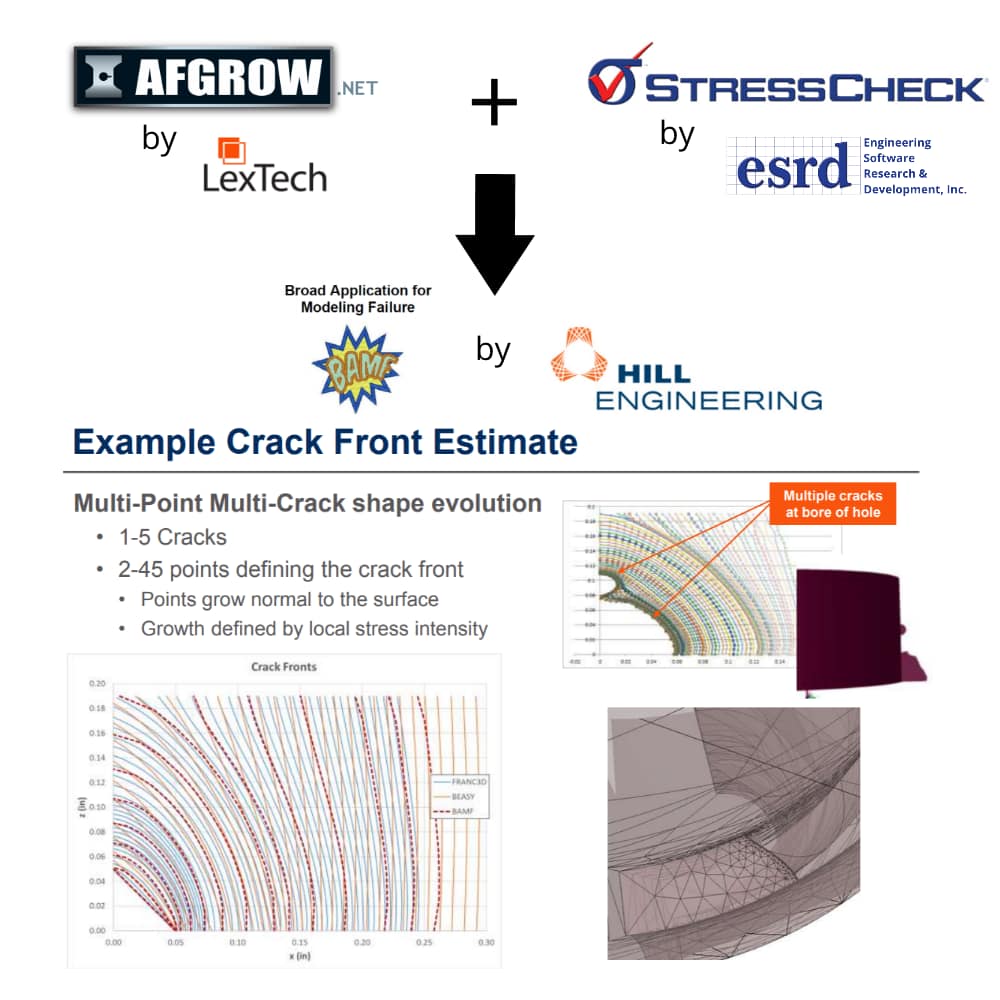
BAMF Example Crack Front Estimate via StressCheck/AFGROW Integration (courtesy Hill Engineering).

WEBINAR SUMMARY

In this webinar we will detail the latest technological advancements for accurate simulation of three-dimensional metallic crack growth via coupled finite element analysis (FEA) and fatigue life computations. Additionally, we will examine why the development of more complex crack growth models requires both tighter control over numerical errors (i.e. solution verification) and rigorous benchmarking to standard handbook solutions and available experimental data (i.e. model validation).

WEBINAR HIGHLIGHTS

  • This webinar will be jointly presented by ESRD, Hill Engineering, LLC (developers of BAMF) and LexTech, Inc. (developers of AFGROW), and will explore the latest technologies, methodologies and software implementations available for DaDT and fatigue engineers to numerically simulate fatigue crack propagation.
  • The effects of engineered residual stresses (ERS) on crack shape evolution and the associated cyclic fatigue life will be assessed in several practical case studies.
  • LIVE DEMO: You will see a 3D crack growth demonstration with Hill Engineering’s Broad Application for Modeling Failure (BAMF) software tool, which provides a robust integration between StressCheck’s DaDT/fracture solutions and AFGROW’s crack growth life prediction capabilities.

WEBINAR PARTICIPANTS

  • ESRD/StressCheck
  • LexTech/AFGROW
  • Hill Engineering/BAMF

ESRD/StressCheck

StressCheck is a comprehensive Windows 10-compatible, 64-bit finite element analysis software (FEA) tool with a fully integrated pre- and post-processor and a suite of solver and analysis modules that support advanced engineering computations in applications of solid mechanics. Productivity tools are available to import NASTRAN bulk data file meshes and CAD geometry, perform 2D and 3D automatic meshing, automate analyses via StressCheck‘s API, and more. StressCheck is ideally suited for damage tolerance and forensic engineers who need the best representation of 2D or 3D SIF’s, ERR’s and beta factors for input in sophisticated crack growth simulations, or when analyzing repairs for mitigation of cracks.

Learn More

LexTech/AFGROW

AFGROW is a Damage Tolerance Analysis (DTA) framework that allows users to analyze crack initiation, fatigue crack growth, and fracture to predict the life of metallic structures. AFGROW (Air Force Grow), was originally developed by The Air Force Research Laboratory. It is now being developed and maintained by LexTech, Inc. AFGROW is one of the most efficient and widely used crack growth life prediction tools available today. AFGROW is mainly used for aerospace applications; however, it can be applied to any type of metallic structure that experiences fatigue cracking. AFGROW is also a very flexible and user-friendly computer program.

Learn More

Hill Engineering/BAMF

BAMF is used for fatigue analysis, and it is capable of predicting the growth of fatigue cracks in 3D parts. Starting from an assumed initial flaw, BAMF combines stress and crack growth analyses to predict the evolution of crack shape and size in 3D. BAMF provides a robust and automated link between two leading tools: AFGROW and StressCheck. Key features of BAMF include: natural crack shape evolution, fully 3D fatigue analysis capability, complex loading support, multiple cracks, and residual stress compatibility.

Learn More

ASIP 2022 Conference Recap

ASIP 2022 Conference Recap

Dec 8, 2022

Recently at ASIP 2022 in Phoenix, AZ, ESRD provided a 2-hour training course titled “Best Practices for the Modeling and Analysis of Bonded Doubler Repairs”, presented a technical paper titled “DTA of Bonded Repairs on the Wing Skin of the C-130 Using Finite Elements”, chatted with “patients” at the StressCheck Clinic, and exhibited at our captivating booth inside the Sheraton Phoenix Hotel & Conference Center.

We are also planning a webinar for February 7, 2023 titled “What’s New and Improved in StressCheck Professional”. We hope you can attend this “must-see” event!

Read the summary of conference events, view the ASIP training course content (including the presentation and demo videos), and register for our upcoming webinar.

ASIP 2021 Conference Recap

ASIP 2021 Conference Recap

Dec 15, 2021

Recently at ASIP 2021, ESRD provided a training course titled “Standardization and Automation of DaDT Solutions via FEA-Based Sim Apps”, chatted with ASIP attendees, provided a StressCheck Clinic, and exhibited at our booth. After two years of virtual meetings, it was great to re-connect in person!

Read the summary of conference events, and view the ASIP training course content (including the presentation and demo videos). In addition, we encourage you to sign up for our Q1 2022 webinar on “New and Improved Features for 3D Fracture Mechanics Analysis in StressCheck”. You don’t want to miss it!

Hierarchic Approaches to Modeling Fastened Connections Webinar Recording Now Available

Hierarchic Approaches to Modeling Fastened Connections Webinar Recording Now Available

Jun 22, 2018

On Wednesday, June 20, 2018 a webinar titled “Hierarchic Approaches to Modeling Fastened Connections” was provided by ESRD’s Brent Lancaster and Gordon Lehman.

In case you missed it, the webinar recording is now available!

ESRD to Exhibit and Provide Training Course at ASIP 2021

ESRD to Exhibit and Provide Training Course at ASIP 2021

Oct 12, 2021

ESRD, Inc. will be exhibiting and providing a training course on the standardization and automation of DaDT solutions via FEA-based #SimApps at the #ASIP Conference 2021 in Austin, TX from November 29-December 2, 2021.

New Webinar: Simulation Governance Is Critical for Reliable Condition-Based (Predictive) Maintenance

New Webinar: Simulation Governance Is Critical for Reliable Condition-Based (Predictive) Maintenance

Apr 13, 2021

ESRD is pleased to announce a new webinar, scheduled for April 22, 2021 @ 11:00 am EST.

This webinar, hosted by ESRD partner Revolution in Simulation, will present a case study in which the goal was the development of a mathematical model for supporting condition-based maintenance (CBM) decisions.

ESRD is Co-Sponsoring NAFEMS Americas’ “Aerospace Simulation Engineering: The Big Issues”

Aug 14, 2017

NAFEMS Americas 2017 Aerospace Simulation Engineering: The Big Issues This year, Aerospace Simulation Engineering is one of the “Big Issues”...

  • 1
  • 2
  • 3
  • 4
  • 5
  • 6
  • 7

Looking for Resources?

Interested in a Demo, Evaluation or Purchase?

Have a Software Question, Issue or Feature Request?

Recent News & Events

  • Trustworthiness in Simulation: Credibility or Decision-grade Reliability?
  • Beyond the Black Box: Explainable AI Requires Explainable Simulation
  • Turtle Shells and Legacy Finite Element Codes: Evolutionary Constraints in the Age of Explainable AI

Quick Links

  • Quick Start Guide
  • Documentation
  • Software FAQs
  • Software Demos

Testimonials

  • “We have been having very good success using the P-Version finite element code, StressCheck, to develop the 2-D solutions for two independent cracks in a plate. I have asked one of our AFGROW team members to model the plate and lug cases using StressCheck and compare them to the existing AFGROW closed-form solutions. [He] modeled the cases several different ways to be sure that he was getting the best possible solutions. He has verified that the bearing load option in StressCheck provides excellent results.”

    Jim Harter
    Team Leader-Analytical Fatigue/Fracture Reliability Team Air Force Research Laboratory (AFRL)

Testimonials

The software provides a highly reliable and user-friendly production stress analysis tool that will replace the Finite Element Method (FEM) tools and failure criteria the experts currently employ for analyzing bonded joints. The software includes an FEM-based handbook format, which allows non-experts to utilize models prepared by specialists. The handbook problems include built-in failure criteria, geometric and material nonlinearities, and the modern FEM technology provides better error control and the treatment of very large aspect ratios.”

Dr. Stephen P. Engelstad, Technical Fellow, Lockheed Martin Aeronautics Company, Structural Methods and Analysis

Member Portal

  • Member Registration
  • Member Login

Contact Us

© 2026 · Engineering Software Research & Development, Inc. | Terms & Conditions | Privacy & Cookie Policy | Software License Agreement | Software Maintenance and Technical Support Policy

We use cookies on our website to give you the most relevant experience by remembering your preferences and repeat visits, as outlined in our Cookie Policy. You may adjust your cookie preferences within .

ESRD
Powered by  GDPR Cookie Compliance
Privacy Overview

This website uses cookies to improve your experience while you navigate through the website. Out of these, the cookies that are categorized as necessary are stored on your browser as they are essential for the working of basic functionalities of the website. We also use third-party cookies that help us analyze and understand how you use this website. These cookies will be stored in your browser only with your consent. You also have the option to opt-out of these cookies. But opting out of some of these cookies may affect your browsing experience.

Strictly Necessary Cookies

Strictly Necessary Cookies should be enabled at all times so that we can save your preferences for cookie settings.