Serving the Numerical Simulation community since 1989
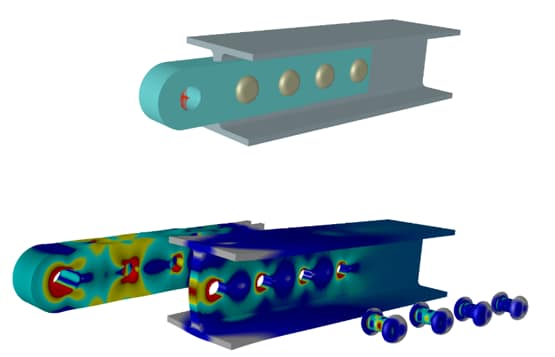
Strategies for modeling, solving & post-processing 3D multi-body contact applications in StressCheck Professional, along with implementation details & troubleshooting recommendations, will be explored.
Introduction to Multi-Body Contact in StressCheck
WEBINAR SUMMARY
In this pre-recorded 2 hour webinar we will review the scope, typical applications, model setup, best practices, quality assurance checks, troubleshooting recommendations, and algorithmic details for StressCheck's multi-body contact implementation.
WEBINAR HIGHLIGHTS
Introduction to Multi-Body Contact: Part 1
- Overview of scope and supported problem classes
- “How It Works”
- Sample multi-body contact applications & use cases (e.g. fastened connections, fittings, splice joints, etc.)
- Setting up a model for multi-body contact & checking solution quality
- End-to-End (E2E) Demo: 3D Fork Fitting Analysis
Introduction to Multi-Body Contact: Part 2
- Implementation details & FAQ’s
- Contact algorithm: theory & application
- Recommendations & best practices
- Troubleshooting common issues
- ESRD Website Resources
WATCH THIS WEBINAR
Part 1: Overview & Applications, E2E Demo
Part 2: Implementation Details & FAQ’s
Want to Set Up an Instructor-Led Training?
Click the below button to get a quote for an on-site, off-site or web-based training course:
Request Training
Interested in a Demo, Evaluation or Purchase?



Have a Software Question, Issue or Feature Request?