• About
    • Who We Are
    • Partners & Providers
    • News & Events
    • The ESRD Blog
    • Careers
    • Contact Us
  • Applications
    • What We Solve
    • Detailed Stress
    • Composites
    • Fracture Mechanics
    • Residual Stress
    • Sim Apps
  • Products
    • What We Develop
    • StressCheck Professional
      • StressCheck Core
      • Solvers
      • Advanced Modules
      • Utilities
      • Academic Licensing
    • StressCheck Apps
      • CAE Handbook
      • StressCheck Tool Box
    • Product Updates
  • Support
    • How We Can Help
    • Training
    • Webinars
    • Quick Start Guide
    • Help Documentation
    • Software FAQ’s
  • Simulation
    • How We Simulate
    • Benchmarks
    • Simulation Governance
    • History of FEA
    • Dictionary & Terms
  • Resources
    • Browse Our Resource Library
    • White Papers
    • Case Studies
    • Product Demos
    • StressCheck Tutorials
Serving the Numerical Simulation community since 1989
  • Contact Us
  • Register
Login
Forgot Password?
Join Us
ESRDESRD
ESRDESRD
  • About
    • Who We Are
    • Partners & Providers
    • News & Events
    • The ESRD Blog
    • Careers
    • Contact Us
  • Applications
    • What We Solve
    • Detailed Stress
    • Composites
    • Fracture Mechanics
    • Residual Stress
    • Sim Apps
  • Products
    • What We Develop
    • StressCheck Professional
      • StressCheck Core
      • Solvers
      • Advanced Modules
      • Utilities
      • Academic Licensing
    • StressCheck Apps
      • CAE Handbook
      • StressCheck Tool Box
    • Product Updates
  • Support
    • How We Can Help
    • Training
    • Webinars
    • Quick Start Guide
    • Help Documentation
    • Software FAQ’s
  • Simulation
    • How We Simulate
    • Benchmarks
    • Simulation Governance
    • History of FEA
    • Dictionary & Terms
  • Resources
    • Browse Our Resource Library
    • White Papers
    • Case Studies
    • Product Demos
    • StressCheck Tutorials

A Memo from the 5th Century BC

Home The ESRD BlogA Memo from the 5th Century BC

A Memo from the 5th Century BC

October 17, 2023 The ESRD Blog

By Dr. Barna Szabó
Engineering Software Research and Development, Inc.
St. Louis, Missouri USA


Let us be reminded of the timeless wisdom found in The Analects of Confucius (Book XIII, Chapter 3):

“If names be not correct, language is not in accordance with the truth of things. If language be not in accordance with the truth of things, affairs cannot be carried on to success [1]”. 

Confucius (551-479 BC) tells us, engineers working in the 21st century AD, that having a firm grasp on terminology is an essential prerequisite to success. For example, if we are interested in setting up a numerical simulation project then we cannot set realistic goals and expectations unless we understand what numerical simulation is. We cannot understand what numerical simulation is unless we understand what simulation is. We cannot understand what simulation is unless we understand the difference between physical reality and an idea of physical reality, and so on.
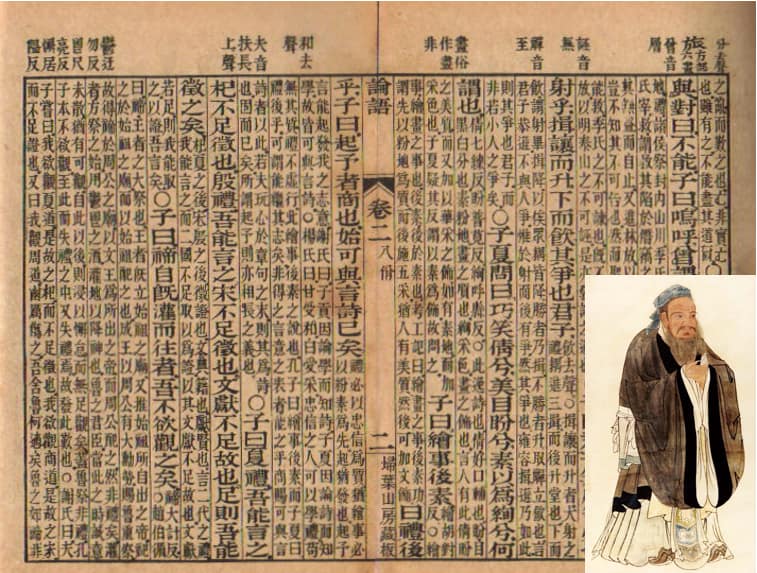
The Analects of Confucius (courtesy Wikipedia)

Misleading or Meaningless Terms

There are many popular but misleading or meaningless terms floating around in engineering presentations, technical papers, blog articles, training and workplace environments such as; “physical reality”, “laws of nature”, “physics-based model”, “physics-informed model”, “computational model”, “governing equations“, “finite element modeling”, and “artificial intelligence”, not in accordance with the truth of things.  Brief explanations follow.

Physical Reality

Quoting Wolfgang Pauli (Physics Nobel Prize 1950); “The layman always means, when he says ‘reality’ that he is speaking of something self-evidently known; whereas to me it seems the most important and exceedingly difficult task of our time is to work on the construction of a new idea of reality [2]”.

A mathematical model is a precisely formulated idea about some aspect of physical reality and must never be confused with reality itself.  Many different models can be formulated about the same aspect of reality.  If the predictive performance of two or more models were found to be the same then the models would be equally valid. This view is known as model-dependent realism.  Quoting Stephen Hawking: “I take the positivist viewpoint that a physical theory is just a mathematical model and that it is meaningless to ask whether it corresponds to reality. All that one can ask is that its predictions should be in agreement with observation [3].” – In other words, aspects of physical reality are seen and understood through mathematical models.

You may ask, since Pauli and Hawking were theoretical physicists, and you are interested in engineering, how would all this pertain to you?  – The answer is that engineering models deal with aspects of reality as well.  As engineers, we benefit from operating within established conceptual frameworks like continuum mechanics, fluid dynamics, and electromagnetism. Working in the foundational sciences, physicists are laboring to formulate and validate a comprehensive conceptual framework.  They are progressing very slowly. A physicist even argued that theoretical physics has been stagnating for about forty years [4].

Laws of Nature

Nature is what it is and if there are such things as laws of nature, they are not known and probably are not knowable.  Laws of great generality and elegance have been formulated to describe aspects of physical reality.  For example, Newton’s laws were considered to be laws of nature for about two centuries, but we now know that they are approximations to a more comprehensive model, the theory of relativity, which has its limitations also.

Physics-based Model

In view of the foregoing, this is a meaningless term.

Physics-informed Model

This vague term is also meaningless.

Computational Model

This term conflates the operations that transform the input data D into the quantities of interest F, called mathematical model, with the procedures by which a numerical approximation Fnum is obtained.  Understanding the difference between F and Fnum is essential.

Governing Equations

This term is misleading. Natural processes are not governed by our equations. Nature knows nothing about our equations. Our equations describe certain aspects of natural processes, subject to limitations imposed by the underlying assumptions and the available calibration data.

Finite Element Modeling

This term refers to the obsolete practice of constructing numerical problems by assembling elements from the library of a finite element code.  In these libraries, the model form and the approximating functions are mixed.

Artificial Intelligence (AI)

This is an umbrella term referring to computer systems designed to perform tasks, such as visual perception, speech recognition, and translation between languages. The term is misleading because these tasks involve the execution of clever algorithms that form only a small subset of the functions we associate with human intelligence. Importantly, there is no algorithm for theory choice [5], that involves elements of creativity, innovation, and, possibly, paradigm-shifting approaches. It would be more accurate to interpret the ‘I’ in AI as signifying ‘idiot savant’ rather than ‘intelligence’.


[1] Translated by James Legge.

[2] Wolfgang Pauli.  Letter to Markus Fierz, 1948.

[3] Stephen Hawking and Roger Penrose.  The nature of space and time. Princeton University Press, 2010.

[4] Sabine Hossenfelder. Lost in math: How beauty leads physics astray. Hachette UK, 2018.

[5] Thomas Kuhn. Postscript to the second edition of “The Structure of Scientific Revolutions”, University of Chicago Press, 1970.

Tags: Artificial IntelligenceFinite Element ModelNumerical Simulation
0

You also might be interested in

S.A.F.E.R. Numerical Simulation for Structural Analysis in the Aerospace Industry Part 5: An Introduction to StressCheck for High-Fidelity Aero-structure Analysis
C130 Hercules transport aircraft.

S.A.F.E.R. Numerical Simulation for Structural Analysis in the Aerospace Industry Part 5: An Introduction to StressCheck for High-Fidelity Aero-structure Analysis

Apr 2, 2018

In this final post of our "S.A.F.E.R. Numerical Simulation for Structural Analysis in the Aerospace Industry" series, we will profile the stress analysis software product StressCheck®, what makes it different from other FEA software and the applications for which it is used in A&D engineering.[...]

Accelerate StressCheck Productivity with the Latest e-Learning Resources

Accelerate StressCheck Productivity with the Latest e-Learning Resources

Apr 13, 2021

With the release of StressCheck v11 in December 2020, ESRD unveiled a significantly improved user interface experience, a voluminous online documentation portal, and a re-written Getting Started Guide with a companion video tutorial. In addition, we've revamped our Getting Started page, with helpful links for member registration, licensing & installation, the basics of StressCheck usage, and other key links & resources. In short, it's never been easier to learn StressCheck!

Happy Holidays from ESRD (2021 Edition)

Happy Holidays from ESRD (2021 Edition)

Dec 22, 2021

While 2021 continued to present unique challenges and unprecedented disturbances, we hope that you found our customer support, on-demand webinars, web-based training services and overall experience with our team to be refreshingly positive. Happy Holidays from all of us at ESRD, and we hope you'll check out our year-end summary!

Leave a Reply

We appreciate your feedback!
Cancel Reply

You must be logged in to post a comment.

Looking for Resources?

Interested in a Demo, Evaluation or Purchase?

Have a Software Question, Issue or Feature Request?

Recent News & Events

  • Trustworthiness in Simulation: Credibility or Decision-grade Reliability?
  • Beyond the Black Box: Explainable AI Requires Explainable Simulation
  • Turtle Shells and Legacy Finite Element Codes: Evolutionary Constraints in the Age of Explainable AI

Quick Links

  • Quick Start Guide
  • Documentation
  • Software FAQs
  • Software Demos

Testimonials

  • “An advanced modeling and analysis tool for complex composite structures is generating benefits across the aerospace industrial base. StressCheck [Composites] is widely viewed as the next-generation composite joint strength tool.”


    Air Force Research Laboratory (AFRL)

Testimonials

When performing parametric structural analysis, ESRD’s p-element StressCheck FEA software is always my preferred choice due to the excellent solution quality, parametric framework, and superior computational efficiency. In fact, I recently used StressCheck to generate stress intensity factors along a parametrically defined elliptical crack-tip across 3,000 unique geometric configurations. Considering multi-body contact was present and all simulations were performed using a laptop, this was a task well suited for StressCheck.

Dr. Lee Zambino, Researcher, Villanova University

Member Portal

  • Member Registration
  • Member Login

Contact Us

© 2026 · Engineering Software Research & Development, Inc. | Terms & Conditions | Privacy & Cookie Policy | Software License Agreement | Software Maintenance and Technical Support Policy

Prev Next

We use cookies on our website to give you the most relevant experience by remembering your preferences and repeat visits, as outlined in our Cookie Policy. You may adjust your cookie preferences within .

ESRD
Powered by  GDPR Cookie Compliance
Privacy Overview

This website uses cookies to improve your experience while you navigate through the website. Out of these, the cookies that are categorized as necessary are stored on your browser as they are essential for the working of basic functionalities of the website. We also use third-party cookies that help us analyze and understand how you use this website. These cookies will be stored in your browser only with your consent. You also have the option to opt-out of these cookies. But opting out of some of these cookies may affect your browsing experience.

Strictly Necessary Cookies

Strictly Necessary Cookies should be enabled at all times so that we can save your preferences for cookie settings.