• About
    • Who We Are
    • Partners & Providers
    • News & Events
    • The ESRD Blog
    • Careers
    • Contact Us
  • Applications
    • What We Solve
    • Detailed Stress
    • Composites
    • Fracture Mechanics
    • Residual Stress
    • Sim Apps
  • Products
    • What We Develop
    • StressCheck Professional
      • StressCheck Core
      • Solvers
      • Advanced Modules
      • Utilities
      • Academic Licensing
    • StressCheck Apps
      • CAE Handbook
      • StressCheck Tool Box
    • Product Updates
  • Support
    • How We Can Help
    • Training
    • Webinars
    • Quick Start Guide
    • Help Documentation
    • Software FAQ’s
  • Simulation
    • How We Simulate
    • Benchmarks
    • Simulation Governance
    • History of FEA
    • Dictionary & Terms
  • Resources
    • Browse Our Resource Library
    • White Papers
    • Case Studies
    • Product Demos
    • StressCheck Tutorials
Serving the Numerical Simulation community since 1989
  • Contact Us
  • Register
Login
Forgot Password?
Join Us
ESRDESRD
ESRDESRD
  • About
    • Who We Are
    • Partners & Providers
    • News & Events
    • The ESRD Blog
    • Careers
    • Contact Us
  • Applications
    • What We Solve
    • Detailed Stress
    • Composites
    • Fracture Mechanics
    • Residual Stress
    • Sim Apps
  • Products
    • What We Develop
    • StressCheck Professional
      • StressCheck Core
      • Solvers
      • Advanced Modules
      • Utilities
      • Academic Licensing
    • StressCheck Apps
      • CAE Handbook
      • StressCheck Tool Box
    • Product Updates
  • Support
    • How We Can Help
    • Training
    • Webinars
    • Quick Start Guide
    • Help Documentation
    • Software FAQ’s
  • Simulation
    • How We Simulate
    • Benchmarks
    • Simulation Governance
    • History of FEA
    • Dictionary & Terms
  • Resources
    • Browse Our Resource Library
    • White Papers
    • Case Studies
    • Product Demos
    • StressCheck Tutorials

Why Finite Element Modeling is Not Numerical Simulation?

Home The ESRD BlogWhy Finite Element Modeling is Not Numerical Simulation?

Why Finite Element Modeling is Not Numerical Simulation?

November 2, 2023 The ESRD Blog

By Dr. Barna Szabó
Engineering Software Research and Development, Inc.
St. Louis, Missouri USA


The term “simulation” is often used interchangeably with “finite element modeling” in the engineering literature and marketing materials.  It is important to understand the difference between the two.

The Origins of Finite Element Modeling

Finite element modeling is a practice rooted in the 1960s and 70s.  The development of the finite element method began in 1956 and was greatly accelerated during the US space program in the 1960s. The pioneers were engineers who were familiar with the matrix methods of structural analysis and sought to extend those methods to solve the partial differential equations that model the behavior of elastic bodies of arbitrary geometry subjected to various loads.   The early papers and the first book on the finite element method [1], written when our understanding of the subject was just a small fraction of what it is today, greatly influenced the idea of finite element modeling and its subsequent implementations.

Guided by their understanding of models for structural trusses and frames, the early code developers formulated finite elements for two- and three-dimensional elasticity problems, plate and shell problems, etc. They focused on getting the stiffness relationships right, subject to the limitations imposed by the software architecture on the number of nodes per element and the number of degrees of freedom per node.  They observed that elements of low polynomial degree were “too stiff”.  The elements were then “softened” by using fewer integration points than necessary.  This caused “hourglassing” (zero energy modes) to occur which was fixed by “hourglass control”.  For example, the formulation of the element designated as C3D8R and described as “8-node linear brick, reduced integration with hourglass control” in the Abaqus Analysis User’s Guide [2] was based on such considerations.

Through an artful combination of elements and the finite element mesh, the code developers were able to show reasonable correspondence between the solutions of some simple problems and the finite element solutions.  It is a logical fallacy, called the fallacy of composition, to assume that elements that performed well in particular situations will also perform well in all situations.

The Science of Finite Element Analysis

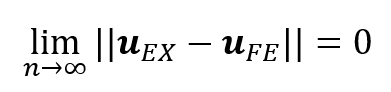
Investigation of the mathematical foundations of finite element analysis (FEA) began in the early 1970s.  Mathematicians understand FEA as a method for obtaining an approximation to the exact solution of a well-defined mathematical problem, such as a problem of elasticity.  Specifically, the finite element solution uFE has to converge to the exact solution uEX in a norm (which depends on the formulation) as the number of degrees of freedom n is increased:
Under conditions that are usually satisfied in practice, it is known that uEX exists and it is unique.

The first mathematical book on finite element analysis was published in 1973 [3].  Looking at the engineering papers and contemporary implementations, the authors identified four types of error, called “variational crimes”. These are (1) non-conforming elements, (2) numerical integration, (3) approximation of the domain and boundary conditions, and (4) mixed methods. In fact, many other kinds of variational crimes commonly occur in finite element modeling, such as using point forces, point constraints, and reduced integration.

By the mid-1980s the mathematical foundations of FEA were substantially established.   It was known how to design finite element meshes and assign polynomial degrees so as to achieve optimal or nearly optimal rates of convergence, how to extract the quantities of interest from the finite element solution, and how to estimate their errors.  Finite element analysis became a branch of applied mathematics.

By that time the software architectures of the large finite element codes used in current engineering practice were firmly established. Unfortunately, they were not flexible enough to accommodate the new technical requirements that arose from scientific understanding of the finite element method. Thus, the pre-scientific origins of finite element analysis became petrified in today’s legacy finite element codes.

Figure 1 shows an example that would be extremely difficult, if not impossible, to solve using legacy finite element analysis tools:
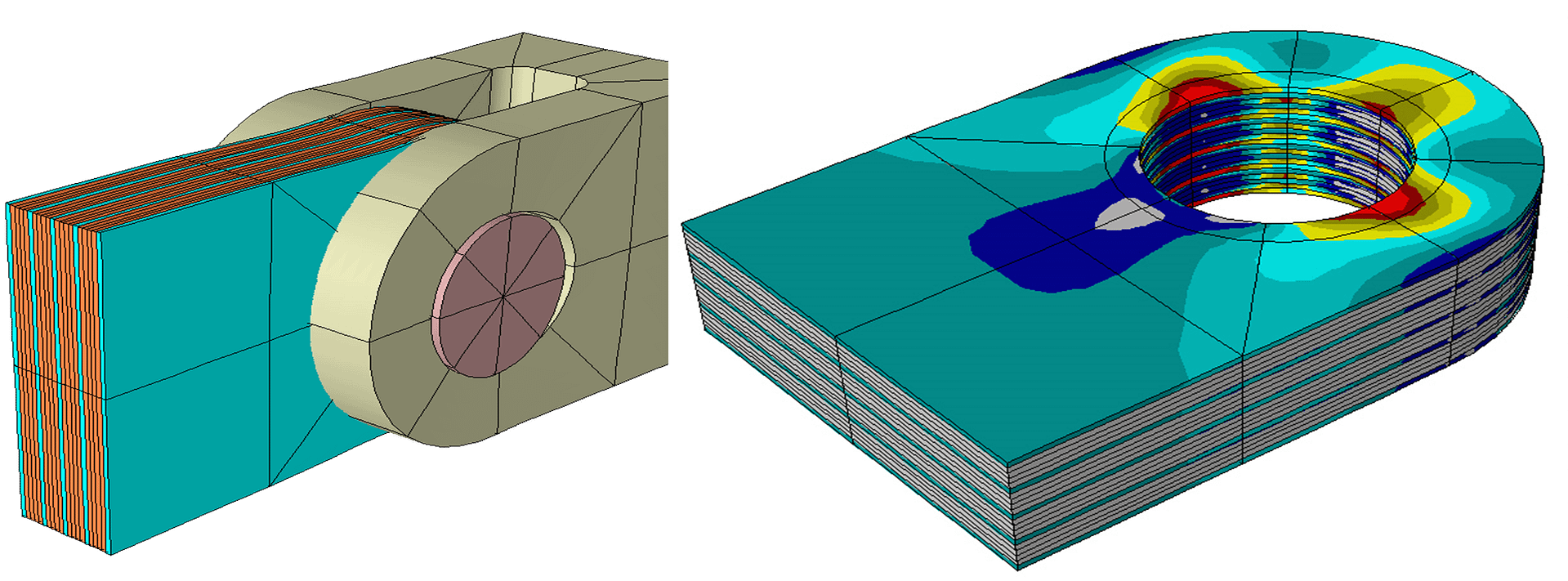
Figure 1: Lug-clevis-pin assembly. The lug is made of 16 fiber-matrix composite plies and 5 titanium plies. The model accounts for mechanical contact as well as the nonlinear deformation of the titanium plies. Solution verification was performed.

Notes on Tuning

On a sufficiently small domain of calibration any model, even a finite element model laden with variational crimes, can produce results that appear reasonable and can be tuned to match experimental observations. We use the term tuning to refer to the artful practice of balancing two large errors in such a way that they nearly cancel each other out. One error is conceptual:  Owing to variational crimes, the numerical solution does not converge to a limit value in the norm of the formulation as the number of degrees of freedom is increased. The other error is numerical: The discretization error is large enough to mask the conceptual error [4].

Tuning can be effective in structural problems, such as automobile crash dynamics and load models of airframes, where the force-displacement relationships are of interest.  Tuning is not effective, however, when the quantities of interest are stresses or strains at stress concentrations.  Therefore finite element modeling is not well suited for strength calculations.

Solution Verification is Mandatory

Solution verification is an essential technical requirement for democratization, model development, and applications of mathematical models.  Legacy FEA software products were not designed to meet this requirement. 

There is a general consensus that numerical simulation will have to be integrated with explainable artificial intelligence (XAI) tools.  This can be successful only if mathematical models are free from variational crimes.

The Main Points

Owing to limitations in their infrastructure, legacy finite element codes have not kept pace with important developments that occurred after the mid-1970s.

The practice of finite element modeling will have to be replaced by numerical simulation.  The changes will be forced by the technical requirements of XAI.

References

[1]  O. C. Zienkiewicz and Y. K. Cheung, The Finite Element Method in Structural and Continuum Mechanics, London: McGraw-Hill, 1967.

[2]  http://130.149.89.49:2080/v6.14/books/usb/default.htm

[3] G. Strang and G. J. Fix, An Analysis of the Finite Element Method, Englewood Cliffs, NJ: Prentice-Hall, 1973. [4] B. Szabό and I. Babuška, Finite Element Analysis: Method, Verification and Validation., 2nd ed., Hoboken, NJ: 2nd edition. John Wiley & Sons, Inc., 2021.

[4] B. Szabό and I. Babuška, Finite Element Analysis: Method, Verification and Validation., 2nd ed., Hoboken, NJ: 2nd edition. John Wiley & Sons, Inc., 2021.

Tags: Artificial IntelligenceFinite Element AnalysisFinite Element ModelingSolution Verification
1

You also might be interested in

S.A.F.E.R. Numerical Simulation for Structural Analysis in the Aerospace Industry Part 4: Simulation Governance
The Fairchild Republic A-10 Thunderbolt II is also known as the 'Warthog' and 'Tankbuster' due to its looks and role as a close support aircraft

S.A.F.E.R. Numerical Simulation for Structural Analysis in the Aerospace Industry Part 4: Simulation Governance

Feb 26, 2018

In this fourth of our multi-part series on “S.A.F.E.R. Numerical Simulation for Structural Analysis in the Aerospace Industry”, we will explore the topic of Simulation Governance, and why both simulation users and their managers on A&D programs should care. [...]

XAI Will Force Clear Thinking About the Nature of Mathematical Models

XAI Will Force Clear Thinking About the Nature of Mathematical Models

Nov 15, 2023

It is generally recognized that explainable artificial intelligence (XAI) will play an important role in numerical simulation where it will impose the requirements of reliability, traceability, and auditability. These requirements will necessitate clear thinking about the nature of mathematical models, the trustworthiness of their predictions, and ways to improve their reliability.

NAFEMS Coil Spring FEA Puzzler Solution Revealed
The finite element mesh used for the reference solution of the NAFEMS FEA Puzzler.

NAFEMS Coil Spring FEA Puzzler Solution Revealed

Sep 3, 2019

In NAFEMS' July 2019 edition of Benchmark Magazine, ESRD Chairman Dr. Barna Szabó reveals the converged StressCheck solution for the incremental spring rates, provides a summary of the FEA Puzzler respondent submissions, and documents the various approaches taken by the respondents.

Leave a Reply

We appreciate your feedback!
Cancel Reply

You must be logged in to post a comment.

Looking for Resources?

Interested in a Demo, Evaluation or Purchase?

Have a Software Question, Issue or Feature Request?

Recent News & Events

  • Trustworthiness in Simulation: Credibility or Decision-grade Reliability?
  • Beyond the Black Box: Explainable AI Requires Explainable Simulation
  • Turtle Shells and Legacy Finite Element Codes: Evolutionary Constraints in the Age of Explainable AI

Quick Links

  • Quick Start Guide
  • Documentation
  • Software FAQs
  • Software Demos

Testimonials

  • “Aerospace materials scientists and structural engineers now have a new state-of-the-art software product called StressCheck, which provides efficient and reliable analysis tools for composite bonded aircraft structures. A composites research team from the aeronautics industry, known as the Composites Affordability Initiative (CAI), has just completed an extensive study of current capabilities in the area of failure analysis tools for composite bonded joints. This study led the CAI team to unanimously choose StressCheck as the software tool to replace as well as radically improve existing industry standard software currently used to size bonded joints.”

    Air Force Research Laboratory (AFRL)

Testimonials

“Accurate and reliable stresses and Stress Intensity Factors are required for determination of static and residual strength and for crack growth analyses in analysis tools such as AFGROW. For some geometries, industry solutions are either insufficient or nonexistent. The geometry, applied forces, and crack shapes and dimensions must be modeled reasonably well to obtain useful engineering data. The p-version finite element software StressCheck (ESRD, Inc., St. Louis, Missouri, USA) is used to demonstrate how accurate finite element solutions can lead to good quality engineering analysis.”

, Analytical Processes/Engineering Solutions, Inc. (AP/ES)

Member Portal

  • Member Registration
  • Member Login

Contact Us

© 2026 · Engineering Software Research & Development, Inc. | Terms & Conditions | Privacy & Cookie Policy | Software License Agreement | Software Maintenance and Technical Support Policy

Prev Next

We use cookies on our website to give you the most relevant experience by remembering your preferences and repeat visits, as outlined in our Cookie Policy. You may adjust your cookie preferences within .

ESRD
Powered by  GDPR Cookie Compliance
Privacy Overview

This website uses cookies to improve your experience while you navigate through the website. Out of these, the cookies that are categorized as necessary are stored on your browser as they are essential for the working of basic functionalities of the website. We also use third-party cookies that help us analyze and understand how you use this website. These cookies will be stored in your browser only with your consent. You also have the option to opt-out of these cookies. But opting out of some of these cookies may affect your browsing experience.

Strictly Necessary Cookies

Strictly Necessary Cookies should be enabled at all times so that we can save your preferences for cookie settings.