• About
    • Who We Are
    • Partners & Providers
    • News & Events
    • The ESRD Blog
    • Careers
    • Contact Us
  • Applications
    • What We Solve
    • Detailed Stress
    • Composites
    • Fracture Mechanics
    • Residual Stress
    • Sim Apps
  • Products
    • What We Develop
    • StressCheck Professional
      • StressCheck Core
      • Solvers
      • Advanced Modules
      • Utilities
      • Academic Licensing
    • StressCheck Apps
      • CAE Handbook
      • StressCheck Tool Box
    • Product Updates
  • Support
    • How We Can Help
    • Training
    • Webinars
    • Quick Start Guide
    • Help Documentation
    • Software FAQ’s
  • Simulation
    • How We Simulate
    • Benchmarks
    • Simulation Governance
    • History of FEA
    • Dictionary & Terms
  • Resources
    • Browse Our Resource Library
    • White Papers
    • Case Studies
    • Product Demos
    • StressCheck Tutorials
Serving the Numerical Simulation community since 1989
  • Contact Us
  • Register
Login
Forgot Password?
Join Us
ESRDESRD
ESRDESRD
  • About
    • Who We Are
    • Partners & Providers
    • News & Events
    • The ESRD Blog
    • Careers
    • Contact Us
  • Applications
    • What We Solve
    • Detailed Stress
    • Composites
    • Fracture Mechanics
    • Residual Stress
    • Sim Apps
  • Products
    • What We Develop
    • StressCheck Professional
      • StressCheck Core
      • Solvers
      • Advanced Modules
      • Utilities
      • Academic Licensing
    • StressCheck Apps
      • CAE Handbook
      • StressCheck Tool Box
    • Product Updates
  • Support
    • How We Can Help
    • Training
    • Webinars
    • Quick Start Guide
    • Help Documentation
    • Software FAQ’s
  • Simulation
    • How We Simulate
    • Benchmarks
    • Simulation Governance
    • History of FEA
    • Dictionary & Terms
  • Resources
    • Browse Our Resource Library
    • White Papers
    • Case Studies
    • Product Demos
    • StressCheck Tutorials

Why Worry About Singularities?

Home The ESRD BlogWhy Worry About Singularities?

Why Worry About Singularities?

December 14, 2023 The ESRD Blog

By Dr. Barna Szabó
Engineering Software Research and Development, Inc.
St. Louis, Missouri USA


A mathematician delivered a keynote presentation at an engineering conference some years ago. At the coffee break, following the presentation, a highly respected senior developer of a legacy finite element code, remarked: “I do not understand why the speaker was so worried about singularities. We never see them.”

In the context of the keynote presentation, singularities were understood to be properties of the exact solutions of mathematical problems approximated by the finite element method. Singularities occur in points where the exact solution lacks differentiability or analyticity. The remark, on the other hand, was in the context of finite element modeling where a numerical problem is constructed without considering the underlying mathematical problem. The remark highlights the lack of a common language between the pre-scientific notion of finite element modeling and finite element analysis, which is a branch of applied mathematics.

Why Do Mathematicians Worry About Singularities?

Mathematicians understand finite element analysis (FEA) as a method for obtaining an approximation to the exact solution of a well-defined mathematical problem, such as a problem of elasticity, cast in variational form. Specifically, the finite element solution uFE converges to the exact solution uEX in a norm (which depends on the variational form) as the number of degrees of freedom N is increased. An important question is, how fast does it converge?  For most practical problems, convergence is quantified by the inequality:

||\boldsymbol u_{EX} -\boldsymbol u_{FE}||_E \le \frac{C}{N^{\beta}}  \quad (1)

where on the left is the energy norm measure of the difference between the exact and the finite element solution (which is closely related to the root-mean-square error in stress), C and β are positive constants, and β is called the rate of convergence. The size of β depends on the regularity (smoothness) of uEX and on the scheme used for increasing N. The details are available in textbooks, see (for example) [1].  The smoothness of uEX is quantified by a positive number λ. In many practical problems 0 < λ < 1.

For instance, consider the two-dimensional elasticity problem on the L-shaped domain, a frequently used benchmark problem, where λ equals 0.544. This is a manufactured problem with a known exact solution, allowing for the calculation of approximation errors [2].

Referring to Figure 1, if uniform mesh refinement is used at a fixed polynomial degree (h-extension) then β = λ/2 = 0.274. If the polynomial degree is increased on a fixed uniform mesh (p-extension) then β = λ = 0.544. If p-extension is used on a mesh that is graded in a geometric progression toward the singular point then, for large N, we still have β = λ = 0.544, however, convergence is much stronger at small N values.

Assume that we wish to reduce the relative error in energy norm to 1 percent. If we increase the polynomial degree uniformly (p-extension), on a geometrically graded mesh then we have to solve less than 103 simultaneous equations. In contrast, if we use a uniform mesh refinement and p = 2  (h-extension) then we have to solve about 107 equations. The ratio is roughly 104. It took less than one second on a desktop computer to solve 103 equations. If we assume that the solution time is proportional to the number of degrees of freedom squared, then achieving 1% relative error with uniform mesh refinement would take 108 seconds or 3.2 years. This shows that the errors of approximation can be controlled only through proper design of the discretization scheme, which involves taking the characteristics of the underlying mathematical problem into consideration.
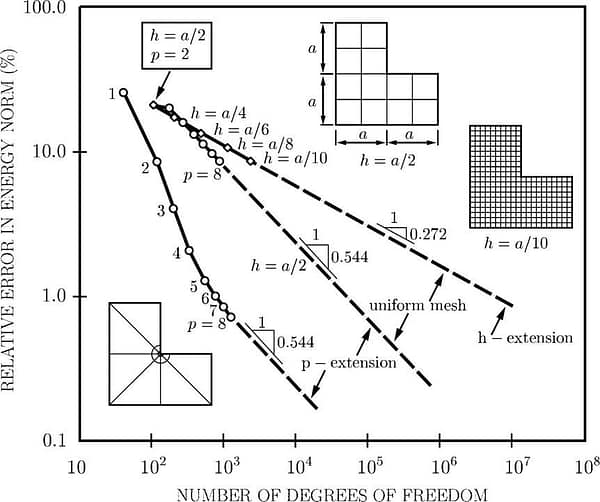
Figure 1: The L-shaped domain problem. Convergence curves for uniform mesh refinement at a fixed polynomial degree (h-extension), increasing polynomial degree on a fixed uniform mesh (p-extension), and increasing polynomial degree on a geometrically graded fixed finite element mesh consisting of 18 elements.

Why Should Engineers Worry About Singularities?

If the solution of the underlying mathematical problem has singular points, as in the case of the L-shaped domain problem, then the goal of the computation cannot be the determination of the maximum stress. The finite element solution predicts finite values for stress, however, the predicted stress increases as N is increased. The error in the maximum stress is infinitely large even if the root-mean-square error in stress on the entire domain is negligibly small. This is illustrated in Figure 2 where the von Mises stress corresponding to the finite element solution on the 18-element geometrically graded mesh and p = 8 is displayed.

In engineering applications of the finite element method, small geometric features, such as fillets, are often neglected, resulting in sharp corners and edges. This may be permissible outside of the domain of primary interest, however, the quantities of interest within the domain of primary interest may be polluted by errors coming from singular points or edges [3].
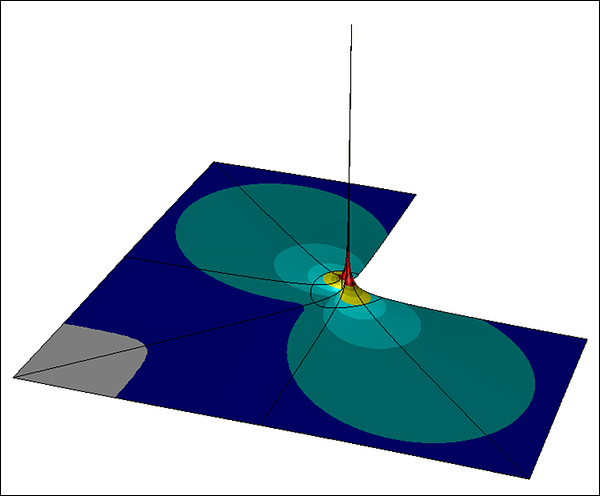
Figure 2: Contours of the von Mises stress corresponding the finite element solution on an 18-element geometrically graded mesh, p=8.

In this model problem, the singularity was caused by a sharp corner. Singularities can be caused by abrupt changes in material properties, loading, and constraint conditions as well.

Outlook

A high level of expertise is required for properly designing a discretization scheme. Experts take into consideration the information contained in the input data and use that information to estimate the regularity of the exact solution. This guides the design of the finite element mesh and the assignment of polynomial degrees.  Feedback information can be utilized to revise and update the discretization scheme when necessary [4].

Explainable artificial intelligence (XAI) tools can provide high-quality guidance in the design of the initial discretization, based on the information content of the input data, and in the management of feedback information. It’s essential, that these tools be trained on the scientific principles of finite element analysis.


References

[1] Szabό, B. and Babuška, I. Finite Element Analysis: Method, Verification and Validation., 2nd ed. John Wiley & Sons, Inc., 2021.

[2] Szabό, B. and Babuška, I. Finite Element Analysis. John Wiley & Sons, Inc., 1991.

[3] Babuška, I., Strouboulis, T., Upadhyay, C.S. and Gangaraj, S.K. A posteriori estimation and adaptive control of the pollution error in the h‐version of the finite element method. International Journal for Numerical Methods in Engineering, 38(24), pp. 4207-4235, 1995.

[4] Babuška, I. and Rank, E. An expert-system-like feedback approach in the hp-version of the finite element method. Finite Elements in Analysis and Design, 3(2), pp.127-147, 1987.


Related Blogs:

  • Where Do You Get the Courage to Sign the Blueprint?
  • A Memo from the 5th Century BC
  • Obstacles to Progress
  • Why Finite Element Modeling is Not Numerical Simulation?
  • XAI Will Force Clear Thinking About the Nature of Mathematical Models
  • The Story of the P-version in a Nutshell
Tags: Discretization Strategyerror controlExplainable Artificial IntelligenceFinite Element Analysisp-Convergence
0

You also might be interested in

A Low-Hanging Fruit: Smart Engineering Simulation Applications

A Low-Hanging Fruit: Smart Engineering Simulation Applications

Jan 19, 2024

Smart Engineering Simulation Applications, (SESA or Sim Apps), are software tools crafted by expert analysts to standardize recurring simulation tasks. Learn more about how Sim Apps and AI tools can work together to enhance engineering simulation workflows.

Lessons From a Failed Model Development Project

Lessons From a Failed Model Development Project

Apr 29, 2025

Some years ago, I attended a meeting of senior engineers at a Fortune 100 company. The topic of discussion was: What should be done about the significant discrepancies between outcomes predicted by finite element models and those observed in physical tests? The chief engineer, who called the meeting, vented his frustration, declaring he was tired of hearing that the finite element mesh was the problem. He no longer believed the predictions from finite element modeling and had lost confidence in the engineers who produced those results. How could this have been prevented?

Variational Crimes and Refloating the Costa Concordia

Variational Crimes and Refloating the Costa Concordia

Mar 25, 2025

In one of my conference presentations, I discussed variational crimes, noting that using point forces and point constraints in finite element analysis serves as examples of such crimes. In the question-and-answer session, I was asked: “If using point constraints is a variational crime, then how is it possible that the structure designed to refloat the Costa Concordia was full of those crimes and yet it worked just fine.” This question presented an opportunity for me to explain that finite element modeling (FEM) and finite element analysis (FEA) are complementary methods when analysts correctly understand their respective domains of application and use them accordingly. However, problems arise when FEM is used outside its scope, which is an all too frequent error.

Leave a Reply

We appreciate your feedback!
Cancel Reply

You must be logged in to post a comment.

Looking for Resources?

Interested in a Demo, Evaluation or Purchase?

Have a Software Question, Issue or Feature Request?

Recent News & Events

  • Trustworthiness in Simulation: Credibility or Decision-grade Reliability?
  • Beyond the Black Box: Explainable AI Requires Explainable Simulation
  • Turtle Shells and Legacy Finite Element Codes: Evolutionary Constraints in the Age of Explainable AI

Quick Links

  • Quick Start Guide
  • Documentation
  • Software FAQs
  • Software Demos

Testimonials

  • The capabilities available with BAMF, AFGROW and StressCheck are highly advanced and offer significant potential to achieve the high-level goal of TITANS –to reduce the need to conduct expensive and time consuming physical tests and to rely more on simulation.

    Dr. Kevin Walker
    Defence Science and Technology Group – Melbourne, Australia

Testimonials

When performing parametric structural analysis, ESRD’s p-element StressCheck FEA software is always my preferred choice due to the excellent solution quality, parametric framework, and superior computational efficiency. In fact, I recently used StressCheck to generate stress intensity factors along a parametrically defined elliptical crack-tip across 3,000 unique geometric configurations. Considering multi-body contact was present and all simulations were performed using a laptop, this was a task well suited for StressCheck.

Dr. Lee Zambino, Researcher, Villanova University

Member Portal

  • Member Registration
  • Member Login

Contact Us

© 2026 · Engineering Software Research & Development, Inc. | Terms & Conditions | Privacy & Cookie Policy | Software License Agreement | Software Maintenance and Technical Support Policy

Prev Next

We use cookies on our website to give you the most relevant experience by remembering your preferences and repeat visits, as outlined in our Cookie Policy. You may adjust your cookie preferences within .

ESRD
Powered by  GDPR Cookie Compliance
Privacy Overview

This website uses cookies to improve your experience while you navigate through the website. Out of these, the cookies that are categorized as necessary are stored on your browser as they are essential for the working of basic functionalities of the website. We also use third-party cookies that help us analyze and understand how you use this website. These cookies will be stored in your browser only with your consent. You also have the option to opt-out of these cookies. But opting out of some of these cookies may affect your browsing experience.

Strictly Necessary Cookies

Strictly Necessary Cookies should be enabled at all times so that we can save your preferences for cookie settings.