• About
    • Who We Are
    • Partners & Providers
    • News & Events
    • The ESRD Blog
    • Careers
    • Contact Us
  • Applications
    • What We Solve
    • Detailed Stress
    • Composites
    • Fracture Mechanics
    • Residual Stress
    • Sim Apps
  • Products
    • What We Develop
    • StressCheck Professional
      • StressCheck Core
      • Solvers
      • Advanced Modules
      • Utilities
      • Academic Licensing
    • StressCheck Apps
      • CAE Handbook
      • StressCheck Tool Box
    • Product Updates
  • Support
    • How We Can Help
    • Training
    • Webinars
    • Quick Start Guide
    • Help Documentation
    • Software FAQ’s
  • Simulation
    • How We Simulate
    • Benchmarks
    • Simulation Governance
    • History of FEA
    • Dictionary & Terms
  • Resources
    • Browse Our Resource Library
    • White Papers
    • Case Studies
    • Product Demos
    • StressCheck Tutorials
Serving the Numerical Simulation community since 1989
  • Contact Us
  • Register
Login
Forgot Password?
Join Us
ESRDESRD
ESRDESRD
  • About
    • Who We Are
    • Partners & Providers
    • News & Events
    • The ESRD Blog
    • Careers
    • Contact Us
  • Applications
    • What We Solve
    • Detailed Stress
    • Composites
    • Fracture Mechanics
    • Residual Stress
    • Sim Apps
  • Products
    • What We Develop
    • StressCheck Professional
      • StressCheck Core
      • Solvers
      • Advanced Modules
      • Utilities
      • Academic Licensing
    • StressCheck Apps
      • CAE Handbook
      • StressCheck Tool Box
    • Product Updates
  • Support
    • How We Can Help
    • Training
    • Webinars
    • Quick Start Guide
    • Help Documentation
    • Software FAQ’s
  • Simulation
    • How We Simulate
    • Benchmarks
    • Simulation Governance
    • History of FEA
    • Dictionary & Terms
  • Resources
    • Browse Our Resource Library
    • White Papers
    • Case Studies
    • Product Demos
    • StressCheck Tutorials

Altair Partner Webinar: Hyper-Fidelity Stress Analysis

Home EventsAltair Partner Webinar: Hyper-Fidelity Stress Analysis

Altair Partner Webinar: Hyper-Fidelity Stress Analysis

October 9, 2017 Events, Webinars

ESRD and Altair will be presenting a novel Aerospace & Defense (A&D) industry webinar, “Hyper-Fidelity Stress Analysis for S.A.F.E.R. Structural Simulation in the Aviation, Aerospace, and Defense Industries“, on October 17th at 10:00 am EDT.  Simulation Analysts, Design Engineers, Aerospace & Defense Professionals, Product Innovators and Engineering Group Managers who are responsible for the performance and quality of structural strength, stress, fatigue, and damage tolerant analysis should attend.

Here is a brief synopsis of the co-hosted webinar:

Creating and verifying finite element models which consistently deliver high-fidelity results though out a design space of varying geometric scales is challenging. This is especially true when the final design is not yet set and even small changes to the design, materials, loads, or general behavior can render a model (and corresponding mesh) that took days to create and debug obsolete.

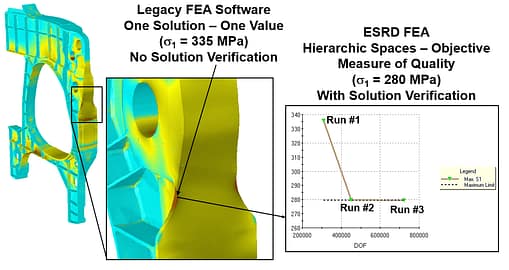
In this webinar we will share advancements in numerical simulation that make the performance of finite element analysis S.A.F.E.R. – Simple, Accurate, Fast, Efficient, and Reliable. An example engineering design problem from the aviation industry, requiring accurate results around stress concentrations to meet durability requirements for a long crack initiation life, will be presented.

If you would like to attend, please sign up for the webinar here.

We look forward to discussing how we can help improve your detailed stress analysis numerical simulations, and how you can incorporate S.A.F.E.R. Simulation in your projects.

Tags: AltairDetailed StressFatigueWebinar
0

You also might be interested in

What inhibits the use of FEA for DaDT applications in the A&D Industry?

What inhibits the use of FEA for DaDT applications in the A&D Industry?

Sep 18, 2017

In this “S.A.F.E.R. Simulation” post we will share the key[...]

Mastering StressCheck Webinar Coming Soon
Whereas most FEA is built on the technology of the 1950's and 1960's, StressCheck is built on active technology and proven to get the right answer faster.

Mastering StressCheck Webinar Coming Soon

Jan 8, 2020

ESRD is pleased to announce our first webinar of 2020, scheduled for February 12 @ 1:00 pm EST. This 2-hour, user-oriented webinar "Mastering StressCheck: Practical Training Approaches & Online Resources for A&D Engineers" will detail training approaches focused on applications to make numerical simulation via finite element analysis S.A.F.E.R. - Simple, Accurate, Fast, Efficient, and Reliable.

New Webinar: Simulation Governance Is Critical for Reliable Condition-Based (Predictive) Maintenance

New Webinar: Simulation Governance Is Critical for Reliable Condition-Based (Predictive) Maintenance

Apr 13, 2021

ESRD is pleased to announce a new webinar, scheduled for April 22, 2021 @ 11:00 am EST. This webinar, hosted by ESRD partner Revolution in Simulation, will present a case study in which the goal was the development of a mathematical model for supporting condition-based maintenance (CBM) decisions.

Leave a Reply

We appreciate your feedback!
Cancel Reply

You must be logged in to post a comment.

Looking for Resources?

Interested in a Demo, Evaluation or Purchase?

Have a Software Question, Issue or Feature Request?

Recent News & Events

  • Trustworthiness in Simulation: Credibility or Decision-grade Reliability?
  • Beyond the Black Box: Explainable AI Requires Explainable Simulation
  • Turtle Shells and Legacy Finite Element Codes: Evolutionary Constraints in the Age of Explainable AI

Quick Links

  • Quick Start Guide
  • Documentation
  • Software FAQs
  • Software Demos

Testimonials

  • “The addition of incremental theory of plasticity in StressCheck has greatly improved our ability to accurately predict the fatigue life of joints with interference fit fasteners and cold worked holes. This ability is especially important, not only in support of maintaining aging aircraft but also in analyzing some of the new cold working techniques that have been introduced in recent years.
    Prior to this implementation, analysts often relied on closed-form approximations or simple factors that were often overly conservative and sometimes even unconservative when used in life prediction. Now, not only can we more accurately predict residual stresses in these complex structural joints, but we can also do so in a timely manner given the modeling and analysis efficiency that exists with a p-version FEA code such as StressCheck.”

    F-15 Structures Manager
    The Boeing Company

Testimonials

“We have found StressCheck very useful for computational fracture mechanics for both metallic and composite components. In recent years it has been extensively used in determining beta factors for RAAF’s C-130 Wing DTA locations and associated generic research.”

Dr. Manfred Heller, Head - Structural Mechanics, DSTO

Member Portal

  • Member Registration
  • Member Login

Contact Us

© 2026 · Engineering Software Research & Development, Inc. | Terms & Conditions | Privacy & Cookie Policy | Software License Agreement | Software Maintenance and Technical Support Policy

Prev Next

We use cookies on our website to give you the most relevant experience by remembering your preferences and repeat visits, as outlined in our Cookie Policy. You may adjust your cookie preferences within .

ESRD
Powered by  GDPR Cookie Compliance
Privacy Overview

This website uses cookies to improve your experience while you navigate through the website. Out of these, the cookies that are categorized as necessary are stored on your browser as they are essential for the working of basic functionalities of the website. We also use third-party cookies that help us analyze and understand how you use this website. These cookies will be stored in your browser only with your consent. You also have the option to opt-out of these cookies. But opting out of some of these cookies may affect your browsing experience.

Strictly Necessary Cookies

Strictly Necessary Cookies should be enabled at all times so that we can save your preferences for cookie settings.