• About
    • Who We Are
    • Partners & Providers
    • News & Events
    • The ESRD Blog
    • Careers
    • Contact Us
  • Applications
    • What We Solve
    • Detailed Stress
    • Composites
    • Fracture Mechanics
    • Residual Stress
    • Sim Apps
  • Products
    • What We Develop
    • StressCheck Professional
      • StressCheck Core
      • Solvers
      • Advanced Modules
      • Utilities
      • Academic Licensing
    • StressCheck Apps
      • CAE Handbook
      • StressCheck Tool Box
    • Product Updates
  • Support
    • How We Can Help
    • Training
    • Webinars
    • Quick Start Guide
    • Help Documentation
    • Software FAQ’s
  • Simulation
    • How We Simulate
    • Benchmarks
    • Simulation Governance
    • History of FEA
    • Dictionary & Terms
  • Resources
    • Browse Our Resource Library
    • White Papers
    • Case Studies
    • Product Demos
    • StressCheck Tutorials
Serving the Numerical Simulation community since 1989
  • Contact Us
  • Register
Login
Forgot Password?
Join Us
ESRDESRD
ESRDESRD
  • About
    • Who We Are
    • Partners & Providers
    • News & Events
    • The ESRD Blog
    • Careers
    • Contact Us
  • Applications
    • What We Solve
    • Detailed Stress
    • Composites
    • Fracture Mechanics
    • Residual Stress
    • Sim Apps
  • Products
    • What We Develop
    • StressCheck Professional
      • StressCheck Core
      • Solvers
      • Advanced Modules
      • Utilities
      • Academic Licensing
    • StressCheck Apps
      • CAE Handbook
      • StressCheck Tool Box
    • Product Updates
  • Support
    • How We Can Help
    • Training
    • Webinars
    • Quick Start Guide
    • Help Documentation
    • Software FAQ’s
  • Simulation
    • How We Simulate
    • Benchmarks
    • Simulation Governance
    • History of FEA
    • Dictionary & Terms
  • Resources
    • Browse Our Resource Library
    • White Papers
    • Case Studies
    • Product Demos
    • StressCheck Tutorials

Second Edition of ESRD Co-Founders’ Finite Element Analysis Book Published

Home NewsSecond Edition of ESRD Co-Founders’ Finite Element Analysis Book Published

Second Edition of ESRD Co-Founders’ Finite Element Analysis Book Published

June 23, 2021 News, Publications, S.A.F.E.R. Simulation
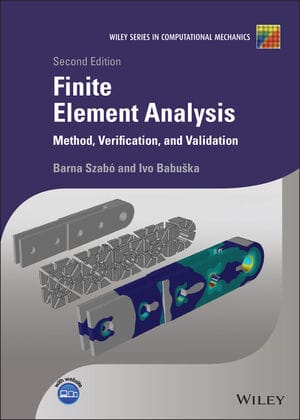
2nd Edition of Finite Element Analysis: Method, Verification and Validation (courtesy Wiley)

Recently, Wiley published the second edition of “Finite Element Analysis: Method, Verification and Validation” by ESRD Co-Founders Dr. Barna Szabo and Dr. Ivo Babuška as part of their “Wiley Series in Computational Mechanics“. This edition provides an updated and comprehensive review of the theoretical foundation of the finite element method, and provides engineering students and professionals the tools, concepts, techniques, and procedures that help with an understanding of finite element analysis.

The following description from Wiley’s website provides additional details on the goals of the new book:

The revised and updated second edition of Finite Element Analysis: Method, Verification, and Validation offers a comprehensive review of the theoretical foundations of the finite element method and highlights the fundamentals of solution verification, validation, and uncertainty quantification. Written by noted experts on the topic, the book covers the theoretical fundamentals as well as the algorithmic structure of the finite element method. The text contains numerous examples and helpful exercises that clearly illustrate the techniques and procedures needed for accurate estimation of the quantities of interest. In addition, the authors describe the technical requirements for the formulation and application of design rules.

To learn more about the new edition of the book (including access to multiple excerpts), to request a digital evaluation copy, and/or to purchase an e-book or hardcopy of the book, visit the book’s official homepage on Wiley’s site:

Visit Book Homepage

For a full list of publications regarding ESRD’s simulation technology and theoretical background, as well as additional publications by ESRD staff, visit our Simulation Technology References page.

1

You also might be interested in

ESRD Chairman Dr. Barna Szabó a Keynote Speaker at NAFEMS World Congress 2017

Apr 24, 2017

ESRD’s Chairman and Co-Founder, Dr. Barna Szabó, will be providing[...]

The Story of the P-version in a Nutshell
Norman Katz, Ivo Babuška and Barna Szabó.

The Story of the P-version in a Nutshell

Nov 30, 2023

The idea of achieving convergence by increasing the polynomial degree (p) of the approximating functions on a fixed mesh, known as the p-version of the finite element method, was at odds with the prevailing view in the finite element research community in the 1960s and 70s. But why?

XAI Will Force Clear Thinking About the Nature of Mathematical Models

XAI Will Force Clear Thinking About the Nature of Mathematical Models

Nov 15, 2023

It is generally recognized that explainable artificial intelligence (XAI) will play an important role in numerical simulation where it will impose the requirements of reliability, traceability, and auditability. These requirements will necessitate clear thinking about the nature of mathematical models, the trustworthiness of their predictions, and ways to improve their reliability.

Leave a Reply

We appreciate your feedback!
Cancel Reply

You must be logged in to post a comment.

Looking for Resources?

Interested in a Demo, Evaluation or Purchase?

Have a Software Question, Issue or Feature Request?

Recent News & Events

  • Trustworthiness in Simulation: Credibility or Decision-grade Reliability?
  • Beyond the Black Box: Explainable AI Requires Explainable Simulation
  • Turtle Shells and Legacy Finite Element Codes: Evolutionary Constraints in the Age of Explainable AI

Quick Links

  • Quick Start Guide
  • Documentation
  • Software FAQs
  • Software Demos

Testimonials

  • “Hearty congratulations to management and staff at ESRD on their 25th anniversary. The quality and capability of their software products are excellent. I hope that ESRD successfully continues for many more years with the fundamental principles of mathematical precision, numerical accuracy, and integrity in computational simulation.”

    Dr. William Oberkampf
    Author of Verification and Validation in Scientific Computing

Testimonials

“We have been having very good success using the P-Version finite element code, StressCheck, to develop the 2-D solutions for two independent cracks in a plate. I have asked one of our AFGROW team members to model the plate and lug cases using StressCheck and compare them to the existing AFGROW closed-form solutions. [He] modeled the cases several different ways to be sure that he was getting the best possible solutions. He has verified that the bearing load option in StressCheck provides excellent results.”

Jim Harter, Team Leader-Analytical Fatigue/Fracture Reliability Team Air Force Research Laboratory (AFRL)

Member Portal

  • Member Registration
  • Member Login

Contact Us

© 2026 · Engineering Software Research & Development, Inc. | Terms & Conditions | Privacy & Cookie Policy | Software License Agreement | Software Maintenance and Technical Support Policy

Prev Next

We use cookies on our website to give you the most relevant experience by remembering your preferences and repeat visits, as outlined in our Cookie Policy. You may adjust your cookie preferences within .

ESRD
Powered by  GDPR Cookie Compliance
Privacy Overview

This website uses cookies to improve your experience while you navigate through the website. Out of these, the cookies that are categorized as necessary are stored on your browser as they are essential for the working of basic functionalities of the website. We also use third-party cookies that help us analyze and understand how you use this website. These cookies will be stored in your browser only with your consent. You also have the option to opt-out of these cookies. But opting out of some of these cookies may affect your browsing experience.

Strictly Necessary Cookies

Strictly Necessary Cookies should be enabled at all times so that we can save your preferences for cookie settings.