• About
    • Who We Are
    • Partners & Providers
    • News & Events
    • The ESRD Blog
    • Careers
    • Contact Us
  • Applications
    • What We Solve
    • Detailed Stress
    • Composites
    • Fracture Mechanics
    • Residual Stress
    • Sim Apps
  • Products
    • What We Develop
    • StressCheck Professional
      • StressCheck Core
      • Solvers
      • Advanced Modules
      • Utilities
      • Academic Licensing
    • StressCheck Apps
      • CAE Handbook
      • StressCheck Tool Box
    • Product Updates
  • Support
    • How We Can Help
    • Training
    • Webinars
    • Quick Start Guide
    • Help Documentation
    • Software FAQ’s
  • Simulation
    • How We Simulate
    • Benchmarks
    • Simulation Governance
    • History of FEA
    • Dictionary & Terms
  • Resources
    • Browse Our Resource Library
    • White Papers
    • Case Studies
    • Product Demos
    • StressCheck Tutorials
Serving the Numerical Simulation community since 1989
  • Contact Us
  • Register
Login
Forgot Password?
Join Us
ESRDESRD
ESRDESRD
  • About
    • Who We Are
    • Partners & Providers
    • News & Events
    • The ESRD Blog
    • Careers
    • Contact Us
  • Applications
    • What We Solve
    • Detailed Stress
    • Composites
    • Fracture Mechanics
    • Residual Stress
    • Sim Apps
  • Products
    • What We Develop
    • StressCheck Professional
      • StressCheck Core
      • Solvers
      • Advanced Modules
      • Utilities
      • Academic Licensing
    • StressCheck Apps
      • CAE Handbook
      • StressCheck Tool Box
    • Product Updates
  • Support
    • How We Can Help
    • Training
    • Webinars
    • Quick Start Guide
    • Help Documentation
    • Software FAQ’s
  • Simulation
    • How We Simulate
    • Benchmarks
    • Simulation Governance
    • History of FEA
    • Dictionary & Terms
  • Resources
    • Browse Our Resource Library
    • White Papers
    • Case Studies
    • Product Demos
    • StressCheck Tutorials

Standard NAFEMS Benchmark Solutions Coming Soon

Home Resource LibraryNew ResourceStandard NAFEMS Benchmark Solutions Coming Soon

Standard NAFEMS Benchmark Solutions Coming Soon

January 23, 2018 New Resource, News, Resource Library

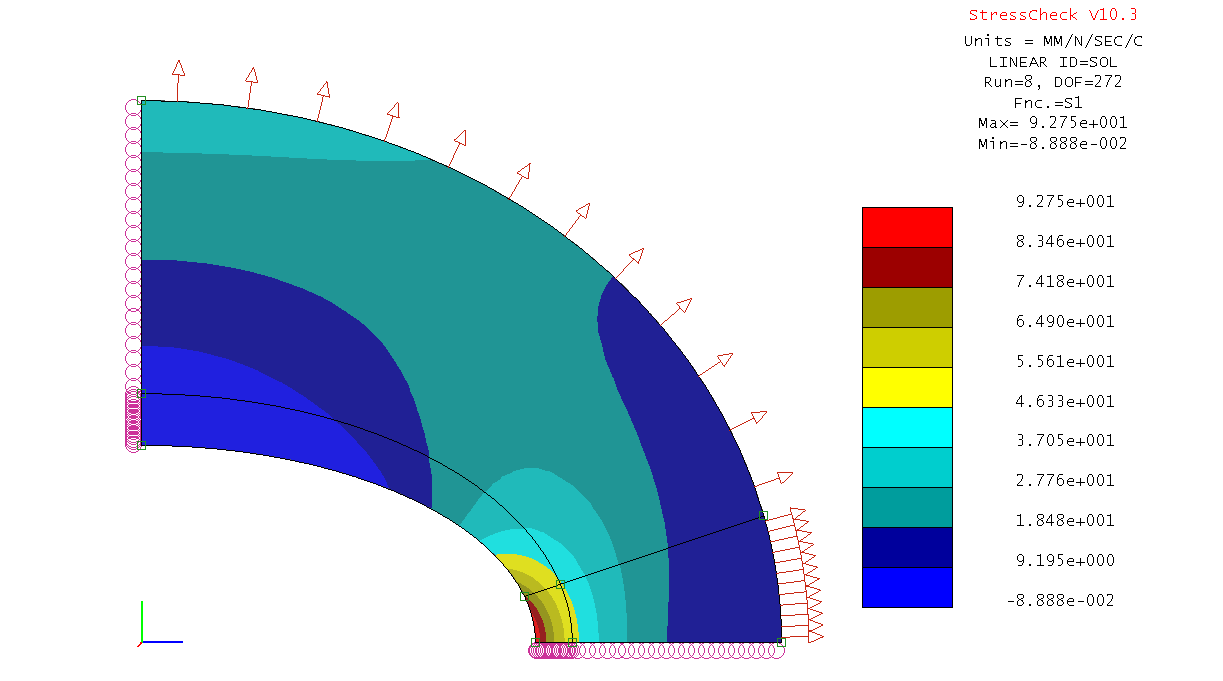
The Standard NAFEMS Benchmarks: LE1 Solution Fringe Plot

In the coming weeks, ESRD will publish our first set of FEA-based numerical simulation results from “The Standard NAFEMS Benchmark Solutions“.  Our initial publication will focus on the Linear Elastic (LE) benchmarks from this reference.

All of ESRD’s solutions were modeled and solved in StressCheck Professional, with the minimum meshes necessary to achieve convergence in the data of interest, as well as denser meshes for comparison.  Benchmarking against any reference solution is not useful unless the numerical simulation’s discretization errors are proven to be small, a feature inherent to ESRD’s Numerical Simulation technology.

Check back shortly on our ESRD Benchmarks page and stayed tuned to ESRD News for updates on these NAFEMS benchmark solutions.

Benchmark Suggestion?  We’re Up to the Challenge!

Do you have a benchmark solution, NAFEMS or otherwise, you would like us to solve?  Fill out the below form, and if the benchmark request is within our capabilities, your benchmark may be considered by ESRD for future publication:

If other please specify in the message.
If a benchmark already exists, please include the details in your message.
Loading
Tags: BenchmarksNAFEMSResource LibraryStressCheck
2

You also might be interested in

Altair Partner Webinar: Global-Local Workflows and High-Fidelity Stress Analysis for a Wing Flap Hinge Fitting
Model courtesy of Altair.

Altair Partner Webinar: Global-Local Workflows and High-Fidelity Stress Analysis for a Wing Flap Hinge Fitting

Mar 12, 2018

ESRD and Altair will be presenting a novel Aerospace & Defense (A&D) industry webinar, "Global-Local Workflows and High-Fidelity Stress Analysis for a Wing Flap Hinge Fitting", on April 10th at 10:00 am EDT. Learn more [...]

StressCheck v11.1 is Officially Released!

StressCheck v11.1 is Officially Released!

Aug 4, 2022

With the release of StressCheck v11.1, we have made tremendous improvements to model rendering, load arrow drawing and load record updating performances to provide the user with maximum efficiency. This release also provides new mixed element meshing functionality in the Crack Front and Boundary Layer methods as well as the all-new Thin Section method, which allow the user to utilize pentahedral and hexahedral elements together with a traditional all-tetrahedral automesh. These improved, high-quality meshes can provide the user more accurate results with less computational cost, especially for fracture and contact problems. StressCheck v11.1 also boasts improvements for Global-Local analysis in the form of TLAP scaling parameters and improved GUI options for point load/constraint rendering, as well as updates to the COM API functionality and the StressCheck Offline Documentation.

StressCheck v10.5, CAE Handbook v10.5 and StressCheck Tool Box 4.5 Released!

StressCheck v10.5, CAE Handbook v10.5 and StressCheck Tool Box 4.5 Released!

Jun 12, 2019

In case you missed it, we are pleased to announce that we've released product updates for StressCheck Professional and StressCheck-Powered Apps!  Many customer-defined enhancements were added, and the software user experience improved.

Leave a Reply

We appreciate your feedback!
Cancel Reply

You must be logged in to post a comment.

Looking for Resources?

Interested in a Demo, Evaluation or Purchase?

Have a Software Question, Issue or Feature Request?

Recent News & Events

  • Trustworthiness in Simulation: Credibility or Decision-grade Reliability?
  • Beyond the Black Box: Explainable AI Requires Explainable Simulation
  • Turtle Shells and Legacy Finite Element Codes: Evolutionary Constraints in the Age of Explainable AI

Quick Links

  • Quick Start Guide
  • Documentation
  • Software FAQs
  • Software Demos

Testimonials

  • “The addition of incremental theory of plasticity in StressCheck has greatly improved our ability to accurately predict the fatigue life of joints with interference fit fasteners and cold worked holes. This ability is especially important, not only in support of maintaining aging aircraft but also in analyzing some of the new cold working techniques that have been introduced in recent years.
    Prior to this implementation, analysts often relied on closed-form approximations or simple factors that were often overly conservative and sometimes even unconservative when used in life prediction. Now, not only can we more accurately predict residual stresses in these complex structural joints, but we can also do so in a timely manner given the modeling and analysis efficiency that exists with a p-version FEA code such as StressCheck.”

    F-15 Structures Manager
    The Boeing Company

Testimonials

“We have been having very good success using the P-Version finite element code, StressCheck, to develop the 2-D solutions for two independent cracks in a plate. I have asked one of our AFGROW team members to model the plate and lug cases using StressCheck and compare them to the existing AFGROW closed-form solutions. [He] modeled the cases several different ways to be sure that he was getting the best possible solutions. He has verified that the bearing load option in StressCheck provides excellent results.”

Jim Harter, Team Leader-Analytical Fatigue/Fracture Reliability Team Air Force Research Laboratory (AFRL)

Member Portal

  • Member Registration
  • Member Login

Contact Us

© 2026 · Engineering Software Research & Development, Inc. | Terms & Conditions | Privacy & Cookie Policy | Software License Agreement | Software Maintenance and Technical Support Policy

Prev Next

We use cookies on our website to give you the most relevant experience by remembering your preferences and repeat visits, as outlined in our Cookie Policy. You may adjust your cookie preferences within .

ESRD
Powered by  GDPR Cookie Compliance
Privacy Overview

This website uses cookies to improve your experience while you navigate through the website. Out of these, the cookies that are categorized as necessary are stored on your browser as they are essential for the working of basic functionalities of the website. We also use third-party cookies that help us analyze and understand how you use this website. These cookies will be stored in your browser only with your consent. You also have the option to opt-out of these cookies. But opting out of some of these cookies may affect your browsing experience.

Strictly Necessary Cookies

Strictly Necessary Cookies should be enabled at all times so that we can save your preferences for cookie settings.