• About
    • Who We Are
    • Partners & Providers
    • News & Events
    • The ESRD Blog
    • Careers
    • Contact Us
  • Applications
    • What We Solve
    • Detailed Stress
    • Composites
    • Fracture Mechanics
    • Residual Stress
    • Sim Apps
  • Products
    • What We Develop
    • StressCheck Professional
      • StressCheck Core
      • Solvers
      • Advanced Modules
      • Utilities
      • Academic Licensing
    • StressCheck Apps
      • CAE Handbook
      • StressCheck Tool Box
    • Product Updates
  • Support
    • How We Can Help
    • Training
    • Webinars
    • Quick Start Guide
    • Help Documentation
    • Software FAQ’s
  • Simulation
    • How We Simulate
    • Benchmarks
    • Simulation Governance
    • History of FEA
    • Dictionary & Terms
  • Resources
    • Browse Our Resource Library
    • White Papers
    • Case Studies
    • Product Demos
    • StressCheck Tutorials
Serving the Numerical Simulation community since 1989
  • Contact Us
  • Register
Login
Forgot Password?
Join Us
ESRDESRD
ESRDESRD
  • About
    • Who We Are
    • Partners & Providers
    • News & Events
    • The ESRD Blog
    • Careers
    • Contact Us
  • Applications
    • What We Solve
    • Detailed Stress
    • Composites
    • Fracture Mechanics
    • Residual Stress
    • Sim Apps
  • Products
    • What We Develop
    • StressCheck Professional
      • StressCheck Core
      • Solvers
      • Advanced Modules
      • Utilities
      • Academic Licensing
    • StressCheck Apps
      • CAE Handbook
      • StressCheck Tool Box
    • Product Updates
  • Support
    • How We Can Help
    • Training
    • Webinars
    • Quick Start Guide
    • Help Documentation
    • Software FAQ’s
  • Simulation
    • How We Simulate
    • Benchmarks
    • Simulation Governance
    • History of FEA
    • Dictionary & Terms
  • Resources
    • Browse Our Resource Library
    • White Papers
    • Case Studies
    • Product Demos
    • StressCheck Tutorials

ESRD Participates in the Engineered Residual Stress Implementation (ERSI) Workshop 2018

Home EventsConferenceESRD Participates in the Engineered Residual Stress Implementation (ERSI) Workshop 2018

ESRD Participates in the Engineered Residual Stress Implementation (ERSI) Workshop 2018

October 8, 2018 Conference, Events, News, Publications

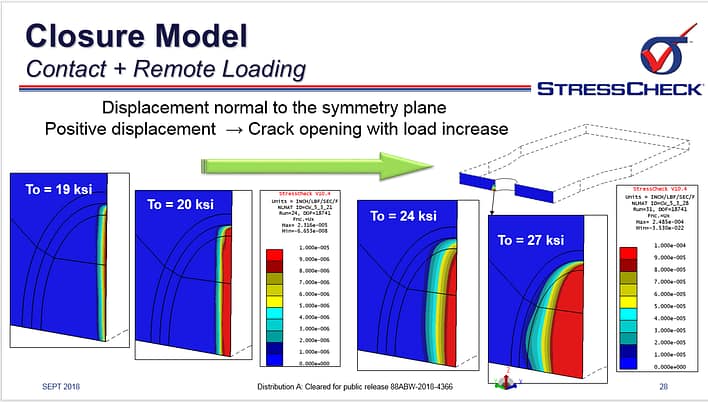
Corner crack at the edge of the hole inserted after cold-working. Contour show the progression of crack opening as the external load is increased from 0 to 27 ksi. First noticeable crack opening appears around 19 ksi.

ESRD’s Dr. Ricardo Actis attended and presented with technology partner Analytical Processes/Engineered Solutions (AP/ES) at the Engineered Residual Stress Implementation (ERSI) Workshop 2018 in Clearfield, UT.  This annual workshop is focused on the development of a damage tolerance methodologies for fatigue crack growth through deep Engineered Residual Stress (ERS) fields.

Sponsored by the US Air Force’s A-10 Airframe Structural Integrity Program (ASIP), the goal of this workshop is to develop a roadmap for the implementation of the beneficial effect of engineered residual stresses within the United States Air Force (USAF) Damage Tolerance Analysis (DTA) fatigue crack growth and lifing programs.

At ERSI Workshop 2018, Dr. Ricardo Actis (ESRD) and Dr. Thomas Mills, Dr. Scott Prost-Domasky, and Mr. Craig Brooks (AP/ES) presented “RS Crack Closure: Experimental Observations and Modeling”, the PDF of which can be downloaded below:

Download PDF


The ERSI Workshop 2018 attendees are shown below:
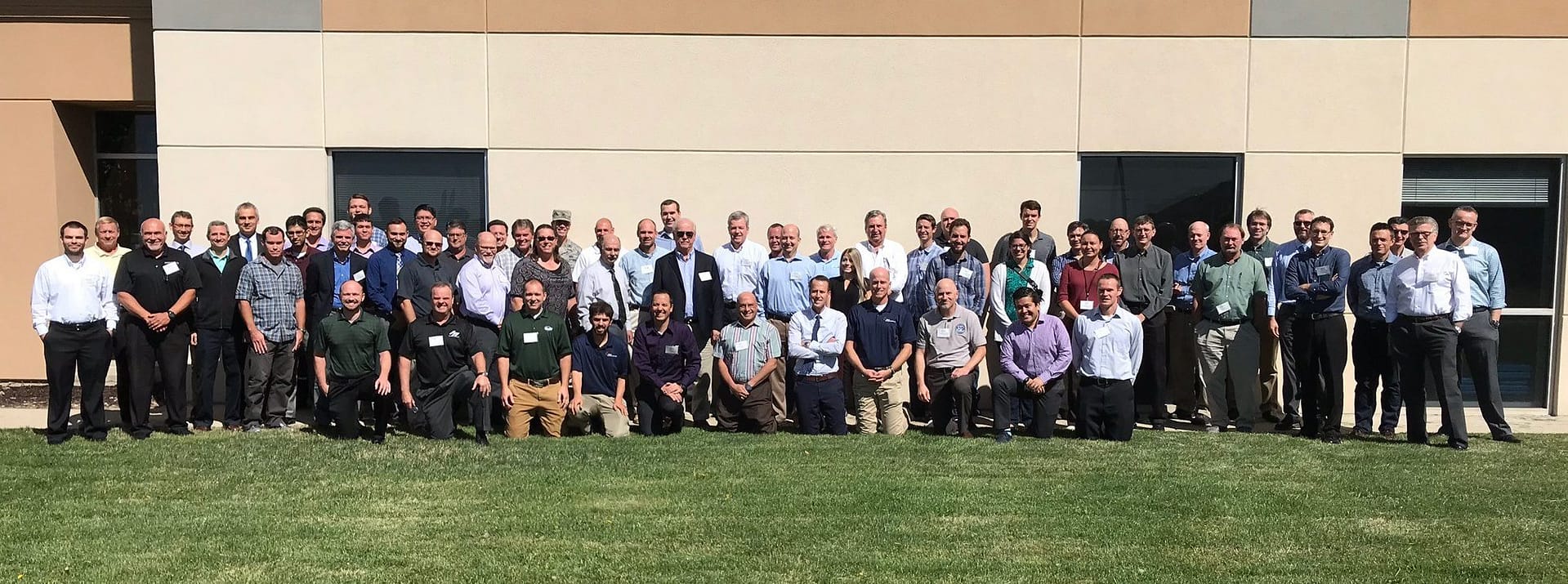
Attendees to the Third ERSI Workshop.

ESRD, Inc. continues to work closely with AP/ES and the USAF to develop and implement accurate solutions for challenging Durability and Damage Tolerant applications.

Tags: Aerospace and DefenseCrack GrowthDaDTERSIFatigueFractureResidual StressWorkshop
0

You also might be interested in

ASIP 2019 Conference Recap
ESRD's Brent Lancaster prepares to discuss StressCheck with attendees during a break at ASIP 2019.

ASIP 2019 Conference Recap

Dec 10, 2019

This past week at ASIP 2019, ESRD provided a training course titled "Automated 3D Crack Beta Curve Development via Smart Sim Apps", chatted with ASIP attendees, provided a StressCheck Clinic, and exhibited at our booth. Read the summary of events and download the ASIP training course presentation and beta factor Sim Apps!

S.A.F.E.R. Numerical Simulation for Structural Analysis in the Aerospace Industry Part 3: FEM is not Numerical Simulation
Gulfstream's G650 private jet airplane flying in sky.

S.A.F.E.R. Numerical Simulation for Structural Analysis in the Aerospace Industry Part 3: FEM is not Numerical Simulation

Jan 29, 2018

In this third of our multi-part series on “S.A.F.E.R. Numerical Simulation for Structural Analysis in the Aerospace Industry” we will examine why Numerical Simulation is not the same as Finite Element Modeling and what this means to the structural analysis function within the A&D industry. [...]

‘3D Crack Growth Simulation: Advancements & Applications’ Webinar Recording Now Available
Demo of BAMF as run through an AFGROW plug-in (courtesy Hill Engineering)

‘3D Crack Growth Simulation: Advancements & Applications’ Webinar Recording Now Available

Jul 23, 2019

On July 17, 2019 a joint webinar on the latest developments in FEA-based 3D crack growth simulation, titled “3D Crack Growth Simulation: Advancements & Applications”, was provided by ESRD’s Brent Lancaster, LexTech's James Harter and Hill Engineering's Joshua Hodges. In case you missed it, the webinar recording is now available!

Leave a Reply

We appreciate your feedback!
Cancel Reply

You must be logged in to post a comment.

Looking for Resources?

Interested in a Demo, Evaluation or Purchase?

Have a Software Question, Issue or Feature Request?

Recent News & Events

  • Trustworthiness in Simulation: Credibility or Decision-grade Reliability?
  • Beyond the Black Box: Explainable AI Requires Explainable Simulation
  • Turtle Shells and Legacy Finite Element Codes: Evolutionary Constraints in the Age of Explainable AI

Quick Links

  • Quick Start Guide
  • Documentation
  • Software FAQs
  • Software Demos

Testimonials

  • “Accurate and reliable stresses and Stress Intensity Factors are required for determination of static and residual strength and for crack growth analyses in analysis tools such as AFGROW. For some geometries, industry solutions are either insufficient or nonexistent. The geometry, applied forces, and crack shapes and dimensions must be modeled reasonably well to obtain useful engineering data. The p-version finite element software StressCheck (ESRD, Inc., St. Louis, Missouri, USA) is used to demonstrate how accurate finite element solutions can lead to good quality engineering analysis.”

    Analytical Processes/Engineering Solutions, Inc. (AP/ES)

Testimonials

“Through the use of StressCheck the A-10 Aircraft Structural Integrity Program’s (ASIP) Analysis Group is able to model more accurately the physics of fatigue crack propagation in critical aircraft structure.  Through this tool we are able to model, analyze and predict failure of aircraft structure and then develop crucial inspection and maintenance planes to ensure the safety and sustainability of our nations warplanes.  Without the analysis capability provided to us through StressCheck we would not be able to provide accurate assessments of the A-10 structure to top USAF leadership.”

SWRI Research Engineer, Southwest Research Institute

Member Portal

  • Member Registration
  • Member Login

Contact Us

© 2026 · Engineering Software Research & Development, Inc. | Terms & Conditions | Privacy & Cookie Policy | Software License Agreement | Software Maintenance and Technical Support Policy

Prev Next

We use cookies on our website to give you the most relevant experience by remembering your preferences and repeat visits, as outlined in our Cookie Policy. You may adjust your cookie preferences within .

ESRD
Powered by  GDPR Cookie Compliance
Privacy Overview

This website uses cookies to improve your experience while you navigate through the website. Out of these, the cookies that are categorized as necessary are stored on your browser as they are essential for the working of basic functionalities of the website. We also use third-party cookies that help us analyze and understand how you use this website. These cookies will be stored in your browser only with your consent. You also have the option to opt-out of these cookies. But opting out of some of these cookies may affect your browsing experience.

Strictly Necessary Cookies

Strictly Necessary Cookies should be enabled at all times so that we can save your preferences for cookie settings.