• About
    • Who We Are
    • Partners & Providers
    • News & Events
    • The ESRD Blog
    • Careers
    • Contact Us
  • Applications
    • What We Solve
    • Detailed Stress
    • Composites
    • Fracture Mechanics
    • Residual Stress
    • Sim Apps
  • Products
    • What We Develop
    • StressCheck Professional
      • StressCheck Core
      • Solvers
      • Advanced Modules
      • Utilities
      • Academic Licensing
    • StressCheck Apps
      • CAE Handbook
      • StressCheck Tool Box
    • Product Updates
  • Support
    • How We Can Help
    • Training
    • Webinars
    • Quick Start Guide
    • Help Documentation
    • Software FAQ’s
  • Simulation
    • How We Simulate
    • Benchmarks
    • Simulation Governance
    • History of FEA
    • Dictionary & Terms
  • Resources
    • Browse Our Resource Library
    • White Papers
    • Case Studies
    • Product Demos
    • StressCheck Tutorials
Serving the Numerical Simulation community since 1989
  • Contact Us
  • Register
Login
Forgot Password?
Join Us
ESRDESRD
ESRDESRD
  • About
    • Who We Are
    • Partners & Providers
    • News & Events
    • The ESRD Blog
    • Careers
    • Contact Us
  • Applications
    • What We Solve
    • Detailed Stress
    • Composites
    • Fracture Mechanics
    • Residual Stress
    • Sim Apps
  • Products
    • What We Develop
    • StressCheck Professional
      • StressCheck Core
      • Solvers
      • Advanced Modules
      • Utilities
      • Academic Licensing
    • StressCheck Apps
      • CAE Handbook
      • StressCheck Tool Box
    • Product Updates
  • Support
    • How We Can Help
    • Training
    • Webinars
    • Quick Start Guide
    • Help Documentation
    • Software FAQ’s
  • Simulation
    • How We Simulate
    • Benchmarks
    • Simulation Governance
    • History of FEA
    • Dictionary & Terms
  • Resources
    • Browse Our Resource Library
    • White Papers
    • Case Studies
    • Product Demos
    • StressCheck Tutorials

Happy Holidays from ESRD (2021 Edition)

Home EventsConferenceHappy Holidays from ESRD (2021 Edition)

Happy Holidays from ESRD (2021 Edition)

December 22, 2021 Conference, Events, News, Partnerships, Product Updates, Publications, Webinars
Geometry courtesy Radu Octavian, GrabCAD.

While this past year continued to present unique challenges and unprecedented disturbances, we hope that you found our customer support, on-demand webinars, web-based training services and overall experience with our team to be refreshingly positive. It is our pleasure to serve you, and we look forward to what the next year brings!

The following are a few highlights we’d like to share:

ASIP Conference 2021 Impressions…

In late November 2021, ESRD exhibited at the ASIP Conference and had a blast re-connecting with StressCheck users, DaDT colleagues and our partners Hill Engineering (BAMpF 3D fatigue crack growth software developers) and LexTech (AFGROW developers). We also provided a training course on standardization and automation of DaDT solutions via StressCheck-based Sim Apps.

Read more about our conference proceedings here.

New Edition of Wiley’s Finite Element Analysis Released…

In June 2021,  Wiley published the second edition of “Finite Element Analysis: Method, Verification and Validation” by ESRD Co-Founders Dr. Barna Szabo and Dr. Ivo Babuška as part of their “Wiley Series in Computational Mechanics“. This edition provides an updated and comprehensive review of the theoretical foundation of the finite element method, and provides engineering students and professionals the tools, concepts, techniques, and procedures that help with an understanding of finite element analysis.

For more information on the new edition, click here.

Live Web-Based Training Options Expanded…

With engineers continuing to work mostly from home or in limited-capacity office settings, we expanded and refined our web-based StressCheck training options to provide more clarity on our supported DaDT features. In addition to revising our successful web-based Intro to StressCheck course, we also developed and deployed a web-based version of our Advanced Training in Fracture Mechanics course. This advanced StressCheck training course focuses on DaDT applications for which StressCheck is well-suited, as well as modeling, analysis and extraction best practices for 2D and 3D crack modeling.

Even though we could not be face-to-face, it was a pleasure connecting with our users via webcam/audio and helping them achieve proficiency with StressCheck’s features.

For more information on scheduling a live web-based training, click here.

Enhanced DaDT Analysis Features In Development…
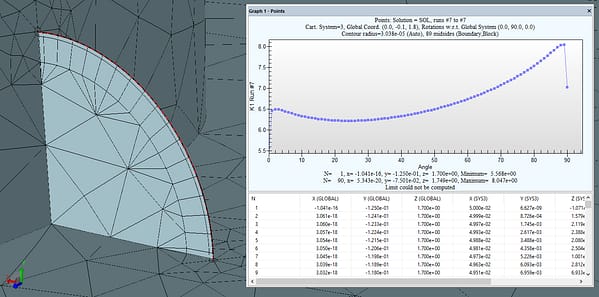
Since the release of StressCheck v11 Update 1 in June 2021, we have been hard at work in preparing for the release of StressCheck v11.1. With this forthcoming release (expected in mid-2022), we are focusing on significant improvements to 3D crack front automeshes and SIF extractions (mixed tetra/penta/hexa meshes are now supported!!) as well as scaling features for imported global loads (TLAPs can now be scaled via parameters in linear or nonlinear analysis!!).

Live Webinar Coming Soon

In Q1 2022, we are planning for a live webinar to preview StressCheck’s new DaDT and TLAP scaling enhancements, and answer questions about the upcoming release of StressCheck v11.1.

Pre-register for the “New and Improved Features for 3D Fracture Mechanics Analysis in StressCheck” webinar:

Once a date/time is announced, you will be notified with more details about the webinar. Stay tuned!

Preview: Mixed Boundary Layer Automesh and SIF Extraction Improvements

The following is a brief demo of the mixed boundary layer automeshing feature (with SIF comparisons) coming soon in StressCheck v11.1:

  • 0:00-1:20 mark – Two all-tetrahedral element boundary layers are automeshed around the crack front of a 180 degree embedded ellipse using the original Crack Front method available in v11.0.
    • The model is then solved at p=4 (for demonstration purposes) and the SIF distribution along the crack front is extracted using Radius = AUTO.
  • 1:21-2:44 mark – Four pentahedral/hexahedral element boundary layers are automeshed around the crack front of a 180 degree embedded ellipse using the new Crack Front method available in v11.1 (and StressCheck v11 Update 1 for beta testing).
    • The model is re-solved solved at p=4 (for demonstration purposes) and the SIF distribution along the crack front is re-extracted using Radius = AUTO.
  • 2:45-3:43 mark – The two SIF distributions are compared, with the new Crack Front automeshing method demonstrating clear improvements in efficiency and quality.


Wishing for Good Tidings and Good Health

Finally, we’d like to wish all of our customers, partners and friends Happy/Safe Holidays and a Happier/Healthier 2022!

Keep up with the latest from ESRD by subscribing to our newsletter:

=
Loading
Tags: CommunityNumerical SimulationStressCheckWebinar
7

You also might be interested in

ESRD @ ASIP 2018 Summary
ESRD's Brent Lancaster chats with ASIP 2018 attendees.

ESRD @ ASIP 2018 Summary

Dec 5, 2018

This past week at ASIP 2018, ESRD provided a training course titled "Modeling Fastened Connections: Hierarchic Approaches Discussion and Demo", chatted with ASIP attendees, provided StressCheck demos, and exhibited at our booth. Read the summary of events and download the ASIP training course presentation, demo video and selected StressCheck model files!

StressCheck v11.1 is Officially Released!

StressCheck v11.1 is Officially Released!

Aug 4, 2022

With the release of StressCheck v11.1, we have made tremendous improvements to model rendering, load arrow drawing and load record updating performances to provide the user with maximum efficiency. This release also provides new mixed element meshing functionality in the Crack Front and Boundary Layer methods as well as the all-new Thin Section method, which allow the user to utilize pentahedral and hexahedral elements together with a traditional all-tetrahedral automesh. These improved, high-quality meshes can provide the user more accurate results with less computational cost, especially for fracture and contact problems. StressCheck v11.1 also boasts improvements for Global-Local analysis in the form of TLAP scaling parameters and improved GUI options for point load/constraint rendering, as well as updates to the COM API functionality and the StressCheck Offline Documentation.

CAE Handbook Featured in Digital Engineering May 2018
T-Joint Handbook Model

CAE Handbook Featured in Digital Engineering May 2018

May 1, 2018

In the May 2018 issue of Digital Engineering, contributing editor Tony Abbey profiled ESRD's CAE Handbook as part of his "new series of overview articles looking at simulation and optimization software products." Read more [...]

Leave a Reply

We appreciate your feedback!
Cancel Reply

You must be logged in to post a comment.

Looking for Resources?

Interested in a Demo, Evaluation or Purchase?

Have a Software Question, Issue or Feature Request?

Recent News & Events

  • Achieving Decision-Grade Reliability in Stress-Based Strength Assessment of Laminated Composites
  • Why is the hp-version of the Finite Element Method Ideally Suited for Laminated Composites?
  • XAI Requirements Paper Published in Computational Mechanics

Quick Links

  • Quick Start Guide
  • Documentation
  • Software FAQs
  • Software Demos

Testimonials

  • When performing parametric structural analysis, ESRD’s p-element StressCheck FEA software is always my preferred choice due to the excellent solution quality, parametric framework, and superior computational efficiency. In fact, I recently used StressCheck to generate stress intensity factors along a parametrically defined elliptical crack-tip across 3,000 unique geometric configurations. Considering multi-body contact was present and all simulations were performed using a laptop, this was a task well suited for StressCheck.

    Dr. Lee Zambino
    Researcher, Villanova University

Testimonials

“Accurate and reliable stresses and Stress Intensity Factors are required for determination of static and residual strength and for crack growth analyses in analysis tools such as AFGROW. For some geometries, industry solutions are either insufficient or nonexistent. The geometry, applied forces, and crack shapes and dimensions must be modeled reasonably well to obtain useful engineering data. The p-version finite element software StressCheck (ESRD, Inc., St. Louis, Missouri, USA) is used to demonstrate how accurate finite element solutions can lead to good quality engineering analysis.”

, Analytical Processes/Engineering Solutions, Inc. (AP/ES)

Member Portal

  • Member Registration
  • Member Login

Contact Us

© 2026 · Engineering Software Research & Development, Inc. | Terms & Conditions | Privacy & Cookie Policy | Software License Agreement | Software Maintenance and Technical Support Policy

Prev Next
GDPR Cookie Banner

We use cookies on our website to give you the most relevant experience by remembering your preferences and repeat visits, as outlined in our Cookie Policy. You may adjust your cookie preferences within .