 Serving the Numerical Simulation community since 1989
By Dr. Barna Szabó
Engineering Software Research and Development, Inc.
St. Louis, Missouri USA
Smart Engineering Simulation Applications, (SESA or Sim Apps), are software tools crafted by expert analysts to standardize recurring simulation tasks. Sim Apps encapsulate expert knowledge and provide important advantages: (a) Help streamline decisions pertaining to design and certification, (b) Ensure the reliability and consistency of results, (c) Provide transparency, (d) Make simulation tools accessible to users whose expertise is in other fields, and (e) Serve to accumulate and preserve tribal knowledge.
The key requirements of explainable artificial intelligence (XAI) are reliability and transparency. In the context of Sim Apps, reliability means: (a) The model form error is within acceptable tolerances, (b) the data and parameters are within the domain of calibration, and (c) code, data, and solution verification are performed. Transparency means the ability to independently and objectively assess the trustworthiness of predictions. Transparency implies traceability and auditability.
ESRD developed and successfully deployed Sim Apps designed to improve engineering workflows concerned with the application of design rules. This involves either the selection of design parameters, such that a structural or mechanical component has a positive margin of safety, given a particular loading condition, or certifying that a component, characterized by a set of parameters, conforms with the applicable design rules, given a loading condition.
Deployment Through AI Tools
Augmented Language Model (ALM) is a term that refers to various techniques aimed at addressing the limitations of standard Large Language Models (LLMs), such as Microsoft’s Bing and Google’s Bard. ALMs enhance the capabilities of LLMs by augmenting them with the ability to use software tools, as well as the information necessary to correctly understand the output of those tools. Properly designed and implemented Sim Apps are ideally suited for this purpose.
Use Case
The following use case illustrates how users will interact with ALMs: The user states a problem in English professional language. For example: “I am interested in estimating the strength of a composite Pi joint with partial delamination. My goal is to estimate whether the delamination will increase, given a loading condition. I need to calculate the energy release rate along the delamination fronts.” Problems like this occur, for example, when making disposition decisions in condition-based maintenance. The ALM responds by recommending one or more expert-designed applications and providing an interface with access to the relevant documentation, and examples, as indicated in Fig. 1.
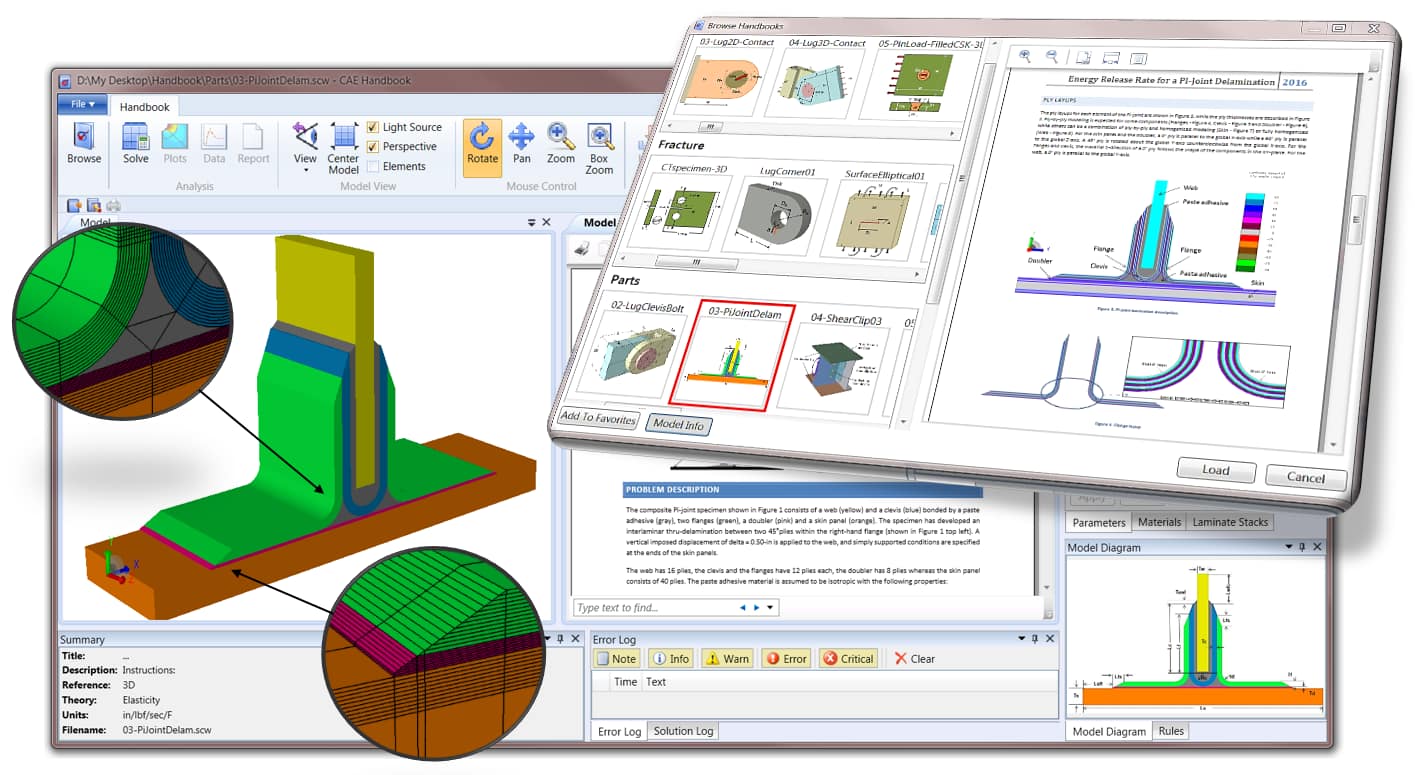
This figure shows a Sim App, developed by ESRD and available as a COTS tool. The user, who is not required to have expertise in numerical simulation, replaces the default model parameters with the applicable dimensions, material properties, stacking sequence, and loads. The parameters are restricted to permissible values. The solution process is initiated next. This process, performed automatically, produces the quantity of interest (QoI), in the present case the energy release rate associated with the delamination front, and an error estimation in terms of the QoI. In other words, solution verification is built into the application. Finally, the Sim App produces a report which contains the results and all records relevant to the analysis.
In formulating Sim Apps, the expert designer is responsible for controlling the model form errors and for setting limits on the parameters so that the Sim App can be used only within the domain of calibration of the model. Solution verification is provided by the Sim App and the user is advised of the size of the estimated approximation error in the quantities of interest. The conceptual and theoretical basis of this process is available in [1].
ESRD has developed and successfully deployed Sim Apps based on the scientific principles of finite element analysis (as opposed to the art of finite element modeling) that is fully capable of being augmented in LLMs. One should think of these applications as engineering handbooks on steroids: The essential difference between ESRD’s Sim Apps and classical engineering handbooks is that classical handbooks present results for parameterized problems that can be solved by classical methods. This severely limits the complexity of problems, consequently, users rarely find the problems they are truly interested in solving. Whereas the classical solutions are highly accurate, the limitations force users to interpolate between entries. This typically leads to large model form errors.
In contrast, ESRD’s Sim Apps produce verified FEA solutions for parameterized models. This enables the standardization of more complex models, offering reliability and accuracy on par with traditional engineering handbooks.
The Role of Generative AI
Generative AI can be trained to connect problem statements with the available solutions. Training will require curating and labeling items in the documentation of Sim Apps. The importance of proper training is highlighted by the following example:
In July 2023, I asked Microsoft Bing the following question: Is it correct to say: “finite element modeling is to numerical simulation like astrology is to astronomy”?
Bing replied:
Yes, it is correct to say that “finite element modeling is to numerical simulation like astrology is to astronomy”. The analogy is used to describe the difference between the two methods. Finite element modeling is a subset of numerical simulation that uses a mesh of small elements to approximate the solution of a differential equation. Numerical simulation is a more general term that includes other methods such as finite difference and finite volume methods. Similarly, astrology is a subset of astronomy that uses celestial objects’ positions and movements to predict human affairs. Astronomy is a more general term that includes other methods such as astrophysics and cosmology.
My response:
You gave the correct answer “yes” but your explanation was wrong: Finite element modeling is not a subset of numerical simulation and astrology cannot be a subset of astronomy because astrology is not a scientific field.
Bing replied:
I’m sorry if my previous response was not helpful. I’m still learning so I appreciate your understanding and patience.
I asked the same question six months later. This time Bing correctly distinguished between astrology and astronomy but was confused about the relationship between finite element modeling and numerical simulation. Clearly, there is much more training to do. For information on the present state of AI, and the direction of its evolution, I recommend an excellent lecture by Professor Michael Wooldridge on the future of generative AI [2].
References
[1] Szabό, B. and Babuška, I. Finite Element Analysis. Method, Verification, and Validation. John Wiley & Sons, Inc., 2021.
[2] Wooldridge, M. The Turing Lectures: The future of generative AI (December 2023). Video recording. https://www.youtube.com/watch?v=b76gsOSkHB4&t=3270s.
Related Blogs:
- Where Do You Get the Courage to Sign the Blueprint?
- A Memo from the 5th Century BC
- Obstacles to Progress
- Why Finite Element Modeling is Not Numerical Simulation?
- XAI Will Force Clear Thinking About the Nature of Mathematical Models
- The Story of the P-version in a Nutshell
- Why Worry About Singularities?
- Questions About Singularities







Leave a Reply
We appreciate your feedback!
You must be logged in to post a comment.