• About
    • Who We Are
    • Partners & Providers
    • News & Events
    • The ESRD Blog
    • Careers
    • Contact Us
  • Applications
    • What We Solve
    • Detailed Stress
    • Composites
    • Fracture Mechanics
    • Residual Stress
    • Sim Apps
  • Products
    • What We Develop
    • StressCheck Professional
      • StressCheck Core
      • Solvers
      • Advanced Modules
      • Utilities
      • Academic Licensing
    • StressCheck Apps
      • CAE Handbook
      • StressCheck Tool Box
    • Product Updates
  • Support
    • How We Can Help
    • Training
    • Webinars
    • Quick Start Guide
    • Help Documentation
    • Software FAQ’s
  • Simulation
    • How We Simulate
    • Benchmarks
    • Simulation Governance
    • History of FEA
    • Dictionary & Terms
  • Resources
    • Browse Our Resource Library
    • White Papers
    • Case Studies
    • Product Demos
    • StressCheck Tutorials
Serving the Numerical Simulation community since 1989
  • Contact Us
  • Register
Login
Forgot Password?
Join Us
ESRDESRD
ESRDESRD
  • About
    • Who We Are
    • Partners & Providers
    • News & Events
    • The ESRD Blog
    • Careers
    • Contact Us
  • Applications
    • What We Solve
    • Detailed Stress
    • Composites
    • Fracture Mechanics
    • Residual Stress
    • Sim Apps
  • Products
    • What We Develop
    • StressCheck Professional
      • StressCheck Core
      • Solvers
      • Advanced Modules
      • Utilities
      • Academic Licensing
    • StressCheck Apps
      • CAE Handbook
      • StressCheck Tool Box
    • Product Updates
  • Support
    • How We Can Help
    • Training
    • Webinars
    • Quick Start Guide
    • Help Documentation
    • Software FAQ’s
  • Simulation
    • How We Simulate
    • Benchmarks
    • Simulation Governance
    • History of FEA
    • Dictionary & Terms
  • Resources
    • Browse Our Resource Library
    • White Papers
    • Case Studies
    • Product Demos
    • StressCheck Tutorials

Why is Simulation Governance Essential for the Reliable Deployment of FEA-Based Engineering Simulation Apps?

Home S.A.F.E.R. SimulationWhy is Simulation Governance Essential for the Reliable Deployment of FEA-Based Engineering Simulation Apps?

Why is Simulation Governance Essential for the Reliable Deployment of FEA-Based Engineering Simulation Apps?

May 8, 2018 S.A.F.E.R. Simulation, The ESRD Blog
SAINT LOUIS, MISSOURI – May 7, 2018

ESRD President and CEO Dr. Ricardo Actis

Finite element modeling originated in the aerospace industry over 60 years ago. Owing to the level of expertise and experience required, it has remained a practice of analysts. There are many reasons for this, among them getting the right mesh for a problem and getting the mesh right is always near the top of why it takes both an expert and much time to get a solution. Not to mention the expertise required to navigate the minefield of multi-purpose finite element software tools in selecting the “right” elements from an ever-expanding element library, and selecting the “right” value of tuning parameters to overcome various deficiencies in implementations.

Yet, looking at this more closely, the focus should not be the level of experience or modeling skills of the user, but the level of intelligence in the software. Nearly all of the most popular legacy FEA software products were designed to support the practice of finite element modeling and as such none of them have the capability to provide a simple Q/A dashboard to advise the non-expert user if they have a good solution.
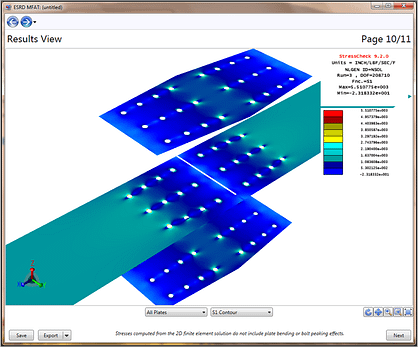
Splice joint stress contours generated by ESRD’s Multi-Fastener Analysis Tool (MFAT) Sim App

How then can the vision for expanding the use of numerical simulation by persons who do not have expertise in finite element analysis (FEA) be safely realized? The solution lies in the establishment of Simulation Governance through the development and dissemination of expert-designed Engineering Simulation Apps to ensure the level of reliability and consistency needed for widespread adoption.

The Key Ingredient for FEA-Based Simulation Apps

FEA-based Simulation Apps for the standardization and automation of recurring analysis tasks and process workflows for use by persons who do not have expertise in FEA must be designed by expert analysts to fit into existing analysis processes, capturing institutional knowledge and best practices to produce consistent results by tested and approved analysis procedures. Only by meeting the technical requirements of Simulation Governance can simulation apps have the reliability and robustness needed to support engineering decision-making processes!

Simulation Governance must be understood as a managerial function that provides a framework for the exercise of command and control over all aspects of numerical simulation through the establishment of processes for the systematic improvement of the tools of engineering decision-making over time. This includes the proper formulation of idealizations, the selection and adoption of the best available simulation technology, the management of experimental data, verification of input data and verification of the numerical solution.

Establishing the Proper Framework
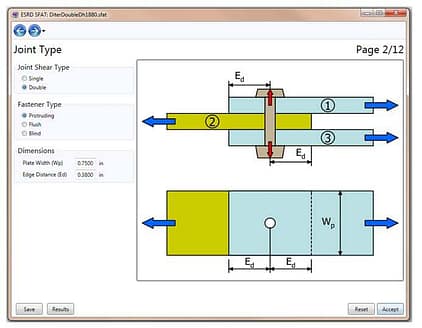
Double lap joint inputs for ESRD’s Single Fastener Analysis Tool (SFAT) Smart Sim App.

In the creation of FEA-based Simulation Apps for the application of established design rules, data verification and solution verification are essential. The goal is to ensure that the data are used properly and the numerical errors in the quantities of interest are reasonably small: they must have built-in safeguards to prevent use outside of the range of parameters for which they were designed; they must incorporate automatic procedures for solution verification; and must be deployed with a detailed description of all assumptions incorporated in the mathematical model and a clear definition of the range and scope of application.

To ensure their proper use, Simulation Apps must incorporate estimation of relative errors in the quantities of interest, an essential technical requirement of Simulation Governance. They should not be deployed without objective measures of the approximation errors for all the reported results. The success of the vision of Democratization of Simulation depends on it!

Learn More


Previous S.A.F.E.R. Simulation Posts…

  • S.A.F.E.R. Numerical Simulation for Structural Analysis in the Aerospace Industry Part 1: Trends in A&D Driving Simulation
  • S.A.F.E.R. Numerical Simulation for Structural Analysis in the Aerospace Industry Part 2: Challenges with Legacy FEA
  • S.A.F.E.R. Numerical Simulation for Structural Analysis in the Aerospace Industry Part 3: FEM is not Numerical Simulation
  • S.A.F.E.R. Numerical Simulation for Structural Analysis in the Aerospace Industry Part 4: Simulation Governance
  • S.A.F.E.R. Numerical Simulation for Structural Analysis in the Aerospace Industry Part 5: An Introduction to StressCheck for High-Fidelity Aero-structure Analysis


To receive future S.A.F.E.R. Simulation posts…

=
Loading
Tags: Aerospace and DefenseCAE HandbookFinite Element ModelingNumerical SimulationSimulation GovernanceStressCheckStressCheck-Powered Apps
6

You also might be interested in

Why Is Solution Verification Necessary?

Why Is Solution Verification Necessary?

Feb 24, 2025

We at ESRD preach and practice solution verification. We believe that reporting data computed by an approximate method is incomplete without providing an estimate of the size of the relative error. This simple and self-evident statement tends to trigger fierce resistance from those who were schooled in the use of legacy finite element modeling tools. But why?

S.A.F.E.R. Numerical Simulation for Structural Analysis in the Aerospace Industry Part 2: Challenges with Legacy FEA
F-18 Military Jet isolated on white.

S.A.F.E.R. Numerical Simulation for Structural Analysis in the Aerospace Industry Part 2: Challenges with Legacy FEA

Dec 5, 2017

In this second of our multi-part series on “S.A.F.E.R. Numerical Simulation for Structural Analysis in the Aerospace Industry” we will distill what the need for higher-fidelity engineering analysis means to stress analysis groups and the challenges experienced when using legacy simulation and analysis technologies based on the finite element method (FEM). [...]

ASIP 2021 Conference Recap

ASIP 2021 Conference Recap

Dec 15, 2021

Recently at ASIP 2021, ESRD provided a training course titled "Standardization and Automation of DaDT Solutions via FEA-Based Sim Apps", chatted with ASIP attendees, provided a StressCheck Clinic, and exhibited at our booth. After two years of virtual meetings, it was great to re-connect in person! Read the summary of conference events, and view the ASIP training course content (including the presentation and demo videos). In addition, we encourage you to sign up for our Q1 2022 webinar on "New and Improved Features for 3D Fracture Mechanics Analysis in StressCheck". You don't want to miss it!

Leave a Reply

We appreciate your feedback!
Cancel Reply

You must be logged in to post a comment.

Looking for Resources?

Interested in a Demo, Evaluation or Purchase?

Have a Software Question, Issue or Feature Request?

Recent News & Events

  • Trustworthiness in Simulation: Credibility or Decision-grade Reliability?
  • Beyond the Black Box: Explainable AI Requires Explainable Simulation
  • Turtle Shells and Legacy Finite Element Codes: Evolutionary Constraints in the Age of Explainable AI

Quick Links

  • Quick Start Guide
  • Documentation
  • Software FAQs
  • Software Demos

Testimonials

  • “Small errors in modeling can lead to substantial errors in joint performance prediction. To alleviate this problem, the CAI used the handbook functionality of ESRD Inc.’s (St. Louis, Mo.) trademarked StressCheck P-version finite element software to develop reusable models of typical joints.”

    Dr. John Russell
    Composites World Magazine

Testimonials

“The p-type element has been used to great advantage in the finite element system ESRD StressCheck, [26]. This software provides the engineer with the means to conduct solution verification in an extremely straightforward manner by simply increasing the degree of the element, monitoring convergence and using Richardson extrapolation reliably to estimate the error. This can be conducted automatically by the software thereby enabling the engineer to concentrate on the engineering rather than the simulation. StressCheck has also been used to develop ESRD’s Handbook and Toolbox applications. The first of these provides engineers with a repository of parameterised standard problems of the type found in texts like Roark’s “Formulas for Stress and Strain”, [27]. The second, Toolbox, is a tool that can be used to parameterise a company’s range of components for rapid and reliable analysis by non-expert analysis. Toolbox then is an exemplary of the way in which the democratisation of simulation can be applied.”

Angus Ramsay, PhD, Engineering Director, Ramsay Maunder Associates

Member Portal

  • Member Registration
  • Member Login

Contact Us

© 2026 · Engineering Software Research & Development, Inc. | Terms & Conditions | Privacy & Cookie Policy | Software License Agreement | Software Maintenance and Technical Support Policy

Prev Next

We use cookies on our website to give you the most relevant experience by remembering your preferences and repeat visits, as outlined in our Cookie Policy. You may adjust your cookie preferences within .

ESRD
Powered by  GDPR Cookie Compliance
Privacy Overview

This website uses cookies to improve your experience while you navigate through the website. Out of these, the cookies that are categorized as necessary are stored on your browser as they are essential for the working of basic functionalities of the website. We also use third-party cookies that help us analyze and understand how you use this website. These cookies will be stored in your browser only with your consent. You also have the option to opt-out of these cookies. But opting out of some of these cookies may affect your browsing experience.

Strictly Necessary Cookies

Strictly Necessary Cookies should be enabled at all times so that we can save your preferences for cookie settings.