• About
    • Who We Are
    • Partners & Providers
    • News & Events
    • The ESRD Blog
    • Careers
    • Contact Us
  • Applications
    • What We Solve
    • Detailed Stress
    • Composites
    • Fracture Mechanics
    • Residual Stress
    • Sim Apps
  • Products
    • What We Develop
    • StressCheck Professional
      • StressCheck Core
      • Solvers
      • Advanced Modules
      • Utilities
      • Academic Licensing
    • StressCheck Apps
      • CAE Handbook
      • StressCheck Tool Box
    • Product Updates
  • Support
    • How We Can Help
    • Training
    • Webinars
    • Quick Start Guide
    • Help Documentation
    • Software FAQ’s
  • Simulation
    • How We Simulate
    • Benchmarks
    • Simulation Governance
    • History of FEA
    • Dictionary & Terms
  • Resources
    • Browse Our Resource Library
    • White Papers
    • Case Studies
    • Product Demos
    • StressCheck Tutorials
Serving the Numerical Simulation community since 1989
  • Contact Us
  • Register
Login
Forgot Password?
Join Us
ESRDESRD
ESRDESRD
  • About
    • Who We Are
    • Partners & Providers
    • News & Events
    • The ESRD Blog
    • Careers
    • Contact Us
  • Applications
    • What We Solve
    • Detailed Stress
    • Composites
    • Fracture Mechanics
    • Residual Stress
    • Sim Apps
  • Products
    • What We Develop
    • StressCheck Professional
      • StressCheck Core
      • Solvers
      • Advanced Modules
      • Utilities
      • Academic Licensing
    • StressCheck Apps
      • CAE Handbook
      • StressCheck Tool Box
    • Product Updates
  • Support
    • How We Can Help
    • Training
    • Webinars
    • Quick Start Guide
    • Help Documentation
    • Software FAQ’s
  • Simulation
    • How We Simulate
    • Benchmarks
    • Simulation Governance
    • History of FEA
    • Dictionary & Terms
  • Resources
    • Browse Our Resource Library
    • White Papers
    • Case Studies
    • Product Demos
    • StressCheck Tutorials

Watch Teaser Video for the NAFEMS Coil Spring FEA Puzzler

Home NewsPublicationsWatch Teaser Video for the NAFEMS Coil Spring FEA Puzzler

Watch Teaser Video for the NAFEMS Coil Spring FEA Puzzler

February 12, 2019 Publications, S.A.F.E.R. Simulation


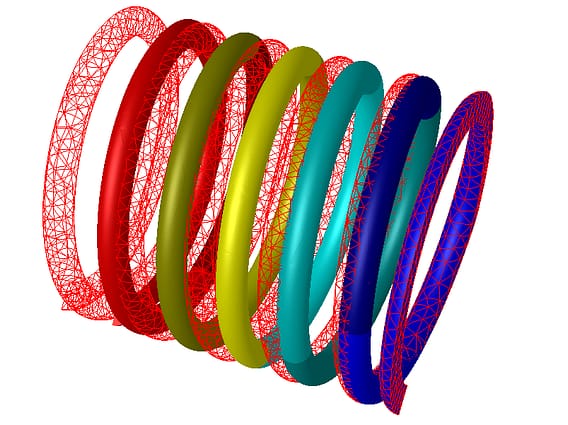
Qualitative Deformation Contours for StressCheck’s Coil Spring Solution

In a recent S.A.F.E.R. Simulation post, we announced that ESRD Chairman Dr. Barna Szabó had posed a new “FEA Puzzler” in the October 2018 edition of NAFEMS Benchmark magazine. This challenge problem related to determining incremental spring rates for a coil spring under axial displacement AND demonstrating that the approximation errors are small via solution verification procedures.

As a refresher, the original NAFEMS FEA Puzzler description was as follows:
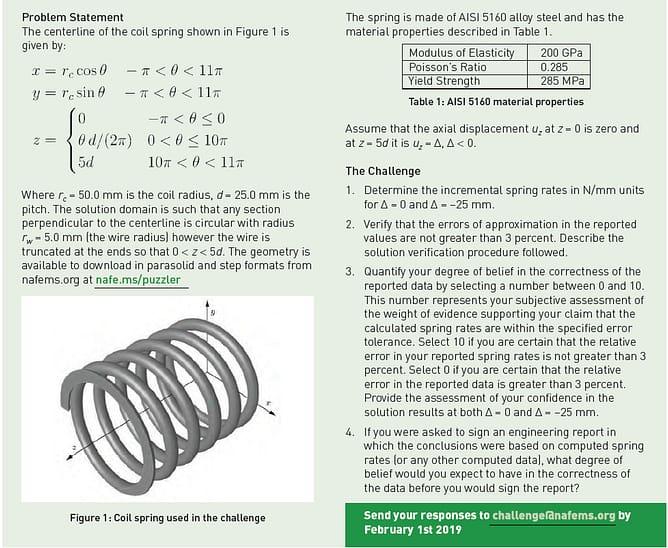
FEA Puzzler from NAFEMS Benchmark Magazine October 2018

As noted in a January 2019 LinkedIn post by Mr. David Quinn (Chief Marketing Officer at NAFEMS), the original deadline of February 1st, 2019 has been extended an additional four (4) months. From Mr. Quinn’s post:

Send your responses, in confidence, to Professor Szabó at challenge@nafems.org. Responses of sufficient merit will win an exclusive NAFEMS business card holder, and a summary of the responses will be published without attribution in a future issue of Benchmark.

The challenge will close on June 1st 2019 – best of luck!

So, there is still ample time to submit your solutions (along with proof of solution verification) to challenge@nafems.org. Feel free to use any FEA software tool, and make note of your modeling process and interpretation of results.

Need A Hint?

To help provide a nudge in the right direction, ESRD has recorded the following teaser video using its StressCheck Professional FEA software to show some of the model setup and results processing (no actual values, that would be cheating!):

Dr. Szabó and NAFEMS are very much looking forward to your submissions!

Tags: BenchmarksNAFEMSNumerical SimulationSolution Verification
3

You also might be interested in

Digital Twins

Digital Twins

May 2, 2024

The idea of a digital twin originated at NASA in the 1960s as a “living model” of the Apollo program. When Apollo 13 experienced an oxygen tank explosion, NASA utilized multiple simulators and extended a physical model of the spacecraft to include digital simulations, creating a digital twin. This twin was used to analyze the events leading up to the accident and investigate ideas for a solution. The term "digital twin" was coined by NASA engineer John Vickers much later. While the term is commonly associated with modeling physical objects, it is also employed to represent organizational processes. Here, we consider digital twins of physical entities only.

ASIP 2023 Conference Recap

ASIP 2023 Conference Recap

Dec 7, 2023

At this year's ASIP 2023 Conference in Denver, CO, ESRD provided a 2-hour training course titled “Enhancements in StressCheck v12.0 for DaDT Analysis of 3D Fastened Connections”, presented a technical paper titled "Experimental Validation of DTA Modeling of Bonded Wing Skin Repairs", and passed out 3D printed F-35 and C-130 models at our booth inside the Gaylord Rockies Resort & Conference Center. Read the summary of conference events, view the ASIP training course content (including the presentation and demo videos), and schedule a preview demo of the upcoming StressCheck v12!

A Memo from the 5th Century BC

A Memo from the 5th Century BC

Oct 17, 2023

Confucius (551-479 BC) tells us, engineers working in the 21st century AD, that having a firm grasp on terminology is an essential prerequisite to success. But why are there so many popular but misleading or meaningless terms floating around in engineering presentations, technical papers, blog articles, trainings and workplace environments? Read more in this blog.

Leave a Reply

We appreciate your feedback!
Cancel Reply

You must be logged in to post a comment.

Looking for Resources?

Interested in a Demo, Evaluation or Purchase?

Have a Software Question, Issue or Feature Request?

Recent News & Events

  • Trustworthiness in Simulation: Credibility or Decision-grade Reliability?
  • Beyond the Black Box: Explainable AI Requires Explainable Simulation
  • Turtle Shells and Legacy Finite Element Codes: Evolutionary Constraints in the Age of Explainable AI

Quick Links

  • Quick Start Guide
  • Documentation
  • Software FAQs
  • Software Demos

Testimonials

  • “The addition of incremental theory of plasticity in StressCheck has greatly improved our ability to accurately predict the fatigue life of joints with interference fit fasteners and cold worked holes. This ability is especially important, not only in support of maintaining aging aircraft but also in analyzing some of the new cold working techniques that have been introduced in recent years.
    Prior to this implementation, analysts often relied on closed-form approximations or simple factors that were often overly conservative and sometimes even unconservative when used in life prediction. Now, not only can we more accurately predict residual stresses in these complex structural joints, but we can also do so in a timely manner given the modeling and analysis efficiency that exists with a p-version FEA code such as StressCheck.”

    F-15 Structures Manager
    The Boeing Company

Testimonials

“Aerospace materials scientists and structural engineers now have a new state-of-the-art software product called StressCheck, which provides efficient and reliable analysis tools for composite bonded aircraft structures. A composites research team from the aeronautics industry, known as the Composites Affordability Initiative (CAI), has just completed an extensive study of current capabilities in the area of failure analysis tools for composite bonded joints. This study led the CAI team to unanimously choose StressCheck as the software tool to replace as well as radically improve existing industry standard software currently used to size bonded joints.”

Air Force Research Laboratory (AFRL)

Member Portal

  • Member Registration
  • Member Login

Contact Us

© 2026 · Engineering Software Research & Development, Inc. | Terms & Conditions | Privacy & Cookie Policy | Software License Agreement | Software Maintenance and Technical Support Policy

Prev Next

We use cookies on our website to give you the most relevant experience by remembering your preferences and repeat visits, as outlined in our Cookie Policy. You may adjust your cookie preferences within .

ESRD
Powered by  GDPR Cookie Compliance
Privacy Overview

This website uses cookies to improve your experience while you navigate through the website. Out of these, the cookies that are categorized as necessary are stored on your browser as they are essential for the working of basic functionalities of the website. We also use third-party cookies that help us analyze and understand how you use this website. These cookies will be stored in your browser only with your consent. You also have the option to opt-out of these cookies. But opting out of some of these cookies may affect your browsing experience.

Strictly Necessary Cookies

Strictly Necessary Cookies should be enabled at all times so that we can save your preferences for cookie settings.