• About
    • Who We Are
    • Partners & Providers
    • News & Events
    • The ESRD Blog
    • Careers
    • Contact Us
  • Applications
    • What We Solve
    • Detailed Stress
    • Composites
    • Fracture Mechanics
    • Residual Stress
    • Sim Apps
  • Products
    • What We Develop
    • StressCheck Professional
      • StressCheck Core
      • Solvers
      • Advanced Modules
      • Utilities
      • Academic Licensing
    • StressCheck Apps
      • CAE Handbook
      • StressCheck Tool Box
    • Product Updates
  • Support
    • How We Can Help
    • Training
    • Webinars
    • Quick Start Guide
    • Help Documentation
    • Software FAQ’s
  • Simulation
    • How We Simulate
    • Benchmarks
    • Simulation Governance
    • History of FEA
    • Dictionary & Terms
  • Resources
    • Browse Our Resource Library
    • White Papers
    • Case Studies
    • Product Demos
    • StressCheck Tutorials
Serving the Numerical Simulation community since 1989
  • Contact Us
  • Register
Login
Forgot Password?
Join Us
ESRDESRD
ESRDESRD
  • About
    • Who We Are
    • Partners & Providers
    • News & Events
    • The ESRD Blog
    • Careers
    • Contact Us
  • Applications
    • What We Solve
    • Detailed Stress
    • Composites
    • Fracture Mechanics
    • Residual Stress
    • Sim Apps
  • Products
    • What We Develop
    • StressCheck Professional
      • StressCheck Core
      • Solvers
      • Advanced Modules
      • Utilities
      • Academic Licensing
    • StressCheck Apps
      • CAE Handbook
      • StressCheck Tool Box
    • Product Updates
  • Support
    • How We Can Help
    • Training
    • Webinars
    • Quick Start Guide
    • Help Documentation
    • Software FAQ’s
  • Simulation
    • How We Simulate
    • Benchmarks
    • Simulation Governance
    • History of FEA
    • Dictionary & Terms
  • Resources
    • Browse Our Resource Library
    • White Papers
    • Case Studies
    • Product Demos
    • StressCheck Tutorials

AA&S/PS&S 2019 Conference Recap

Home EventsConferenceAA&S/PS&S 2019 Conference Recap

AA&S/PS&S 2019 Conference Recap

April 29, 2019 Conference, Events

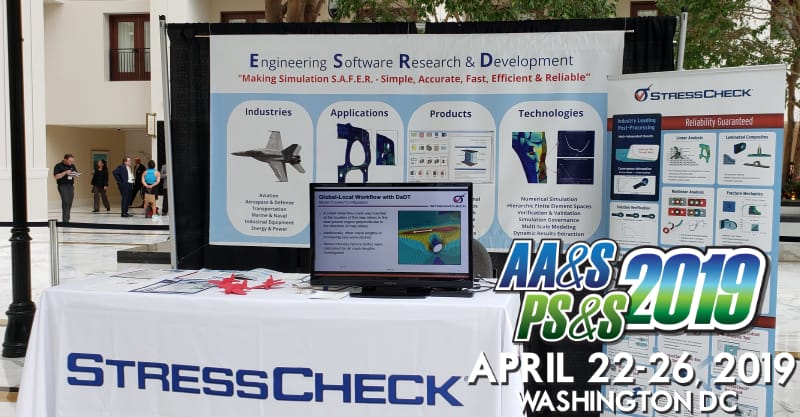
ESRD’s booth at AA&S/PS&S 2019 in Washington, D.C.

This past week at AA&S/PS&S 2019, ESRD’s Gordon Lehman provided a 2-hour training course titled “How Do You Verify the Accuracy of Engineering Simulations?”, chatted with attendees about StressCheck and how it supports detailed aerostructures analyses, and exhibited at our colorful & engaging booth (see above image).

Mr. Gordon Lehman, PE.

Gordon enjoyed meeting many of the AA&S/PS&S attendees, connecting with a wide variety of ESRD customers and colleagues, and sharing ESRD’s expertise on checking the quality of FEA results during his training course. Thanks to those who stopped by to say hello to Gordon (and took home one of our red aerodynamic flyers).

AA&S/PS&S 2019 Training Presentation Available…

On Monday, April 22nd, Gordon had the pleasure of providing a training course on FEA solution verification best practices (illustrated by industry and benchmark case studies) to a large group of AA&S engineers. Thanks to those who attended and/or requested the training course presentation.

If you are interested in learning more about this fascinating topic, you can download Mr. Lehman’s AA&S training presentation (in PowerPoint show or PDF format) from the link below:

AA&S 2019 Training – How Do You Verify the Accuracy of Engineering Simulations?

We are looking forward to receiving your feedback on the training course presentation.

Benchmarking-By-FEA…

Interested in learning more about the “benchmarking-by-FEA” process discussed in the training course? See this process in action for one of the training course examples:

StressCheck Demo: Benchmarking 3D Stress Concentration Factors via Numerical Simulation

If you’d like to see a specific “benchmarking-by-FEA” case study demonstrated, please submit your request and we’ll be happy to review.

Upcoming Webinar…
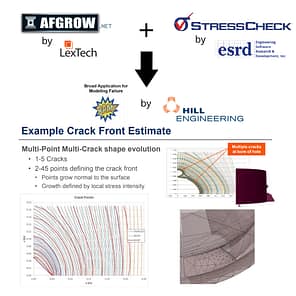
BAMF Example Crack Front Estimate via StressCheck/AFGROW Integration (courtesy Hill Engineering).

We are pleased to announce a joint Summer 2019 webinar with Hill Engineering, LLC (developers of BAMF) and LexTech, Inc. (developers of AFGROW) to discuss the state-of-the-art in 3D crack growth simulations. During this DaDT-focused webinar, Hill Engineering will provide a demonstration of how StressCheck and AFGROW were seamlessly integrated into their fatigue analysis software application BAMF. From the latest BAMF release notes:

Hill Engineering is announcing the release of version 6.0 of our Broad Application for Modeling Failure (BAMF) software. BAMF is used for fatigue analysis, and it is capable of predicting the growth of fatigue cracks in 3D parts. Starting from an assumed initial flaw, BAMF combines stress and crack growth analyses to predict the evolution of crack shape and size in 3D.

BAMF provides a robust and automated link between two leading tools: AFGROW and StressCheck™. Key features of BAMF include: natural crack shape evolution, fully 3D fatigue analysis capability, complex loading support, multiple cracks, and residual stress compatibility.

Learn more and register for the July 17th, 2019 webinar:

Learn More
Tags: AA&SAerospace and DefenseBenchmarksDaDTFatigueFractureNumerical SimulationSolution VerificationStressCheckWorkshop
2

You also might be interested in

The Differences Between Calibration and Tuning

The Differences Between Calibration and Tuning

Jan 7, 2026

Anyone who relies on information generated through numerical simulation must know the difference between calibration and tuning, and understand the interactions between finite element modeling and finite element analysis. This blog post covers the main points.

Turtle Shells and Legacy Finite Element Codes: Evolutionary Constraints in the Age of Explainable AI

Turtle Shells and Legacy Finite Element Codes: Evolutionary Constraints in the Age of Explainable AI

Mar 18, 2026

This blog post explains why legacy finite element codes are like a turtle’s carapace: a protective structure that provided a survival advantage in the resource-scarce 1960s but now impedes the flexibility needed to meet the demands of explainable AI (XAI). The good news is that the technology required to support XAI already exists.

StressCheck v11 Update 1 Released!

StressCheck v11 Update 1 Released!

Jun 17, 2021

ESRD is pleased to announce that we've released StressCheck Professional v11 Update 1. In addition to all the improvements introduced with the release of StressCheck v11, in Update 1 we have optimized the Solve and Results panes for maximum efficiency and improved user flow.

Leave a Reply

We appreciate your feedback!
Cancel Reply

You must be logged in to post a comment.

Looking for Resources?

Interested in a Demo, Evaluation or Purchase?

Have a Software Question, Issue or Feature Request?

Recent News & Events

  • Trustworthiness in Simulation: Credibility or Decision-grade Reliability?
  • Beyond the Black Box: Explainable AI Requires Explainable Simulation
  • Turtle Shells and Legacy Finite Element Codes: Evolutionary Constraints in the Age of Explainable AI

Quick Links

  • Quick Start Guide
  • Documentation
  • Software FAQs
  • Software Demos

Testimonials

  • “The p-type element has been used to great advantage in the finite element system ESRD StressCheck, [26]. This software provides the engineer with the means to conduct solution verification in an extremely straightforward manner by simply increasing the degree of the element, monitoring convergence and using Richardson extrapolation reliably to estimate the error. This can be conducted automatically by the software thereby enabling the engineer to concentrate on the engineering rather than the simulation. StressCheck has also been used to develop ESRD’s Handbook and Toolbox applications. The first of these provides engineers with a repository of parameterised standard problems of the type found in texts like Roark’s “Formulas for Stress and Strain”, [27]. The second, Toolbox, is a tool that can be used to parameterise a company’s range of components for rapid and reliable analysis by non-expert analysis. Toolbox then is an exemplary of the way in which the democratisation of simulation can be applied.”

    Angus Ramsay, PhD
    Engineering Director, Ramsay Maunder Associates

Testimonials

When performing parametric structural analysis, ESRD’s p-element StressCheck FEA software is always my preferred choice due to the excellent solution quality, parametric framework, and superior computational efficiency. In fact, I recently used StressCheck to generate stress intensity factors along a parametrically defined elliptical crack-tip across 3,000 unique geometric configurations. Considering multi-body contact was present and all simulations were performed using a laptop, this was a task well suited for StressCheck.

Dr. Lee Zambino, Researcher, Villanova University

Member Portal

  • Member Registration
  • Member Login

Contact Us

© 2026 · Engineering Software Research & Development, Inc. | Terms & Conditions | Privacy & Cookie Policy | Software License Agreement | Software Maintenance and Technical Support Policy

Prev Next

We use cookies on our website to give you the most relevant experience by remembering your preferences and repeat visits, as outlined in our Cookie Policy. You may adjust your cookie preferences within .

ESRD
Powered by  GDPR Cookie Compliance
Privacy Overview

This website uses cookies to improve your experience while you navigate through the website. Out of these, the cookies that are categorized as necessary are stored on your browser as they are essential for the working of basic functionalities of the website. We also use third-party cookies that help us analyze and understand how you use this website. These cookies will be stored in your browser only with your consent. You also have the option to opt-out of these cookies. But opting out of some of these cookies may affect your browsing experience.

Strictly Necessary Cookies

Strictly Necessary Cookies should be enabled at all times so that we can save your preferences for cookie settings.