• About
    • Who We Are
    • Partners & Providers
    • News & Events
    • The ESRD Blog
    • Careers
    • Contact Us
  • Applications
    • What We Solve
    • Detailed Stress
    • Composites
    • Fracture Mechanics
    • Residual Stress
    • Sim Apps
  • Products
    • What We Develop
    • StressCheck Professional
      • StressCheck Core
      • Solvers
      • Advanced Modules
      • Utilities
      • Academic Licensing
    • StressCheck Apps
      • CAE Handbook
      • StressCheck Tool Box
    • Product Updates
  • Support
    • How We Can Help
    • Training
    • Webinars
    • Quick Start Guide
    • Help Documentation
    • Software FAQ’s
  • Simulation
    • How We Simulate
    • Benchmarks
    • Simulation Governance
    • History of FEA
    • Dictionary & Terms
  • Resources
    • Browse Our Resource Library
    • White Papers
    • Case Studies
    • Product Demos
    • StressCheck Tutorials
Serving the Numerical Simulation community since 1989
  • Contact Us
  • Register
Login
Forgot Password?
Join Us
ESRDESRD
ESRDESRD
  • About
    • Who We Are
    • Partners & Providers
    • News & Events
    • The ESRD Blog
    • Careers
    • Contact Us
  • Applications
    • What We Solve
    • Detailed Stress
    • Composites
    • Fracture Mechanics
    • Residual Stress
    • Sim Apps
  • Products
    • What We Develop
    • StressCheck Professional
      • StressCheck Core
      • Solvers
      • Advanced Modules
      • Utilities
      • Academic Licensing
    • StressCheck Apps
      • CAE Handbook
      • StressCheck Tool Box
    • Product Updates
  • Support
    • How We Can Help
    • Training
    • Webinars
    • Quick Start Guide
    • Help Documentation
    • Software FAQ’s
  • Simulation
    • How We Simulate
    • Benchmarks
    • Simulation Governance
    • History of FEA
    • Dictionary & Terms
  • Resources
    • Browse Our Resource Library
    • White Papers
    • Case Studies
    • Product Demos
    • StressCheck Tutorials

3D Crack Growth Simulation Advancements Webinar Coming Soon

Home News3D Crack Growth Simulation Advancements Webinar Coming Soon

3D Crack Growth Simulation Advancements Webinar Coming Soon

May 14, 2019 News, Webinars

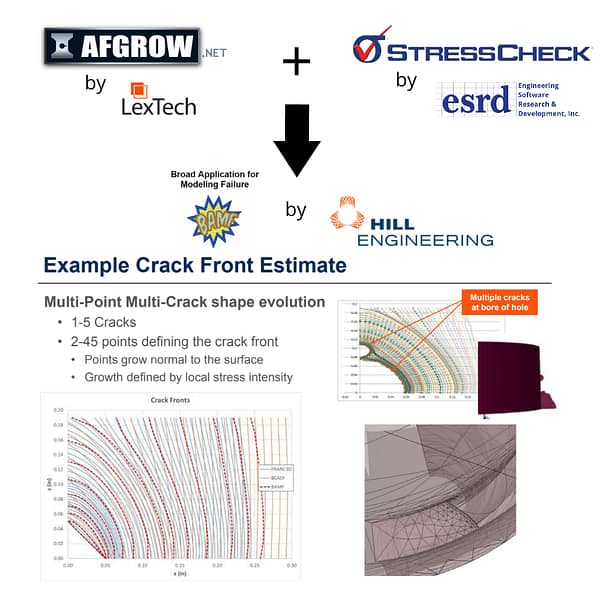
BAMF Example Crack Front Prediction via StressCheck/AFGROW Integration (courtesy Hill Engineering).

ESRD is pleased to join Hill Engineering, LLC (developers of BAMF) and LexTech, Inc. (developers of AFGROW) for a joint webinar on July 17, 2019 @ 1:00 pm EST. This collaborative webinar will be titled “3D Crack Growth Simulation: Advancements & Applications“, and will detail the latest technological advancements for accurate simulation of three-dimensional metallic crack growth via coupled finite element analysis (FEA) and fatigue life computations.

During this webinar, you will see the latest in 3D crack growth predictions via Hill Engineering’s Broad Application for Modeling Failure (BAMF) software tool, which provides a robust integration between StressCheck’s high-fidelity DaDT/fracture solutions and AFGROW’s crack growth life prediction capabilities.

Additionally, ESRD, LexTech & Hill Engineering representatives will explain how each of their respective technologies seamlessly fit together to enable automated, verified & validated (i.e. backed by experimental data) fatigue crack propagation. You don’t want to miss it!

Register Now


Tags: Aerospace and DefenseAFGROWASIPBAMFCrack GrowthDaDTFatigueFractureNumerical SimulationResidual StressSolution VerificationStressCheck-Powered AppsWebinar
2

You also might be interested in

Model Development in the Engineering Sciences

Model Development in the Engineering Sciences

Feb 12, 2024

In the engineering sciences, mathematical models are based on the equations of continuum mechanics, heat flow, Maxwell, Navier-Stokes, or some combination of these. These equations have been validated and their domains of calibration are generally much larger than the expected domain of calibration of the model being developed. In the terminology introduced by Lakatos, the assumptions incorporated in these equations are called hardcore assumptions, and the assumptions incorporated in the other constituents of a model are called auxiliary hypotheses. Model development is concerned with the formulation, calibration, and validation of auxiliary hypotheses.

What Bottlenecks Limit the Adoption of Simulation Governance?
Beware the bottlenecks preventing the adoption of simulation governance.

What Bottlenecks Limit the Adoption of Simulation Governance?

Oct 3, 2019

While the idea of simulation governance may be easy to understand, the challenges of two potential bottlenecks must be addressed before it can adopted by engineering management. Read Dr. Barna Szabo's latest S.A.F.E.R. simulation post to learn more.

S.A.F.E.R. Numerical Simulation for Structural Analysis in the Aerospace Industry Part 3: FEM is not Numerical Simulation
Gulfstream's G650 private jet airplane flying in sky.

S.A.F.E.R. Numerical Simulation for Structural Analysis in the Aerospace Industry Part 3: FEM is not Numerical Simulation

Jan 29, 2018

In this third of our multi-part series on “S.A.F.E.R. Numerical Simulation for Structural Analysis in the Aerospace Industry” we will examine why Numerical Simulation is not the same as Finite Element Modeling and what this means to the structural analysis function within the A&D industry. [...]

Leave a Reply

We appreciate your feedback!
Cancel Reply

You must be logged in to post a comment.

Looking for Resources?

Interested in a Demo, Evaluation or Purchase?

Have a Software Question, Issue or Feature Request?

Recent News & Events

  • Trustworthiness in Simulation: Credibility or Decision-grade Reliability?
  • Beyond the Black Box: Explainable AI Requires Explainable Simulation
  • Turtle Shells and Legacy Finite Element Codes: Evolutionary Constraints in the Age of Explainable AI

Quick Links

  • Quick Start Guide
  • Documentation
  • Software FAQs
  • Software Demos

Testimonials

  • “Hearty congratulations to management and staff at ESRD on their 25th anniversary. The quality and capability of their software products are excellent. I hope that ESRD successfully continues for many more years with the fundamental principles of mathematical precision, numerical accuracy, and integrity in computational simulation.”

    Dr. William Oberkampf
    Author of Verification and Validation in Scientific Computing

Testimonials

“We have been having very good success using the P-Version finite element code, StressCheck, to develop the 2-D solutions for two independent cracks in a plate. I have asked one of our AFGROW team members to model the plate and lug cases using StressCheck and compare them to the existing AFGROW closed-form solutions. [He] modeled the cases several different ways to be sure that he was getting the best possible solutions. He has verified that the bearing load option in StressCheck provides excellent results.”

Jim Harter, Team Leader-Analytical Fatigue/Fracture Reliability Team Air Force Research Laboratory (AFRL)

Member Portal

  • Member Registration
  • Member Login

Contact Us

© 2026 · Engineering Software Research & Development, Inc. | Terms & Conditions | Privacy & Cookie Policy | Software License Agreement | Software Maintenance and Technical Support Policy

Prev Next

We use cookies on our website to give you the most relevant experience by remembering your preferences and repeat visits, as outlined in our Cookie Policy. You may adjust your cookie preferences within .

ESRD
Powered by  GDPR Cookie Compliance
Privacy Overview

This website uses cookies to improve your experience while you navigate through the website. Out of these, the cookies that are categorized as necessary are stored on your browser as they are essential for the working of basic functionalities of the website. We also use third-party cookies that help us analyze and understand how you use this website. These cookies will be stored in your browser only with your consent. You also have the option to opt-out of these cookies. But opting out of some of these cookies may affect your browsing experience.

Strictly Necessary Cookies

Strictly Necessary Cookies should be enabled at all times so that we can save your preferences for cookie settings.