• About
    • Who We Are
    • Partners & Providers
    • News & Events
    • The ESRD Blog
    • Careers
    • Contact Us
  • Applications
    • What We Solve
    • Detailed Stress
    • Composites
    • Fracture Mechanics
    • Residual Stress
    • Sim Apps
  • Products
    • What We Develop
    • StressCheck Professional
      • StressCheck Core
      • Solvers
      • Advanced Modules
      • Utilities
      • Academic Licensing
    • StressCheck Apps
      • CAE Handbook
      • StressCheck Tool Box
    • Product Updates
  • Support
    • How We Can Help
    • Training
    • Webinars
    • Quick Start Guide
    • Help Documentation
    • Software FAQ’s
  • Simulation
    • How We Simulate
    • Benchmarks
    • Simulation Governance
    • History of FEA
    • Dictionary & Terms
  • Resources
    • Browse Our Resource Library
    • White Papers
    • Case Studies
    • Product Demos
    • StressCheck Tutorials
Serving the Numerical Simulation community since 1989
  • Contact Us
  • Register
Login
Forgot Password?
Join Us
ESRDESRD
ESRDESRD
  • About
    • Who We Are
    • Partners & Providers
    • News & Events
    • The ESRD Blog
    • Careers
    • Contact Us
  • Applications
    • What We Solve
    • Detailed Stress
    • Composites
    • Fracture Mechanics
    • Residual Stress
    • Sim Apps
  • Products
    • What We Develop
    • StressCheck Professional
      • StressCheck Core
      • Solvers
      • Advanced Modules
      • Utilities
      • Academic Licensing
    • StressCheck Apps
      • CAE Handbook
      • StressCheck Tool Box
    • Product Updates
  • Support
    • How We Can Help
    • Training
    • Webinars
    • Quick Start Guide
    • Help Documentation
    • Software FAQ’s
  • Simulation
    • How We Simulate
    • Benchmarks
    • Simulation Governance
    • History of FEA
    • Dictionary & Terms
  • Resources
    • Browse Our Resource Library
    • White Papers
    • Case Studies
    • Product Demos
    • StressCheck Tutorials

Great Expectations: Agentic AI in Mechanical Engineering

Home The ESRD BlogGreat Expectations: Agentic AI in Mechanical Engineering

Great Expectations: Agentic AI in Mechanical Engineering

December 11, 2025 The ESRD Blog

By Dr. Barna Szabó
Engineering Software Research and Development, Inc.
St. Louis, Missouri USA


To learn about the latest thinking about Agentic AI within mechanical engineering—where independent AI modules interact to solve complex problems—I consulted the popular AI assistant Grok. Here is what came up:

An Agentic AI in mechanical engineering is an autonomous software system that can independently pursue complex, open-ended engineering goals with minimal human intervention by repeatedly perceiving the current state, reasoning about it, planning actions, executing those actions (usually via tools or APIs), and learning from the outcomes. In mechanical engineering practice, this typically manifests as one or more of the following concrete capabilities:

  1. Design Autonomy
    • Takes a high-level requirement (e.g., “design a 50 kW gearbox for an EV with < 0.5% efficiency loss at 12,000 rpm, under 12 kg, cost < $180 in 100k volume”).
    • Iteratively generates CAD/solid models, runs topology optimization, selects materials, performs FEA/CFD, checks manufacturability (DFM), iterates, and outputs production-ready STEP files, drawings, and a BOM — all without human-in-the-loop after the initial prompt.
  2. Simulation & Validation Agency
    • Sets up its own multi-physics simulations (Ansys, Abaqus, STAR-CCM+, OpenFOAM, etc.), writes input decks or Python scripts, runs parameter sweeps or formal design optimization (Bayesian, genetic, gradient-based), interprets results, and decides whether the design meets specs or needs another loop.
  3. Physical Test Autonomy
    • Generates G-code or robot paths, instructs collaborative robots or test rigs via API to build and test prototypes, reads sensor data (torque, vibration, thermography, strain gauges), compares to simulation, and closes the digital–physical loop.
  4. Supply-Chain & Manufacturing Agency
    • Queries supplier APIs for real-time pricing/lead times, runs should-cost models, negotiates (in some advanced cases), selects processes (additive vs. CNC vs. casting), generates CAM toolpaths, and pushes work orders to MES systems.
  5. Lifecycle & Maintenance Agency
    • In service, an agentic system can ingest fleet telemetry, diagnose failures, propose redesigned parts, validate them virtually, and push OTA updates to reconfigurable hardware (e.g., metamaterial lattices or adjustable mechanisms).

Upon reading this, I thought it to be an extremely ambitious aspirational statement, and not more than that. Then Grok added:

Based on expert forecasts, scaling laws, and industry signals, we’re 2-5 years from meaningful realization of agentic AI handling integrated workflows like full product lifecycle management in mechanical engineering, with human oversight reduced to 20-30%. This aligns with broader AI trends, where timelines have compressed dramatically.
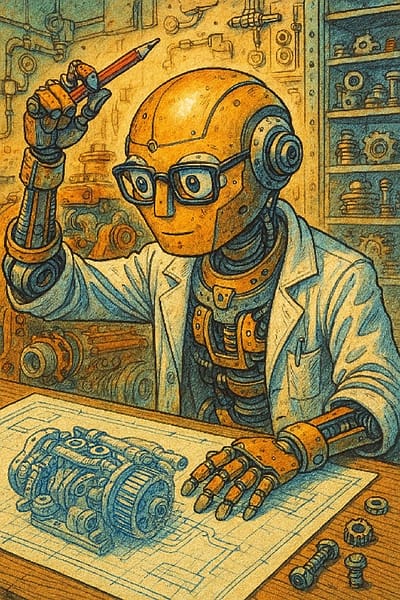
Image generated by Microsoft Copilot.

In my opinion, this forecast is completely unrealistic for the following reason: In a multi-agent system, an error made by one agent will propagate to others, leading to poor or even nonsensical outcomes. Therefore, tight control of model form and approximation errors is essential. While the theoretical understanding of how to control these errors does exist, the vast majority of software tools used in industry, including those mentioned under the heading Simulation & Validation Agency, lack the requisite capabilities and are thus unsuited for incorporation into agentic AI systems.

Any effort to develop an agentic system with some or most of the functionalities listed above should, first and foremost, focus on controlling errors in numerical simulation through the application of verification, validation, and uncertainty quantification procedures.

Building an agentic system on top of legacy finite element modeling practices is like building a skyscraper on quicksand. Any team serious about reaching these capability levels must treat the soundness of numerical simulation as the highest priority, not an afterthought.


Related Blogs:

  • A Memo from the 5th Century BC
  • Obstacles to Progress
  • Why Finite Element Modeling is Not Numerical Simulation?
  • XAI Will Force Clear Thinking About the Nature of Mathematical Models
  • The Story of the P-version in a Nutshell
  • Why Worry About Singularities?
  • Questions About Singularities
  • A Low-Hanging Fruit: Smart Engineering Simulation Applications
  • The Demarcation Problem in the Engineering Sciences
  • Model Development in the Engineering Sciences
  • Certification by Analysis (CbA) – Are We There Yet?
  • Not All Models Are Wrong
  • Digital Twins
  • Digital Transformation
  • Simulation Governance
  • Variational Crimes
  • The Kuhn Cycle in the Engineering Sciences
  • Finite Element Libraries: Mixing the “What” with the “How”
  • A Critique of the World Wide Failure Exercise
  • Meshless Methods
  • Isogeometric Analysis (IGA)
  • Chaos in the Brickyard Revisited
  • Why Is Solution Verification Necessary?
  • Variational Crimes and Refloating the Costa Concordia
  • Lessons From a Failed Model Development Project
  • Where Do You Get the Courage to Sign the Blueprint?
Tags: Agentic AIerror controlNumerical SimulationValidation
0

You also might be interested in

3D Crack Growth Simulation Advancements Webinar Coming Soon
BAMF Example Crack Front Estimate via StressCheck/AFGROW Integration (courtesy Hill Engineering).

3D Crack Growth Simulation Advancements Webinar Coming Soon

May 14, 2019

ESRD is pleased to join Hill Engineering, LLC (developers of BAMF) and LexTech, Inc. (developers of AFGROW) for a joint webinar on July 17, 2019 @ 1:00 pm EST. This collaborative webinar will be titled "3D Crack Growth Simulation: Advancements & Applications", and will detail the latest technological advancements for accurate simulation of three-dimensional metallic crack growth via coupled finite element analysis (FEA) and fatigue life computations.

ESRD’s ASME VVUQ 2023 Symposium Keynote Presentation Recording Now Available
Courtesy ASME.

ESRD’s ASME VVUQ 2023 Symposium Keynote Presentation Recording Now Available

Oct 11, 2023

In mid-May 2023, ESRD’s Co-Founder and Chairman Dr. Barna Szabó delivered a keynote presentation at the ASME VVUQ 2023 Symposium in Baltimore, Maryland, USA. Dr. Szabó’s presentation, entitled “Simulation Governance: An Idea Whose Time Has Come”, will focus on the goals and means of Simulation Governance with reference to mechanical/aerospace engineering practice. We are pleased to announce that the recording of the keynote presentation is now available.

StressCheck Results for “The Standard NAFEMS Benchmarks: Linear Elastic Tests” Are Now Available

StressCheck Results for “The Standard NAFEMS Benchmarks: Linear Elastic Tests” Are Now Available

Feb 15, 2018

Converged StressCheck® results for "The Standard NAFEMS Benchmarks: Linear Elastic Tests” are now available for download! Read more to see how ESRD's Simulation Technology performed [...]

Leave a Reply

We appreciate your feedback!
Cancel Reply

You must be logged in to post a comment.

Looking for Resources?

Interested in a Demo, Evaluation or Purchase?

Have a Software Question, Issue or Feature Request?

Recent News & Events

  • Trustworthiness in Simulation: Credibility or Decision-grade Reliability?
  • Beyond the Black Box: Explainable AI Requires Explainable Simulation
  • Turtle Shells and Legacy Finite Element Codes: Evolutionary Constraints in the Age of Explainable AI

Quick Links

  • Quick Start Guide
  • Documentation
  • Software FAQs
  • Software Demos

Testimonials

  • “Hearty congratulations to management and staff at ESRD on their 25th anniversary. The quality and capability of their software products are excellent. I hope that ESRD successfully continues for many more years with the fundamental principles of mathematical precision, numerical accuracy, and integrity in computational simulation.”

    Dr. William Oberkampf
    Author of Verification and Validation in Scientific Computing

Testimonials

“In the case of the through crack configuration, the comparison of experimental and StressCheck derived geometry factors showed a close correlation and were an improvement to solutions provided in AFGROW at the time. Based on the results of this research, StressCheck pin-loaded lug geometry factors have since been incorporated into the AFGROW software.”

Dr. Alten Grandt, Purdue University

Member Portal

  • Member Registration
  • Member Login

Contact Us

© 2026 · Engineering Software Research & Development, Inc. | Terms & Conditions | Privacy & Cookie Policy | Software License Agreement | Software Maintenance and Technical Support Policy

Prev Next

We use cookies on our website to give you the most relevant experience by remembering your preferences and repeat visits, as outlined in our Cookie Policy. You may adjust your cookie preferences within .

ESRD
Powered by  GDPR Cookie Compliance
Privacy Overview

This website uses cookies to improve your experience while you navigate through the website. Out of these, the cookies that are categorized as necessary are stored on your browser as they are essential for the working of basic functionalities of the website. We also use third-party cookies that help us analyze and understand how you use this website. These cookies will be stored in your browser only with your consent. You also have the option to opt-out of these cookies. But opting out of some of these cookies may affect your browsing experience.

Strictly Necessary Cookies

Strictly Necessary Cookies should be enabled at all times so that we can save your preferences for cookie settings.