• About
    • Who We Are
    • Partners & Providers
    • News & Events
    • The ESRD Blog
    • Careers
    • Contact Us
  • Applications
    • What We Solve
    • Detailed Stress
    • Composites
    • Fracture Mechanics
    • Residual Stress
    • Sim Apps
  • Products
    • What We Develop
    • StressCheck Professional
      • StressCheck Core
      • Solvers
      • Advanced Modules
      • Utilities
      • Academic Licensing
    • StressCheck Apps
      • CAE Handbook
      • StressCheck Tool Box
    • Product Updates
  • Support
    • How We Can Help
    • Training
    • Webinars
    • Quick Start Guide
    • Help Documentation
    • Software FAQ’s
  • Simulation
    • How We Simulate
    • Benchmarks
    • Simulation Governance
    • History of FEA
    • Dictionary & Terms
  • Resources
    • Browse Our Resource Library
    • White Papers
    • Case Studies
    • Product Demos
    • StressCheck Tutorials
Serving the Numerical Simulation community since 1989
  • Contact Us
  • Register
Login
Forgot Password?
Join Us
ESRDESRD
ESRDESRD
  • About
    • Who We Are
    • Partners & Providers
    • News & Events
    • The ESRD Blog
    • Careers
    • Contact Us
  • Applications
    • What We Solve
    • Detailed Stress
    • Composites
    • Fracture Mechanics
    • Residual Stress
    • Sim Apps
  • Products
    • What We Develop
    • StressCheck Professional
      • StressCheck Core
      • Solvers
      • Advanced Modules
      • Utilities
      • Academic Licensing
    • StressCheck Apps
      • CAE Handbook
      • StressCheck Tool Box
    • Product Updates
  • Support
    • How We Can Help
    • Training
    • Webinars
    • Quick Start Guide
    • Help Documentation
    • Software FAQ’s
  • Simulation
    • How We Simulate
    • Benchmarks
    • Simulation Governance
    • History of FEA
    • Dictionary & Terms
  • Resources
    • Browse Our Resource Library
    • White Papers
    • Case Studies
    • Product Demos
    • StressCheck Tutorials

NAFEMS Coil Spring FEA Puzzler Solution Revealed

Home NewsPublicationsNAFEMS Coil Spring FEA Puzzler Solution Revealed

NAFEMS Coil Spring FEA Puzzler Solution Revealed

September 3, 2019 Publications, S.A.F.E.R. Simulation

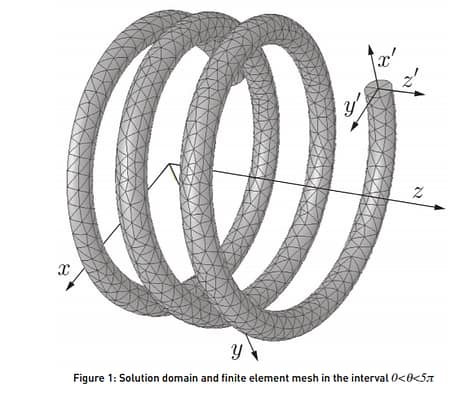
The finite element mesh used in the reference solution for the NAFEMS FEA Puzzler (courtesy NAFEMS).

In a February 2019 S.A.F.E.R. Simulation post, ESRD provided a teaser video of the October 2018 NAFEMS FEA Puzzler solution, in which the incremental spring rates for a 3D coil spring were numerically investigated. In NAFEMS’ July 2019 edition of Benchmark Magazine, ESRD Chairman Dr. Barna Szabó reveals the converged Numerical Simulation solution for the incremental spring rates, provides a summary of the FEA Puzzler respondent submissions, and documents the various approaches taken by the respondents.

As a refresher, the original October 2018 NAFEMS FEA Puzzler description was as follows:
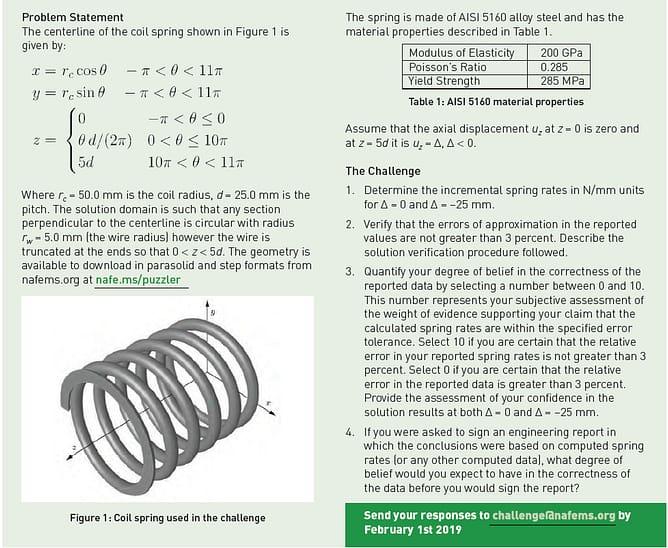
FEA Puzzler from NAFEMS Benchmark Magazine October 2018

Reference Solution

Below is a short summary of Dr. Szabó’s reference solution results, computed with ESRD’s StressCheck and verified by numerical convergence studies (all images courtesy NAFEMS):
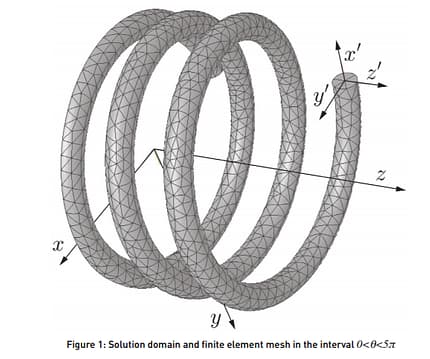
The finite element mesh chosen for the reference solution is shown in Figure 1. The mesh is comprised of 9,691 tetrahedral isoparametric (10-node) elements, and solved by p-extension from p=2 to 5.

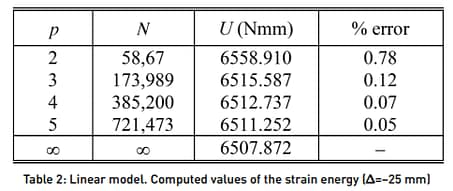
Table 2 summarizes the computed values of strain energy, U, associated with each polynomial level, p, and degrees of freedom, N:
The spring rate, k, may be computed from the strain energy, U, and imposed spring displacement, Δ, using the following equation:

k = 2*U/Δ2

Using the extrapolated value of U, in which N→∞, we compute k = 20.83 N/mm for an imposed spring displacement Δ=-25 mm.

From the NAFEMS FEA Puzzler solution article:

The estimated relative error in k is less than 0.05%. Note that this error does not account for the curved surfaces being approximated by piecewise quadratic polynomials. However, given the large number of 10-node tetrahedra (see Figure 1), the errors of approximation in the surface representation can be neglected.

More generally, the stiffness of the spring can be computed by energy methods. These methods are superconvergent.

Download the Full NAFEMS Article

The entire NAFEMS FEA Puzzler article, complete with the computation of the spring rate via linear and geometric nonlinear force resultants (also shown to be k=20.8 N/mm), comparison with classical methods (k=19.33 N/mm), a summary of respondent submissions, and additional commentary, may be downloaded at the following link:

Download Article


Note: There is a typo in Equation 1 on page 28 of the NAFEMS article. The value of k in Equation 1 should be 20.83 N/mm and not 25.83 N/mm.

Tags: BenchmarksNAFEMSNumerical SimulationSolution Verification
6

You also might be interested in

Happy Holidays from ESRD!

Happy Holidays from ESRD!

Dec 8, 2020

While this past year presented unique challenges and unprecedented disturbances, we hope that you found our customer support, on-demand webinars, web-based training services and overall experience with our team to be refreshingly positive. Click to see a special message from ESRD!

Model Development in the Engineering Sciences

Model Development in the Engineering Sciences

Feb 12, 2024

In the engineering sciences, mathematical models are based on the equations of continuum mechanics, heat flow, Maxwell, Navier-Stokes, or some combination of these. These equations have been validated and their domains of calibration are generally much larger than the expected domain of calibration of the model being developed. In the terminology introduced by Lakatos, the assumptions incorporated in these equations are called hardcore assumptions, and the assumptions incorporated in the other constituents of a model are called auxiliary hypotheses. Model development is concerned with the formulation, calibration, and validation of auxiliary hypotheses.

ESRD + NAVAIR Flaw-Tolerant Presentation Now Available

ESRD + NAVAIR Flaw-Tolerant Presentation Now Available

Jul 6, 2018

This past year, ESRD's Drs. Barna Szabó and Ricardo Actis collaborated with NAVAIR's Mr. Dave Rusk on a technical paper titled "Fatigue Life Prediction of Flaw-Tolerant Damaged Rotorcraft Structures".  This paper was presented at the American Helicopter Society Annual Forum 74 in Phoenix, Arizona May 14-17, 2018. Download the paper and presentation from our Resource Library!

Leave a Reply

We appreciate your feedback!
Cancel Reply

You must be logged in to post a comment.

Looking for Resources?

Interested in a Demo, Evaluation or Purchase?

Have a Software Question, Issue or Feature Request?

Recent News & Events

  • Trustworthiness in Simulation: Credibility or Decision-grade Reliability?
  • Beyond the Black Box: Explainable AI Requires Explainable Simulation
  • Turtle Shells and Legacy Finite Element Codes: Evolutionary Constraints in the Age of Explainable AI

Quick Links

  • Quick Start Guide
  • Documentation
  • Software FAQs
  • Software Demos

Testimonials

  • “Through the use of StressCheck the A-10 Aircraft Structural Integrity Program’s (ASIP) Analysis Group is able to model more accurately the physics of fatigue crack propagation in critical aircraft structure.  Through this tool we are able to model, analyze and predict failure of aircraft structure and then develop crucial inspection and maintenance planes to ensure the safety and sustainability of our nations warplanes.  Without the analysis capability provided to us through StressCheck we would not be able to provide accurate assessments of the A-10 structure to top USAF leadership.”

    SWRI Research Engineer
    Southwest Research Institute

Testimonials

“At DST Group, we have effectively used StressCheck over the last 10 years to determine accurate stress intensity factors. The results have been used to improve our residual strength and structural life estimates for aircraft in service with the Royal Australian Airforce, including C-130, P-3C and F/A-18 A/B. We have found it to be extremely easy to use and a very versatile code with which to create parametric models.

We have recently used StressCheck to obtain improved stress intensity factor solutions (Improved stress intensity factors for selected configurations in cracked plates and Improved stress intensity factors for a single corner crack at a loaded fastener hole) for five key generic configurations. These transferable parametric results have been published externally. One specific example is the non-linear contact analysis of a cracked, filled fastener hole, with both fastener and remote plate loading.”

Dr. Manfred Heller, Head, Structural & Damage Mechanics, DST Group

Member Portal

  • Member Registration
  • Member Login

Contact Us

© 2026 · Engineering Software Research & Development, Inc. | Terms & Conditions | Privacy & Cookie Policy | Software License Agreement | Software Maintenance and Technical Support Policy

Prev Next

We use cookies on our website to give you the most relevant experience by remembering your preferences and repeat visits, as outlined in our Cookie Policy. You may adjust your cookie preferences within .

ESRD
Powered by  GDPR Cookie Compliance
Privacy Overview

This website uses cookies to improve your experience while you navigate through the website. Out of these, the cookies that are categorized as necessary are stored on your browser as they are essential for the working of basic functionalities of the website. We also use third-party cookies that help us analyze and understand how you use this website. These cookies will be stored in your browser only with your consent. You also have the option to opt-out of these cookies. But opting out of some of these cookies may affect your browsing experience.

Strictly Necessary Cookies

Strictly Necessary Cookies should be enabled at all times so that we can save your preferences for cookie settings.