• About
    • Who We Are
    • Partners & Providers
    • News & Events
    • The ESRD Blog
    • Careers
    • Contact Us
  • Applications
    • What We Solve
    • Detailed Stress
    • Composites
    • Fracture Mechanics
    • Residual Stress
    • Sim Apps
  • Products
    • What We Develop
    • StressCheck Professional
      • StressCheck Core
      • Solvers
      • Advanced Modules
      • Utilities
      • Academic Licensing
    • StressCheck Apps
      • CAE Handbook
      • StressCheck Tool Box
    • Product Updates
  • Support
    • How We Can Help
    • Training
    • Webinars
    • Quick Start Guide
    • Help Documentation
    • Software FAQ’s
  • Simulation
    • How We Simulate
    • Benchmarks
    • Simulation Governance
    • History of FEA
    • Dictionary & Terms
  • Resources
    • Browse Our Resource Library
    • White Papers
    • Case Studies
    • Product Demos
    • StressCheck Tutorials
Serving the Numerical Simulation community since 1989
  • Contact Us
  • Register
Login
Forgot Password?
Join Us
ESRDESRD
ESRDESRD
  • About
    • Who We Are
    • Partners & Providers
    • News & Events
    • The ESRD Blog
    • Careers
    • Contact Us
  • Applications
    • What We Solve
    • Detailed Stress
    • Composites
    • Fracture Mechanics
    • Residual Stress
    • Sim Apps
  • Products
    • What We Develop
    • StressCheck Professional
      • StressCheck Core
      • Solvers
      • Advanced Modules
      • Utilities
      • Academic Licensing
    • StressCheck Apps
      • CAE Handbook
      • StressCheck Tool Box
    • Product Updates
  • Support
    • How We Can Help
    • Training
    • Webinars
    • Quick Start Guide
    • Help Documentation
    • Software FAQ’s
  • Simulation
    • How We Simulate
    • Benchmarks
    • Simulation Governance
    • History of FEA
    • Dictionary & Terms
  • Resources
    • Browse Our Resource Library
    • White Papers
    • Case Studies
    • Product Demos
    • StressCheck Tutorials

ESRD + NAVAIR Flaw-Tolerant Presentation Now Available

Home EventsConferenceESRD + NAVAIR Flaw-Tolerant Presentation Now Available

ESRD + NAVAIR Flaw-Tolerant Presentation Now Available

July 6, 2018 Conference, New Resource, News, Publications

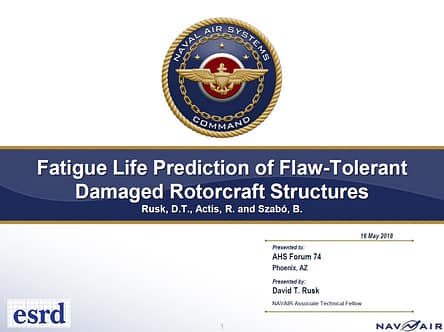
This past year, ESRD’s Drs. Barna Szabó and Ricardo Actis collaborated with Naval Air Systems Command’s Mr. Dave Rusk on a technical paper titled “Fatigue Life Prediction of Flaw-Tolerant Damaged Rotorcraft Structures”.  This paper was presented at the American Helicopter Society Annual Forum 74 in Phoenix, Arizona May 14-17, 2018.

The presentation and paper report the work done by ESRD and NAVAIR under a SBIR program to develop an analytical approach to predicting the remaining useful fatigue life of metallic rotorcraft structural components with surface flaws.  Below is the paper’s abstract:

A phenomenological model has been developed to predict the remaining useful life of flaw-damaged Ti 6Al-4V Beta-STOA titanium and 7075-T73 aluminum rotorcraft components. The model extends the use of traditional notched fatigue analysis methods that were developed for machined notches, down to the scale of small surface flaws such as dents, dings, scratches, gouges and corrosion pits. The highly stressed volume in the vicinity of flaws is used for reference in the model calibration. This eliminates the requirement to define an equivalent notch root radius for an arbitrary flaw shape. Calibration of the model was performed using sets of dogbone fatigue coupons with embedded surface flaws. Validation of the model was performed using other sets of dogbone and double-edge notched tension (DENT) flawed coupon fatigue test data, under both constant amplitude and spectrum loading. Validation results have shown that the model provides reasonably accurate life predictions within the range of calibration of the model, when compared to a reference S-N working curve. The analytical capability demonstrated here has important implications for current life management practices of rotorcraft dynamic components. Fatigue life prediction of flaw damaged components is a key enabling technology for the application of Condition Based Maintenance (CBM) practices to rotor system structures.

The paper and presentation can be downloaded below:

Fatigue Life Prediction of Flaw-Tolerant Damaged Rotorcraft Structures

Tags: Aerospace and DefenseDaDTFatigueNumerical SimulationResource LibraryRotorcraftStressCheck
2

You also might be interested in

Happy Holidays from ESRD!

Happy Holidays from ESRD!

Dec 8, 2020

While this past year presented unique challenges and unprecedented disturbances, we hope that you found our customer support, on-demand webinars, web-based training services and overall experience with our team to be refreshingly positive. Click to see a special message from ESRD!

StressCheck User Experience v2.0 Survey Results

StressCheck User Experience v2.0 Survey Results

Apr 21, 2020

In early 2020 ESRD rolled out v2.0 of the StressCheck User Experience survey, and the results have been tallied! Find out what features & applications your peers want to see in a future StressCheck release.

Happy Holidays from ESRD (2022 Edition)

Happy Holidays from ESRD (2022 Edition)

Dec 20, 2022

As we continue to adapt to a mix of remote and in-office work, we hope that this past year you found our software products, customer support, training options/courses, "StressCheck Tip of the Week" posts, and e-Learning resources to be helpful and accommodating. We certainly couldn't do it without your valuable feedback and contributions! We are committed to supporting your current and future engineering endeavors and look forward to what the future holds in 2023. Happy Holidays from all of us at ESRD, and we hope you'll check out our year-end summary!

Leave a Reply

We appreciate your feedback!
Cancel Reply

You must be logged in to post a comment.

Looking for Resources?

Interested in a Demo, Evaluation or Purchase?

Have a Software Question, Issue or Feature Request?

Recent News & Events

  • Trustworthiness in Simulation: Credibility or Decision-grade Reliability?
  • Beyond the Black Box: Explainable AI Requires Explainable Simulation
  • Turtle Shells and Legacy Finite Element Codes: Evolutionary Constraints in the Age of Explainable AI

Quick Links

  • Quick Start Guide
  • Documentation
  • Software FAQs
  • Software Demos

Testimonials

  • “We used StressCheck on two projects last year, and we were very happy with it. I thank your engineers who provided their insights and suggestions for us during these projects. We really appreciate your team’s contributions this year to the Navy P-8 project. We look forward to working with ESRD again during next year on other Navy projects.”

    Dr. Nagaraja Iyyer
    Director of Engineering, Technical Data Analysis, Inc.

Testimonials

“Through the use of StressCheck the A-10 Aircraft Structural Integrity Program’s (ASIP) Analysis Group is able to model more accurately the physics of fatigue crack propagation in critical aircraft structure.  Through this tool we are able to model, analyze and predict failure of aircraft structure and then develop crucial inspection and maintenance planes to ensure the safety and sustainability of our nations warplanes.  Without the analysis capability provided to us through StressCheck we would not be able to provide accurate assessments of the A-10 structure to top USAF leadership.”

SWRI Research Engineer, Southwest Research Institute

Member Portal

  • Member Registration
  • Member Login

Contact Us

© 2026 · Engineering Software Research & Development, Inc. | Terms & Conditions | Privacy & Cookie Policy | Software License Agreement | Software Maintenance and Technical Support Policy

Prev Next

We use cookies on our website to give you the most relevant experience by remembering your preferences and repeat visits, as outlined in our Cookie Policy. You may adjust your cookie preferences within .

ESRD
Powered by  GDPR Cookie Compliance
Privacy Overview

This website uses cookies to improve your experience while you navigate through the website. Out of these, the cookies that are categorized as necessary are stored on your browser as they are essential for the working of basic functionalities of the website. We also use third-party cookies that help us analyze and understand how you use this website. These cookies will be stored in your browser only with your consent. You also have the option to opt-out of these cookies. But opting out of some of these cookies may affect your browsing experience.

Strictly Necessary Cookies

Strictly Necessary Cookies should be enabled at all times so that we can save your preferences for cookie settings.