
• About
    • Who We Are
    • Partners & Providers
    • News & Events
    • The ESRD Blog
    • Careers
    • Contact Us
  • Applications
    • What We Solve
    • Detailed Stress
    • Composites
    • Fracture Mechanics
    • Residual Stress
    • Sim Apps
  • Products
    • What We Develop
    • StressCheck Professional
      • StressCheck Core
      • Solvers
      • Advanced Modules
      • Utilities
      • Academic Licensing
    • StressCheck Apps
      • CAE Handbook
      • StressCheck Tool Box
    • Product Updates
  • Support
    • How We Can Help
    • Training
    • Webinars
    • Quick Start Guide
    • Help Documentation
    • Software FAQ’s
  • Simulation
    • How We Simulate
    • Benchmarks
    • Simulation Governance
    • History of FEA
    • Dictionary & Terms
  • Resources
    • Browse Our Resource Library
    • White Papers
    • Case Studies
    • Product Demos
    • StressCheck Tutorials
Serving the Numerical Simulation community since 1989
  • Contact Us
  • Register
Login
Forgot Password?
Join Us
ESRDESRD
ESRDESRD
  • About
    • Who We Are
    • Partners & Providers
    • News & Events
    • The ESRD Blog
    • Careers
    • Contact Us
  • Applications
    • What We Solve
    • Detailed Stress
    • Composites
    • Fracture Mechanics
    • Residual Stress
    • Sim Apps
  • Products
    • What We Develop
    • StressCheck Professional
      • StressCheck Core
      • Solvers
      • Advanced Modules
      • Utilities
      • Academic Licensing
    • StressCheck Apps
      • CAE Handbook
      • StressCheck Tool Box
    • Product Updates
  • Support
    • How We Can Help
    • Training
    • Webinars
    • Quick Start Guide
    • Help Documentation
    • Software FAQ’s
  • Simulation
    • How We Simulate
    • Benchmarks
    • Simulation Governance
    • History of FEA
    • Dictionary & Terms
  • Resources
    • Browse Our Resource Library
    • White Papers
    • Case Studies
    • Product Demos
    • StressCheck Tutorials

StressCheck v11 Update 1 Released!

Home Resource LibraryNew ResourceStressCheck v11 Update 1 Released!

StressCheck v11 Update 1 Released!

June 17, 2021 New Resource, News, Product Updates

ESRD is pleased to announce that we’ve released StressCheck Professional v11 Update 1. In addition to all the improvements introduced with the release of StressCheck v11, in Update 1 we have optimized the Solve and Results panes for maximum efficiency and improved user flow. Each solver tab now contains all the appropriate solver inputs, user-defined solution settings, and commands to seamlessly perform the desired analysis. Similarly, all extraction settings are automatically labeled and available directly on each tab.
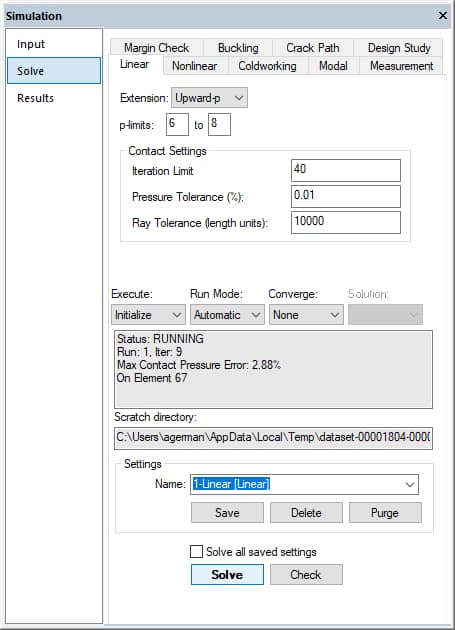
Solve pane during a multi-body contact analysis.

StressCheck v11 Update 1 includes the following key features and enhancements since the release of StressCheck v11 in December 2020:

  • General GUI Cleanup, Tune-ups, Optimizations & Fixes
  • Optimized Solve and Results Panes for Improved User Flow
  • Dockable Panes Extended to Display Objects, View Controls, & More
  • New Feature for Exporting & Importing Solution and/or Extracting Settings
  • Significantly Improved Accuracy of Mesh Region Assignments
  • Offline Documentation Now Available

Watch the StressCheck v11 Update 1 Demo

Watch this short video for a demonstration of some of the new features and enhancements available in StressCheck v11 Update 1:


Learn More About StressCheck v11 Update 1

Scroll through the below PDF to view detailed descriptions of the new StressCheck v11 Update 1 features and enhancements:

Loader Loading...
EAD Logo Taking too long?
Reload Reload document
| Open Open in new tab

Download StressCheck v11 Update 1

Download the StressCheck v11 Update 1 MSI from our StressCheck software download page (Software Downloader membership is required):

Get Latest Update

Note: StressCheck v11 Update 1 may be installed concurrently with StressCheck v10.x. Installing StressCheck v11 Update 1 will automatically uninstall StressCheck v11. StressCheck v11 Update 1 does not require a license upgrade if StressCheck v11 licenses are already installed.

Tags: Numerical SimulationResource LibraryStressCheck
4

You also might be interested in

The Demarcation Problem in the Engineering Sciences

The Demarcation Problem in the Engineering Sciences

Feb 1, 2024

In engineering sciences, we classify mathematical models as ‘proper’ or ‘improper’ rather than ‘scientific’ or ‘pseudoscientific’. A model is said to be proper if it is consistent with the relevant mathematical theorems that guarantee the existence and, when applicable, the uniqueness of the exact solution. Otherwise, the model is improper. At present, the large majority of models used in engineering practice are improper. Following are examples of frequently occurring types of error, with brief explanations.

New Webinar: Simulation Governance & Management (NWC 2021)
Calibration of the predictor.

New Webinar: Simulation Governance & Management (NWC 2021)

Sep 8, 2021

In this 15-minute pre-recorded webinar, ESRD Chairman Dr. Barna Szabó addresses some of the key issues of simulation governance, including how model development must adhere to the requirements of simulation governance in order to minimize risk and increase reliability.

Great Expectations: Agentic AI in Mechanical Engineering
Image generated by Microsoft Copilot.

Great Expectations: Agentic AI in Mechanical Engineering

Dec 11, 2025

Building an agentic system on top of legacy finite element modeling practices is like building a skyscraper on quicksand. Any team serious about reaching these capability levels must treat the soundness of numerical simulation as the highest priority, not an afterthought.

Leave a Reply

We appreciate your feedback!
Cancel Reply

You must be logged in to post a comment.

Looking for Resources?

Interested in a Demo, Evaluation or Purchase?

Have a Software Question, Issue or Feature Request?

Recent News & Events

  • Trustworthiness in Simulation: Credibility or Decision-grade Reliability?
  • Beyond the Black Box: Explainable AI Requires Explainable Simulation
  • Turtle Shells and Legacy Finite Element Codes: Evolutionary Constraints in the Age of Explainable AI

Quick Links

  • Quick Start Guide
  • Documentation
  • Software FAQs
  • Software Demos

Testimonials

  • “The addition of incremental theory of plasticity in StressCheck has greatly improved our ability to accurately predict the fatigue life of joints with interference fit fasteners and cold worked holes. This ability is especially important, not only in support of maintaining aging aircraft but also in analyzing some of the new cold working techniques that have been introduced in recent years.
    Prior to this implementation, analysts often relied on closed-form approximations or simple factors that were often overly conservative and sometimes even unconservative when used in life prediction. Now, not only can we more accurately predict residual stresses in these complex structural joints, but we can also do so in a timely manner given the modeling and analysis efficiency that exists with a p-version FEA code such as StressCheck.”

    F-15 Structures Manager
    The Boeing Company

Testimonials

“StressCheck is the work horse for NAVAIR Structures’ detailed stress and stress concentration calculations. This software also is the basis for our development of a Structural Analysis Management System.”

Dr. David John Barrett, Head , Airframe Technology Branch, NAVAIR

Member Portal

  • Member Registration
  • Member Login

Contact Us

© 2026 · Engineering Software Research & Development, Inc. | Terms & Conditions | Privacy & Cookie Policy | Software License Agreement | Software Maintenance and Technical Support Policy

Prev Next

We use cookies on our website to give you the most relevant experience by remembering your preferences and repeat visits, as outlined in our Cookie Policy. You may adjust your cookie preferences within .

ESRD
Powered by  GDPR Cookie Compliance
Privacy Overview

This website uses cookies to improve your experience while you navigate through the website. Out of these, the cookies that are categorized as necessary are stored on your browser as they are essential for the working of basic functionalities of the website. We also use third-party cookies that help us analyze and understand how you use this website. These cookies will be stored in your browser only with your consent. You also have the option to opt-out of these cookies. But opting out of some of these cookies may affect your browsing experience.

Strictly Necessary Cookies

Strictly Necessary Cookies should be enabled at all times so that we can save your preferences for cookie settings.