Watch Teaser Video for the NAFEMS Coil Spring FEA Puzzler
The deadline for the NAFEMS coil spring “FEA Puzzler” submissions has been extended through June 1st! View a teaser video of ESRD’s StressCheck model and qualitative deformation results.
ESRD, Inc. will be exhibiting and providing a training course on verifying the accuracy of engineering simulations at the AA&S/PS&S Conference 2019 in Washington, D.C. from April 22-26, 2019. We hope you will drop by our training course and booth to check out the latest!
March 18, 2021 @ 10:00 am EST
Strategies for the democratization & standardization of recurring simulation tasks via ESRD’s CAE Handbook will be demonstrated. This webinar is now available to watch on-demand.

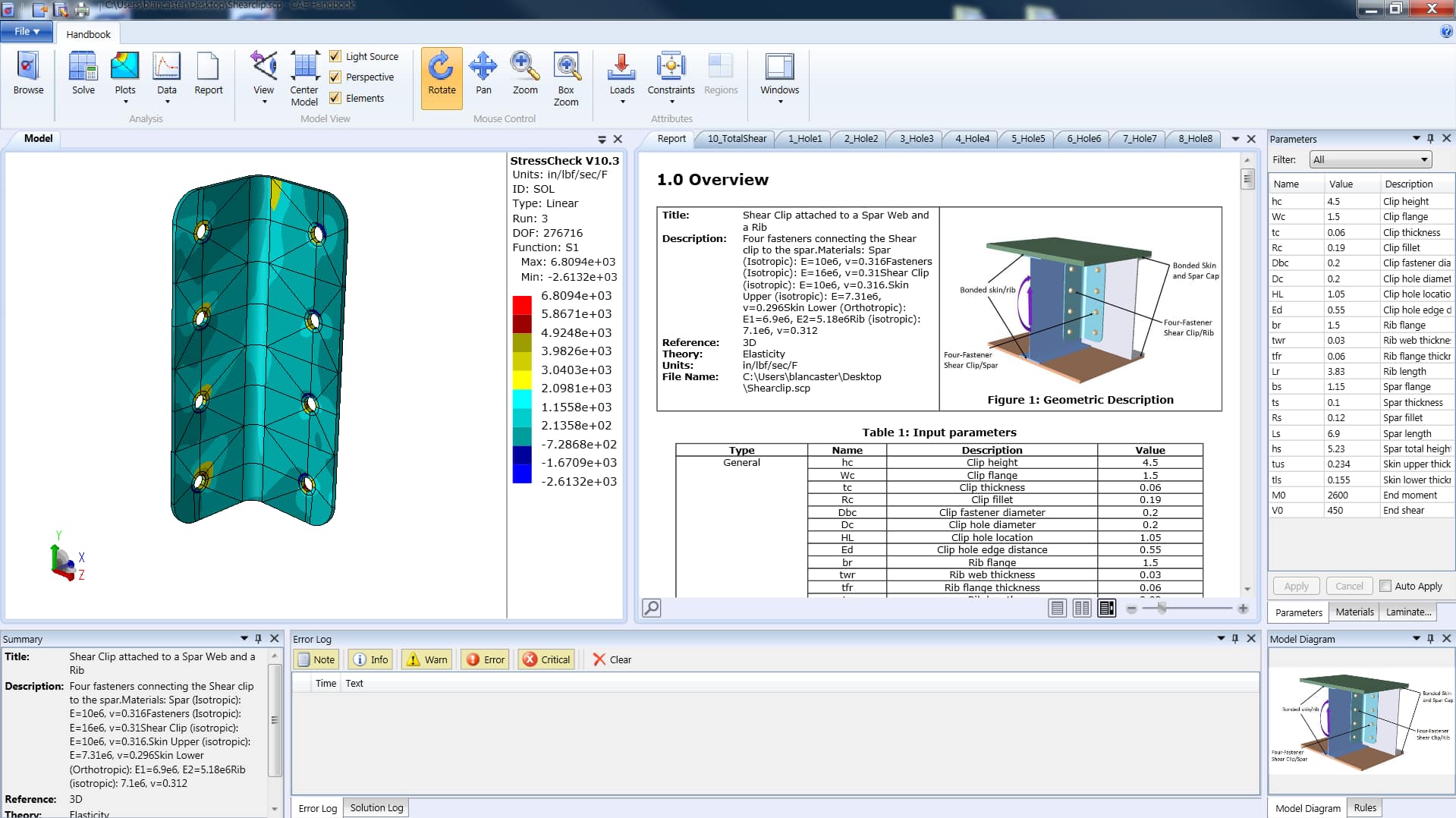
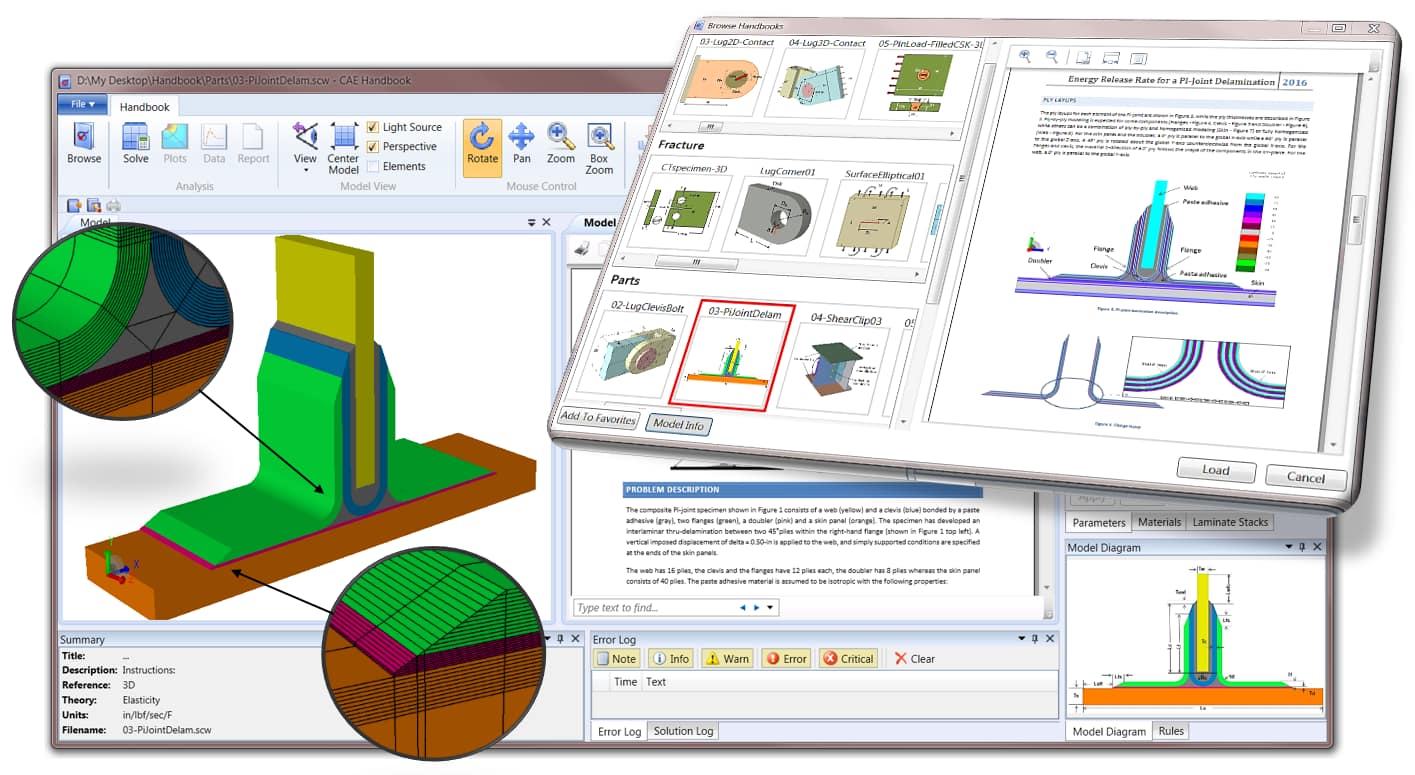
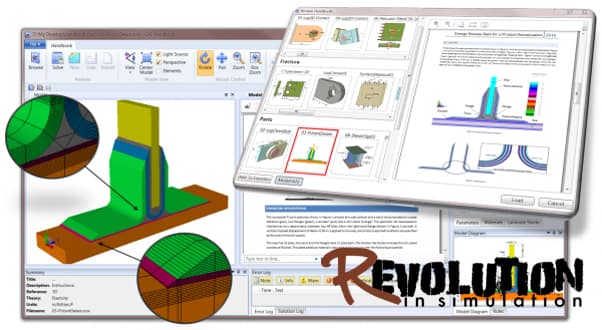
ESRD’s CAE Handbook
In this 45-minute webinar, hosted by the Altair Partner Alliance (APA), we will discuss how ESRD’s CAE Handbook modernizes and streamlines the implementation of digital engineering handbooks for the standardization of corporate process workflows.

The CAE Handbook framework allows for the corporate standardization of many engineering computational simulations. This is done by allowing companies to build an electronic or digital handbook models that captures corporate intellectual property. This enables non-FEA experts to solve many basic simulations that historically have been simplified in the form of Microsoft Excel engineering computation spreadsheets, and internally developed engineering programs that are only fully understood by the engineers who develop them. CAE Handbook guarantees consistent results and provides an objective measure of the quality of the solution.
Topics covered include:
April 22, 2021 @ 11:00 am EST
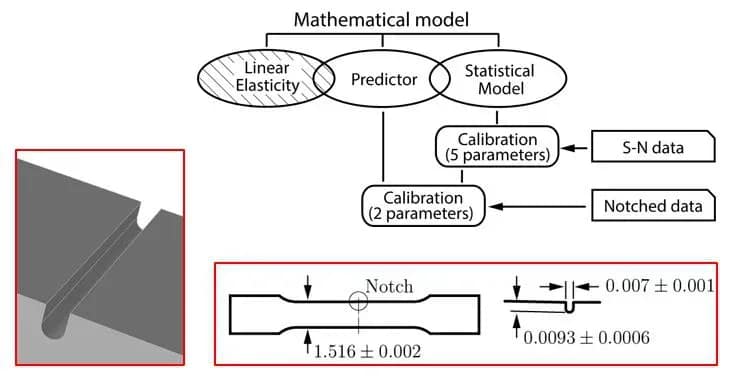
Strategies will be explored for developing mathematical models to support condition-based maintenance (CBM) decisions via a practical case study.


This webinar, hosted by ESRD partner Revolution in Simulation, will present a case study in which the goal was the development of a mathematical model for supporting condition-based maintenance (CBM) decisions.
The model was designed for estimating the remaining fatigue service life of high-value mechanical components, given their service history and that specific flaws (such as corrosion defects) have been discovered in them, thus enabling CBM to move damaged component removals from unscheduled to scheduled maintenance action.
September 2, 2021 @ 1:00 pm EST
This 15-minute recorded presentation was prepared for the NAFEMS World Congress (Salzburg, October 2021). It highlights the mission-oriented nature of simulation governance and presents an example of a model development project.
This webinar is now available to watch on-demand.

The main ideas of, and the case for, simulation governance are easy to understand. The development and implementation of a plan for simulation governance is not at all easy, however, and requires careful consideration of the mission, and associated predictive model(s), at hand.
In this pre-recorded webinar, ESRD Chairman Dr. Barna Szabó addresses some of the key issues of simulation governance, including how model development must adhere to the requirements of simulation governance in order to minimize risk and magnify reliability.
Note: this webinar was originally prepared by Drs. Szabó and Actis for the NAFEMS World Congress 2021 session on Simulation Governance.
February 12, 2020 @ 1:00 pm EST
Strategies for mastering StressCheck Professional for a variety of Aerospace & Defense engineering applications, and a review of the available training options and online resources, will be explored.
This webinar is now available to watch on-demand.

In this 2 hour webinar we will review training approaches focused on applications to make numerical simulation via finite element analysis S.A.F.E.R. - Simple, Accurate, Fast, Efficient, and Reliable.
January 16, 2019 @ 1:00 pm EST
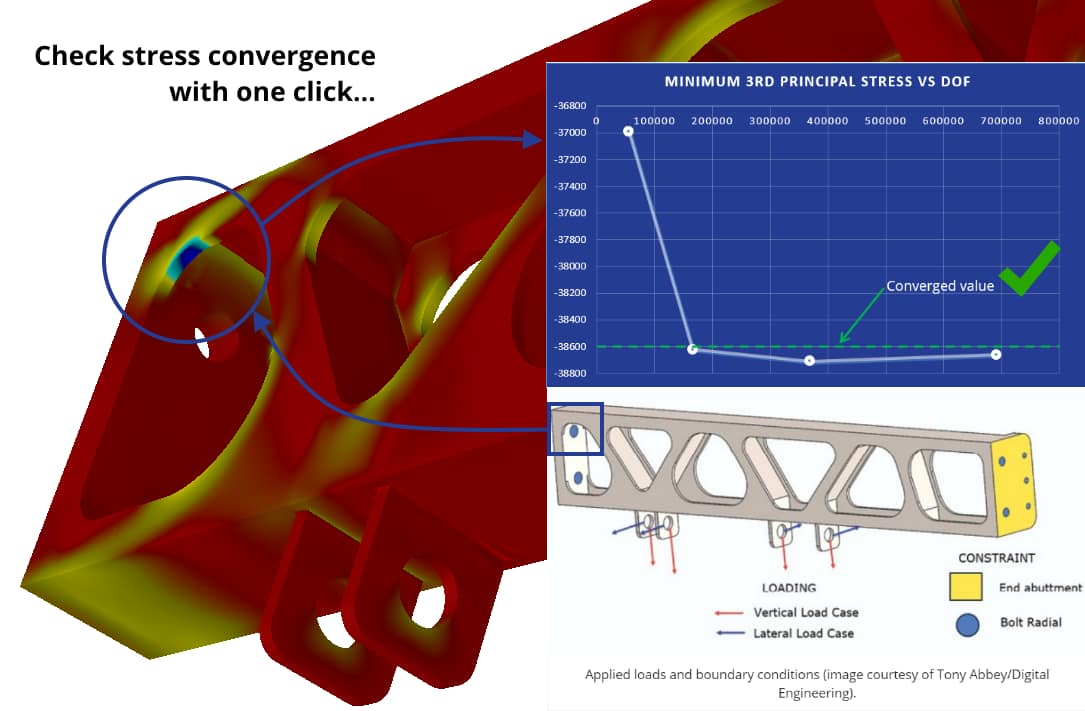
Strategies for verifying the accuracy of engineering data will be explored, including best practices and common pitfalls engineers may encounter when assessing the quality of the results.

July 29, 2019 @ 1:00 pm EST
Strategies will be explored for democratizing engineering simulations via Sim Apps which are: 1) based on the latest Numerical Simulation technologies, 2) available in Commercial Off the Shelf (COTS) form, and most importantly 3) Simulation Governance-compliant.
This webinar is now available to watch on-demand.

When utilized by engineers without specialized training, simulation technologies (and Sim Apps) based on legacy FEA technologies struggle to deliver trustworthy solutions due to their inability to objectively measure & report solution quality, an essential requirement of Simulation Governance (Sim Gov). This uncertainty inhibits true democratization of engineering simulations. So what is needed?
In this timely webinar, we will discuss why it is essential that Sim Apps implement Numerical Simulation technologies which enable the practice of Sim Gov in order for the vision of democratization of simulations to be realized, as well as why it is important for engineering managers to get on the Sim Gov train sooner rather than later.
July 17, 2019 @ 1:00 pm EST
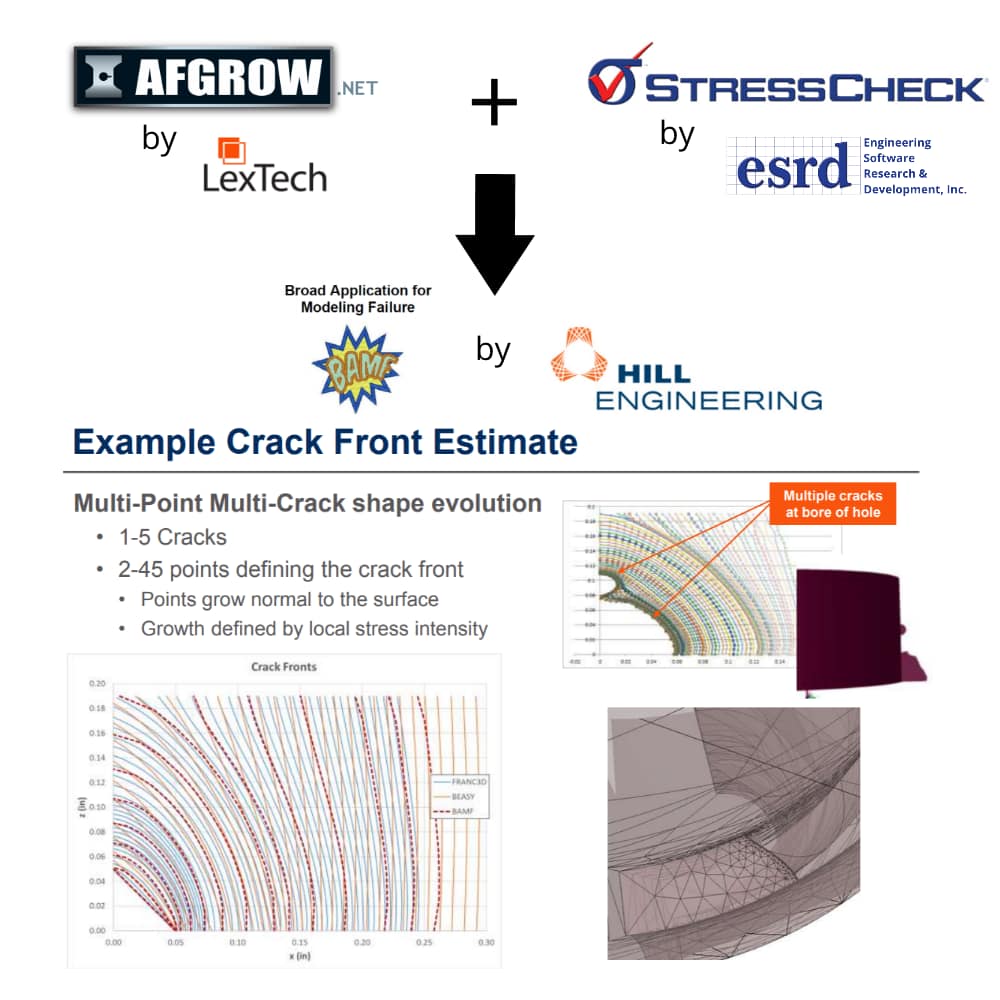
Strategies for seamlessly integrating the advanced fracture & DaDT capabilities of two numerical simulation software products into a state-of-the-art 3D fatigue crack growth application will be explored.
This webinar is now available to watch on-demand.

In this webinar we will detail the latest technological advancements for accurate simulation of three-dimensional metallic crack growth via coupled finite element analysis (FEA) and fatigue life computations. Additionally, we will examine why the development of more complex crack growth models requires both tighter control over numerical errors (i.e. solution verification) and rigorous benchmarking to standard handbook solutions and available experimental data (i.e. model validation).
StressCheck is a comprehensive Windows 10-compatible, 64-bit finite element analysis software (FEA) tool with a fully integrated pre- and post-processor and a suite of solver and analysis modules that support advanced engineering computations in applications of solid mechanics. Productivity tools are available to import NASTRAN bulk data file meshes and CAD geometry, perform 2D and 3D automatic meshing, automate analyses via StressCheck‘s API, and more. StressCheck is ideally suited for damage tolerance and forensic engineers who need the best representation of 2D or 3D SIF’s, ERR’s and beta factors for input in sophisticated crack growth simulations, or when analyzing repairs for mitigation of cracks.
AFGROW is a Damage Tolerance Analysis (DTA) framework that allows users to analyze crack initiation, fatigue crack growth, and fracture to predict the life of metallic structures. AFGROW (Air Force Grow), was originally developed by The Air Force Research Laboratory. It is now being developed and maintained by LexTech, Inc. AFGROW is one of the most efficient and widely used crack growth life prediction tools available today. AFGROW is mainly used for aerospace applications; however, it can be applied to any type of metallic structure that experiences fatigue cracking. AFGROW is also a very flexible and user-friendly computer program.
BAMF is used for fatigue analysis, and it is capable of predicting the growth of fatigue cracks in 3D parts. Starting from an assumed initial flaw, BAMF combines stress and crack growth analyses to predict the evolution of crack shape and size in 3D. BAMF provides a robust and automated link between two leading tools: AFGROW and StressCheck. Key features of BAMF include: natural crack shape evolution, fully 3D fatigue analysis capability, complex loading support, multiple cracks, and residual stress compatibility.
September 2, 2021 @ 1:00 pm EST Simulation Governance & Management This 15-minute recorded presentation was prepared for the NAFEMS...
“The p-type element has been used to great advantage in the finite element system ESRD StressCheck, [26]. This software provides the engineer with the means to conduct solution verification in an extremely straightforward manner by simply increasing the degree of the element, monitoring convergence and using Richardson extrapolation reliably to estimate the error. This can be conducted automatically by the software thereby enabling the engineer to concentrate on the engineering rather than the simulation. StressCheck has also been used to develop ESRD’s Handbook and Toolbox applications. The first of these provides engineers with a repository of parameterised standard problems of the type found in texts like Roark’s “Formulas for Stress and Strain”, [27]. The second, Toolbox, is a tool that can be used to parameterise a company’s range of components for rapid and reliable analysis by non-expert analysis. Toolbox then is an exemplary of the way in which the democratisation of simulation can be applied.”
© 2026 · Engineering Software Research & Development, Inc. | Terms & Conditions | Privacy & Cookie Policy | Software License Agreement | Software Maintenance and Technical Support Policy