• About
    • Who We Are
    • Partners & Providers
    • News & Events
    • The ESRD Blog
    • Careers
    • Contact Us
  • Applications
    • What We Solve
    • Detailed Stress
    • Composites
    • Fracture Mechanics
    • Residual Stress
    • Sim Apps
  • Products
    • What We Develop
    • StressCheck Professional
      • StressCheck Core
      • Solvers
      • Advanced Modules
      • Utilities
      • Academic Licensing
    • StressCheck Apps
      • CAE Handbook
      • StressCheck Tool Box
    • Product Updates
  • Support
    • How We Can Help
    • Training
    • Webinars
    • Quick Start Guide
    • Help Documentation
    • Software FAQ’s
  • Simulation
    • How We Simulate
    • Benchmarks
    • Simulation Governance
    • History of FEA
    • Dictionary & Terms
  • Resources
    • Browse Our Resource Library
    • White Papers
    • Case Studies
    • Product Demos
    • StressCheck Tutorials
Serving the Numerical Simulation community since 1989
  • Contact Us
  • Register
Login
Forgot Password?
Join Us
ESRDESRD
ESRDESRD
  • About
    • Who We Are
    • Partners & Providers
    • News & Events
    • The ESRD Blog
    • Careers
    • Contact Us
  • Applications
    • What We Solve
    • Detailed Stress
    • Composites
    • Fracture Mechanics
    • Residual Stress
    • Sim Apps
  • Products
    • What We Develop
    • StressCheck Professional
      • StressCheck Core
      • Solvers
      • Advanced Modules
      • Utilities
      • Academic Licensing
    • StressCheck Apps
      • CAE Handbook
      • StressCheck Tool Box
    • Product Updates
  • Support
    • How We Can Help
    • Training
    • Webinars
    • Quick Start Guide
    • Help Documentation
    • Software FAQ’s
  • Simulation
    • How We Simulate
    • Benchmarks
    • Simulation Governance
    • History of FEA
    • Dictionary & Terms
  • Resources
    • Browse Our Resource Library
    • White Papers
    • Case Studies
    • Product Demos
    • StressCheck Tutorials

‘How Do You Verify the Accuracy of Engineering Simulations?’ Webinar Recording Now Available

Home Events‘How Do You Verify the Accuracy of Engineering Simulations?’ Webinar Recording Now Available

‘How Do You Verify the Accuracy of Engineering Simulations?’ Webinar Recording Now Available

January 16, 2019 Events, Webinars

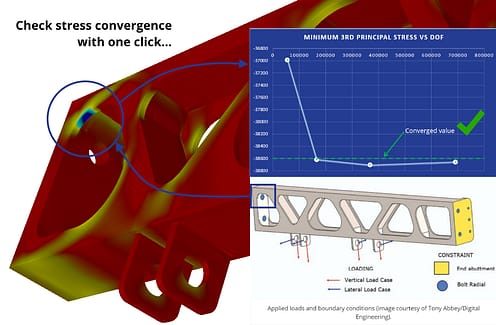
Convergence of minimum principal stress in an aircraft keel beam structure (courtesy Digital Engineering)

On Wednesday, January 16, 2019 an FEA best practices webinar titled “How Do You Verify the Accuracy of Engineering Simulations?” was provided by ESRD’s Brent Lancaster and Gordon Lehman. This webinar was intended to dive deeper into the S.A.F.E.R. Simulation principles originally introduced in our High-Fidelity Stress Analysis for SAFER Simulation webinar, notably what are the minimum checks required to inspire confidence in FEA solutions and what are the recommended techniques to achieve this goal.

In this essential webinar, we shared best practices for verifying the accuracy of detailed stress analysis results, including the Four Key Quality Checks. Additionally, we provided a live demo of a practical industry example to reinforce these best practices and demonstrate our advanced live dynamic processing capabilities in support of solution verification.

View Webinar Recording

Click the below button to view the 38-minute webinar recording (scroll to the bottom of the webinar landing page and click the play button):

View Recording

Download Webinar Slides

Click the below button to download the webinar slides (PowerPoint Show and PDF) below:

Download Slides


As always, thanks to our attendees for their interest and feedback! We are already looking forward to our next webinar (date and topic TBD).

Tags: BenchmarksDetailed StressDigital EngineeringNAFEMSNumerical SimulationSolution VerificationStressCheckWebinar
5

You also might be interested in

ASIP 2019 Conference Recap
ESRD's Brent Lancaster prepares to discuss StressCheck with attendees during a break at ASIP 2019.

ASIP 2019 Conference Recap

Dec 10, 2019

This past week at ASIP 2019, ESRD provided a training course titled "Automated 3D Crack Beta Curve Development via Smart Sim Apps", chatted with ASIP attendees, provided a StressCheck Clinic, and exhibited at our booth. Read the summary of events and download the ASIP training course presentation and beta factor Sim Apps!

ASIP 2022 Conference Recap
ESRD's Exhibit Booth at ASIP 2022 in Phoenix, AZ.

ASIP 2022 Conference Recap

Dec 8, 2022

Recently at ASIP 2022 in Phoenix, AZ, ESRD provided a 2-hour training course titled “Best Practices for the Modeling and Analysis of Bonded Doubler Repairs”, presented a technical paper titled "DTA of Bonded Repairs on the Wing Skin of the C-130 Using Finite Elements", chatted with "patients" at the StressCheck Clinic, and exhibited at our captivating booth inside the Sheraton Phoenix Hotel & Conference Center. We are also planning a webinar for February 7, 2023 titled "What's New and Improved in StressCheck Professional". We hope you can attend this "must-see" event! Read the summary of conference events, view the ASIP training course content (including the presentation and demo videos), and register for our upcoming webinar.

Hierarchic Approaches to Modeling Fastened Connections Webinar Coming Soon
Comparison of von Mises stress distributions for fastened connection model hierarchies.

Hierarchic Approaches to Modeling Fastened Connections Webinar Coming Soon

Jun 12, 2018

There is now only one week until ESRD's June 20th @ 1:00 pm EST webinar titled "Hierarchic Approaches to Modeling Fastened Connections". Register now to learn more and get the meeting details!

Leave a Reply

We appreciate your feedback!
Cancel Reply

You must be logged in to post a comment.

Looking for Resources?

Interested in a Demo, Evaluation or Purchase?

Have a Software Question, Issue or Feature Request?

Recent News & Events

  • Trustworthiness in Simulation: Credibility or Decision-grade Reliability?
  • Beyond the Black Box: Explainable AI Requires Explainable Simulation
  • Turtle Shells and Legacy Finite Element Codes: Evolutionary Constraints in the Age of Explainable AI

Quick Links

  • Quick Start Guide
  • Documentation
  • Software FAQs
  • Software Demos

Testimonials

  • The software provides a highly reliable and user-friendly production stress analysis tool that will replace the Finite Element Method (FEM) tools and failure criteria the experts currently employ for analyzing bonded joints. The software includes an FEM-based handbook format, which allows non-experts to utilize models prepared by specialists. The handbook problems include built-in failure criteria, geometric and material nonlinearities, and the modern FEM technology provides better error control and the treatment of very large aspect ratios.”

    Dr. Stephen P. Engelstad
    Technical Fellow, Lockheed Martin Aeronautics Company, Structural Methods and Analysis

Testimonials

“StressCheck’s quality control features have given us the tool we need to perform detailed … bonded joint analysis with confidence that the results are accurate.”

Technical Fellow, The Boeing Company

Member Portal

  • Member Registration
  • Member Login

Contact Us

© 2026 · Engineering Software Research & Development, Inc. | Terms & Conditions | Privacy & Cookie Policy | Software License Agreement | Software Maintenance and Technical Support Policy

Prev Next

We use cookies on our website to give you the most relevant experience by remembering your preferences and repeat visits, as outlined in our Cookie Policy. You may adjust your cookie preferences within .

ESRD
Powered by  GDPR Cookie Compliance
Privacy Overview

This website uses cookies to improve your experience while you navigate through the website. Out of these, the cookies that are categorized as necessary are stored on your browser as they are essential for the working of basic functionalities of the website. We also use third-party cookies that help us analyze and understand how you use this website. These cookies will be stored in your browser only with your consent. You also have the option to opt-out of these cookies. But opting out of some of these cookies may affect your browsing experience.

Strictly Necessary Cookies

Strictly Necessary Cookies should be enabled at all times so that we can save your preferences for cookie settings.