• About
    • Who We Are
    • Partners & Providers
    • News & Events
    • The ESRD Blog
    • Careers
    • Contact Us
  • Applications
    • What We Solve
    • Detailed Stress
    • Composites
    • Fracture Mechanics
    • Residual Stress
    • Sim Apps
  • Products
    • What We Develop
    • StressCheck Professional
      • StressCheck Core
      • Solvers
      • Advanced Modules
      • Utilities
      • Academic Licensing
    • StressCheck Apps
      • CAE Handbook
      • StressCheck Tool Box
    • Product Updates
  • Support
    • How We Can Help
    • Training
    • Webinars
    • Quick Start Guide
    • Help Documentation
    • Software FAQ’s
  • Simulation
    • How We Simulate
    • Benchmarks
    • Simulation Governance
    • History of FEA
    • Dictionary & Terms
  • Resources
    • Browse Our Resource Library
    • White Papers
    • Case Studies
    • Product Demos
    • StressCheck Tutorials
Serving the Numerical Simulation community since 1989
  • Contact Us
  • Register
Login
Forgot Password?
Join Us
ESRDESRD
ESRDESRD
  • About
    • Who We Are
    • Partners & Providers
    • News & Events
    • The ESRD Blog
    • Careers
    • Contact Us
  • Applications
    • What We Solve
    • Detailed Stress
    • Composites
    • Fracture Mechanics
    • Residual Stress
    • Sim Apps
  • Products
    • What We Develop
    • StressCheck Professional
      • StressCheck Core
      • Solvers
      • Advanced Modules
      • Utilities
      • Academic Licensing
    • StressCheck Apps
      • CAE Handbook
      • StressCheck Tool Box
    • Product Updates
  • Support
    • How We Can Help
    • Training
    • Webinars
    • Quick Start Guide
    • Help Documentation
    • Software FAQ’s
  • Simulation
    • How We Simulate
    • Benchmarks
    • Simulation Governance
    • History of FEA
    • Dictionary & Terms
  • Resources
    • Browse Our Resource Library
    • White Papers
    • Case Studies
    • Product Demos
    • StressCheck Tutorials

‘3D Crack Growth Simulation: Advancements & Applications’ Webinar Recording Now Available

Home Events‘3D Crack Growth Simulation: Advancements & Applications’ Webinar Recording Now Available

‘3D Crack Growth Simulation: Advancements & Applications’ Webinar Recording Now Available

July 23, 2019 Events, Webinars

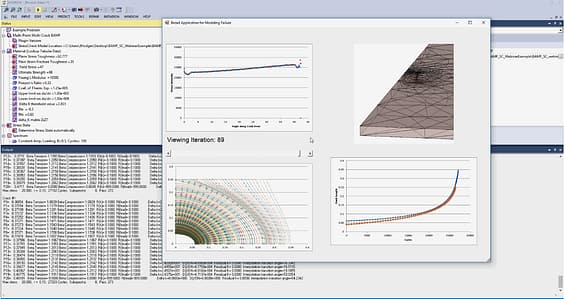
BAMF running as an AFGROW plug-in (courtesy Mr. Josh Hodges/Hill Engineering, LLC)

On July 17, 2019 a joint webinar on the latest developments in FEA-based 3D crack growth simulation, titled “3D Crack Growth Simulation: Advancements & Applications”, was provided by ESRD’s Brent Lancaster, LexTech’s James Harter and Hill Engineering’s Joshua Hodges.

In this webinar, we detailed the latest technological advancements for accurate simulation of three-dimensional crack growth in metallic structures, with and without residual stresses, via coupled finite element analysis (FEA) and fatigue life computations. Additionally, the webinar expanded further on the DaDT analysis best practices presented in ESRD’s June 2017 webinar, titled “Durability and Damage Tolerance (DaDT) Analysis Best Practices“, and highlighted the importance of mitigating the errors of approximation associated with stress intensity factors (SIF’s) and if applicable, engineered residual stresses (e.g. cold-working).

Webinar attendees from a wide range of industries were treated to a demo of Hill Engineering’s Broad Application for Modeling Failure (BAMF) Sim App, which provides a robust integration between StressCheck’s high-fidelity DaDT/fracture solutions and AFGROW’s crack growth life prediction capabilities. The BAMF demonstration showed how to set up a parametric model for DaDT analysis via StressCheck and then, with limited user intervention, integrate with AFGROW and StressCheck via their respective COM API’s to perform an on-demand 3D crack growth simulation. It was very impressive demo, indeed!

View Webinar Recording

Click the button below to view the 3 part, 65-minute webinar recording (scroll to the bottom of the webinar landing page to find the videos):

View Recording


View Webinar Slides

Click the button below to view the webinar slides (PowerPoint Show):

View Slides


Additional Resources

During the webinar, we identified several relevant DaDT and/or crack growth simulation resources that may be of interest:

  • “Analytical Modelling of Fatigue Crack Behaviour Under Representative Spectrum Loading in the F/A-18 A/B Y508 Wing Root Shear Tie”, Dr. Kevin Walker (DST Group)
  • “Crack Aspect Ratio Investigation, Analytical Methods Subcommittee: Round Robin for Cx Holes”, Mr. Robert Pilarczyk (Hill Engineering, LLC)
  • “Benchmarking Problems in Fatigue Crack Growth Analyses”, Mr. Robert Pilarczyk (Hill Engineering, LLC)
  • “Numerical Simulation Series: Fracture Mechanics Parameters”, Dr. Ricardo Actis (ESRD)
  • “Improving Global-Local Simulation Workflows for High-Fidelity Stress and Damage Tolerance Analysis”, Mr. Eric Buettmann & Mr. Gordon Lehman (ESRD)
  • “Computation of SIFs for Cracks in Cold-Worked Holes”, Dr. Ricardo Actis & Mr. Matt Watkins (ESRD), Dr. Scott Prost-Domasky (AP/ES) and Mr. Joshua Hodges (USAF)
  • “Crack Propagation Analysis Tool for 3D Crack Simulation: A Simulation App Case Study”, Mr. Matt Watkins (ESRD)
  • The Contour Method for Measuring Residual Stresses (Hill Engineering, LLC)


Acknowledgments

As always, many thanks to our attendees for their interest and feedback! And, of course, thanks to LexTech and Hill Engineering for their time and contributions. We hope to collaborate on another webinar in the future!

Tags: Aerospace and DefenseAFGROWASIPBAMFBenchmarksCrack GrowthDaDTDemosERSIFatigueFractureNumerical SimulationResidual StressSim AppsSolution VerificationStressCheckStressCheck-Powered AppsWebinar
6

You also might be interested in

Digital Transformation

Digital Transformation

May 16, 2024

Digital transformation is a multifaceted concept with plenty of room for interpretation. Its common theme emphasizes the proactive adoption of digital technologies to reshape business practices with the goal of gaining a competitive edge. The scope, timeline, and resource allocation of digital transformation projects depend on the specific goals and objectives. Here, we address digital transformation in the engineering sciences, focusing on numerical simulation.

‘How Do You Verify the Accuracy of Engineering Simulations?’ Webinar Recording Now Available
Convergence of minimum principal stress in an aircraft keel beam structure (courtesy Digital Engineering).

‘How Do You Verify the Accuracy of Engineering Simulations?’ Webinar Recording Now Available

Jan 16, 2019

On Wednesday, January 16, 2019 a webinar titled “How Do You Verify the Accuracy of Engineering Simulations?” was provided by ESRD’s Gordon Lehman and Brent Lancaster. In case you missed it, the webinar recording is now available!

Watch Teaser Video for the NAFEMS Coil Spring FEA Puzzler
Teaser Contour Plot for Coil Spring Solution

Watch Teaser Video for the NAFEMS Coil Spring FEA Puzzler

Feb 12, 2019

The deadline for the NAFEMS coil spring "FEA Puzzler" submissions has been extended through June 1st! View a teaser video of ESRD's StressCheck model and qualitative deformation results.

Leave a Reply

We appreciate your feedback!
Cancel Reply

You must be logged in to post a comment.

Looking for Resources?

Interested in a Demo, Evaluation or Purchase?

Have a Software Question, Issue or Feature Request?

Recent News & Events

  • Trustworthiness in Simulation: Credibility or Decision-grade Reliability?
  • Beyond the Black Box: Explainable AI Requires Explainable Simulation
  • Turtle Shells and Legacy Finite Element Codes: Evolutionary Constraints in the Age of Explainable AI

Quick Links

  • Quick Start Guide
  • Documentation
  • Software FAQs
  • Software Demos

Testimonials

  • “StressCheck’s quality control features have given us the tool we need to perform detailed … bonded joint analysis with confidence that the results are accurate.”

    Technical Fellow
    The Boeing Company

Testimonials

“At DST Group, we have effectively used StressCheck over the last 10 years to determine accurate stress intensity factors. The results have been used to improve our residual strength and structural life estimates for aircraft in service with the Royal Australian Airforce, including C-130, P-3C and F/A-18 A/B. We have found it to be extremely easy to use and a very versatile code with which to create parametric models.

We have recently used StressCheck to obtain improved stress intensity factor solutions (Improved stress intensity factors for selected configurations in cracked plates and Improved stress intensity factors for a single corner crack at a loaded fastener hole) for five key generic configurations. These transferable parametric results have been published externally. One specific example is the non-linear contact analysis of a cracked, filled fastener hole, with both fastener and remote plate loading.”

Dr. Manfred Heller, Head, Structural & Damage Mechanics, DST Group

Member Portal

  • Member Registration
  • Member Login

Contact Us

© 2026 · Engineering Software Research & Development, Inc. | Terms & Conditions | Privacy & Cookie Policy | Software License Agreement | Software Maintenance and Technical Support Policy

Prev Next

We use cookies on our website to give you the most relevant experience by remembering your preferences and repeat visits, as outlined in our Cookie Policy. You may adjust your cookie preferences within .

ESRD
Powered by  GDPR Cookie Compliance
Privacy Overview

This website uses cookies to improve your experience while you navigate through the website. Out of these, the cookies that are categorized as necessary are stored on your browser as they are essential for the working of basic functionalities of the website. We also use third-party cookies that help us analyze and understand how you use this website. These cookies will be stored in your browser only with your consent. You also have the option to opt-out of these cookies. But opting out of some of these cookies may affect your browsing experience.

Strictly Necessary Cookies

Strictly Necessary Cookies should be enabled at all times so that we can save your preferences for cookie settings.